Books to avoid
10 Replies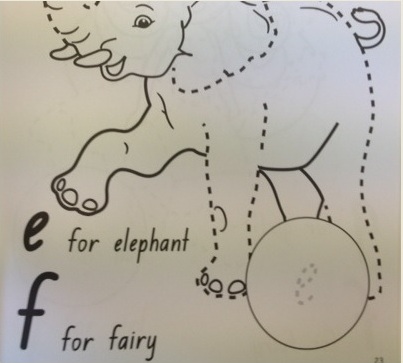
I seem to have a special talent for going to the post office or newsagency right on Peak Minute, and end up standing in a queue next to carousels full of cheap cards, stickers and books with titles like “Teach Your Child To Read” and “Amazing ABCs”.
I am irresistibly drawn to these books and start leafing through them, though I know from experience this will only make me grumpy.
These books are almost invariably written by people who don’t seem to have much linguistics knowledge or to have studied the best way to help children learn to read. Many are at least as likely to confuse children and waste their time as help them learn to read and spell.
Let’s look at some example pages I photographed last time I stood grumpily in such a queue, ignoring the people staring at me because of this odd behaviour. All these activities are marketed at parents of absolute literacy beginners, aged 5 and up:

Here we have a mixture of short and long words, easy and hard spellings, and no obvious beginning reading/spelling skill being taught at all.
The only way absolute beginners will be able to do this activity is if they can get an adult to explain how to do it, and read out all the words for them.
“Red” is really the only word on this page that belongs in a reading/spelling activity for absolute beginners, because it’s a short word with one letter representing each sound.
What is synthetic phonics?
3 Replies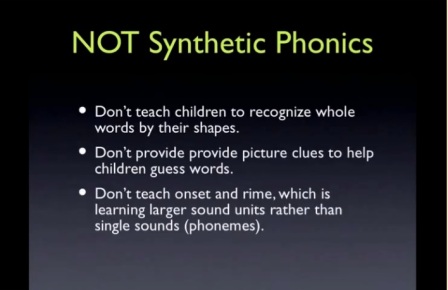
ReadingTeacher.com
I just got an email from Francis Morgan of the ReadingTeacher.com website, suggesting I add his program to my resource list.
Absolutely! I can’t believe I haven’t noticed it before. It looks like a really nice, explicit, systematic, synthetic phonics program for little kids.
It’s from the US so the sounds will be slightly different from the Australian English I speak, and from UK and other Englishes without a syllable-final “r” sound. But small Australian children know what the American accent is from watching TV, so for little learners without speech-language difficulties this shouldn’t be a major barrier.
Some of this program is free and the rest looks good value for money. To find out more about it, click here.
Video explaining synthetic phonics
I work mostly with older, struggling learners, many of whom also have spoken language difficulties. Thanks to all the research I’ve done for this blog, I have a long resources-to-buy wishlist for my clinic. So a ReadingTeacher.com subscription is lower down my own list than resources specifically targeting older, reluctant readers.
However, this site’s 10-minute video explaining what Synthetic Phonics is, and is not, is relevant to teaching beginners or strugglers of any age group. Highly recommended, here it is:
Multisyllable words
4 Replies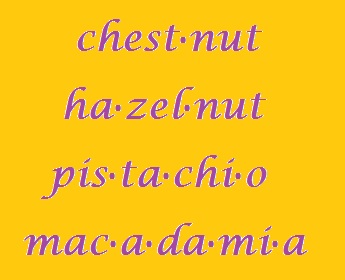
Breaking up multisyllable words
When first introducing multisyllable words to learners, I like to break them into separate syllables with little dots, like this:
crick·et ba·na·na hel·i·cop·ter hip·po·pot·a·mus
Dots are more subtle than hyphens or spaces, but help beginners to see the syllable boundaries, and know where to stop and blend each "mouthful" of the word.
I don't ask learners to put these dots in themselves when writing/spelling, I just put them in new words for the first time a learner reads them.
What makes multisyllable words harder?
As well as all the skills required to read and spell one-syllable words, learners reading multisyllable words have to:
- Work out where one syllable ends and the next one begins,
- Learn the many extra spelling patterns used in multisyllable words e.g. the "ti" in "action", the "y" in "funny" and the "age" in "luggage",
- Keep all the syllables in memory long enough to say each whole word,
- Work out whether any of the syllables are unstressed, by trying out different stress patterns.
Raising Awareness of Language Learning Impairment
3 Replies
An average of one child in every classroom has a Specific Language Impairment (sometimes called Language Disorder).
Specific Language Impairment leads to difficulties with understanding and/or using spoken language, as well as difficulties with reading and spelling.

Last year, some concerned academics and a speech pathologist in the UK launched the absolutely wonderful Raising Awareness of Language Learning Impairment campaign, or RALLI, on YouTube.
I urge everyone to have a look at their short, easy-to-understand, informative videos, whether you're a parent, someone who struggles with language yourself, a professional, an academic or anyone else concerned about those with language and literacy difficulties.
Introduction to RALLI
Click here for more information about what Specific Language Impairment is, who is behind the campaign, and what it's all about.

RALLI for kids
Click here to listen to learners with Specific Language Impairment talk about what it's like, and give encouragement to others with difficulties like theirs.

RALLI for families
Click here for videos designed for families that explain what a language impairment is, the impact it can have and how to get help.
There's also a video about how Speech and Language Therapy helps children with Specific Language Impairment. Click here to see it.
There's also one specifically about the literacy difficulties associated with SLI, which you can see by clicking here.

RALLI for professionals
Click here for videos about identification of Specific Language Impairment, and about how it affects learners in the classroom, told by professionals, and children themselves. You will also find relevant evidence-based research information.
This channel also includes several videos in languages other than English about Specific Language Impairment.
I hope that you'll help spread the word about this sorely-needed YouTube campaign, and thus help (as the wonderful Professor Dorothy Bishop, one of the key people behind RALLI, says) inform others about Specific Language Impairment, and help children affected by it to get wider recognition and more help, and a better chance in life.
Specific praise
0 Replies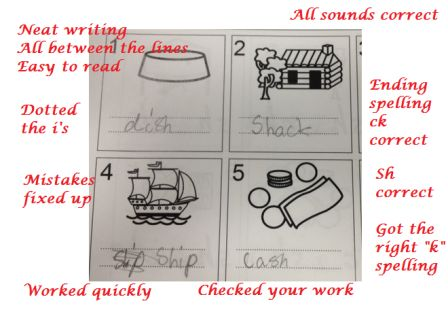
Think of how you'd react to the following compliment: "You look nice".
Now compare it with this one: "Oh, you've done something different to your hair, it really suits the shape of your face, and I love that colour on you, it matches your eyes. And where did you get those great shoes?"
Compliment 2 feels a lot more genuine and sincere, because it's specific and detailed. They aren't just saying it to be polite (or if they are, they are very good at being nice!).
Compliment 2 also significantly increases the chances that you'll keep the hairstyle, and wear that colour and those shoes again.
Literacy-learners are no different from anyone else, they believe in and respond to specific praise more than vague praise.
So when you're telling your learner that their work is good, don't just say "good work". Tell them in how it's good.
The Reading Rope
11 Replies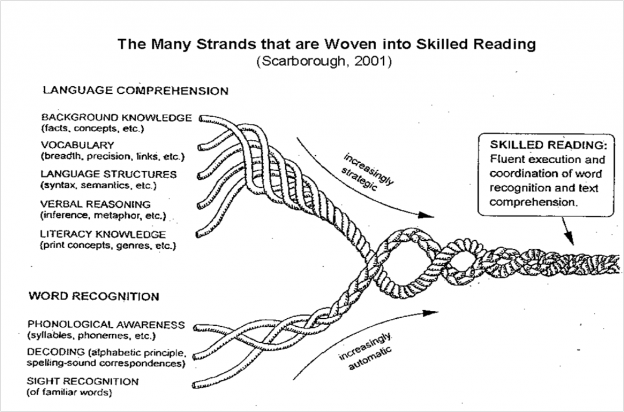
Last week I went to two days of training with Speech Pathology Australia's queen of knowing everything about literacy, Dr Roslyn Nielson from NSW. They were two excellent days, jam-packed with blogworthy ideas and information, about which (it's only fair to warn you) I will be raving for some time.
One neat metaphor for reading Ros presented is The Reading Rope, devised by US psychologist Dr Hollis Scarborough, who has kindly given me permission to put it in this blog post, as long as I don't alter it, and include the published source1.
Dr Scarborough emailed me saying, "I drew it originally for talks with parents and I think it works especially well for that purpose", and I think a plain English blog about sounds and spellings is probably the internet equivalent.
Many strands
According to the Reading Rope metaphor, skilled reading is like a rope woven of many strands.
Phonics Hero Classroom
12 Replies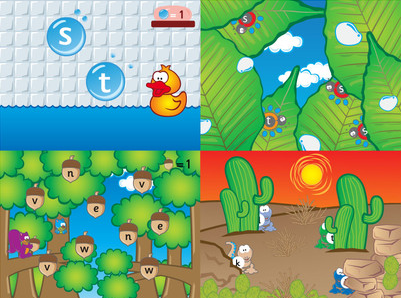
 Last week I recommended the free Phonics Hero app* for the iPad to a colleague, but the next day she told me, to my dismay, that it was no longer available in the Australian apps store.
Oh no! It was one of my very, very favourite apps for children aged 4-7 (and even little older) who were still learning the absolute basics about letters and sounds.
I was working with a 5-year-old with an Autism Spectrum Disorder just the other day, and he got a terrible case of the whiny-I-don’t-want-to’s at every literacy activity I presented to him, except this one, which he wanted to keep doing, till I had to ask him to stop.
Don’t panic, there’s a new, even better version
I checked the Apps store this evening myself, and calloo, callay, there is a new version, called Phonics Hero Classroom. It’s still free, and if anything it looks even better than its predecessor.*
It has simple graphics and activities, crisp sounds, funny rewards, helpful hints, and a well-organised teaching sequence, all in a young-child-friendly game format with an escape narrative.
There are bubbles to pop, flies to swat, laughing ghosts, treasure chests, ladybirds to colour in, an ice-cream-eating giraffe, a brick-smashing troll, a brewing witch and lambs to spray-paint (apologies to the RSPCA).
 The Spelfabet shop has affordable, downloadable spelling teaching resources.