
Write On Phonics app
5 Replies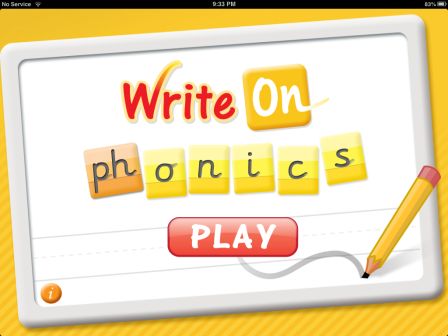
(July 2017 update: This is a 2013 blog post, and this app seems to no longer be available)
Isn’t that always the way? I’ve just found a word-building letter tile iPad app which I think is about ten times as good as Sound Literacy, the topic of my last blog post.
If there’s any word-building app that could get me to sometimes leave my trusty movable alphabet at home, it’s Write On Phonics.
Great price
The first noticeably excellent thing about this app is the price – 99c.
I should have kept that information for last, half my readers have now gone straight off to the apps store to get it. But anyway I’ll carry on for those of you who want more detail.
Sound literacy app
5 Replies
Someone suggested a while ago that my print-and-laminate movable alphabet has been superseded by clever movable alphabet apps.
I had been wondering this myself, especially on days when I misplaced one or two pieces, or had to spend five minutes putting it back in order after a group of especially curious and creative kids had had their way with it.
So I downloaded what looked like the most promising of these apps – called Sound Literacy – and tried it out.
In a world where you can get lots of great apps for just a couple of dollars, it seemed a little pricey at $25.99, but I crossed my fingers you get what you pay for, and forked out.
I was hoping it would do everything my alphabet does without the setup time, and without having to carry an extra thing around (I carry my iPad round already). Plus I envisaged that it would say sounds and words as well as representing them visually.
Download free ebooks
1 Replies
I wrote a previous blog post about the wonderful 125 SPELD-SA free decodable e-books, but someone has asked me whether these can be downloaded onto an iPad for use away from the internet.
I didn't know the answer, so tried it myself, and it was incredibly easy. I now have all 125 books at my fingertips on my iPad, for use in any therapy session anywhere, Wifi or no Wifi.
Here's how you download them.
 First, go to the Apps store and download the iBooks app, if you don't already have it.
This is the icon for it, and it's free. There must be a similar app for Android devices, but sorry to say I don't know what it is. Maybe someone who does know can put it in a comment.
Next, you go to the SPELD-SA website, and click on Services, then SPELD-SA Phonic books.
Creative writing
6 Replies
One of the things very young children are encouraged to do in my local schools is creative writing. Putting your personal ideas on paper is a highly valued skill in our education system.
Of course, the kids I work with can’t do it. They stare at the blank page and get some chicken scratchings down, but their letters are poorly formed, they can’t spell the words they want to write, and quite often when they’re finished, even they can’t read it. The whole process makes them feel like failures.
These children have creative ideas, all right, and all but the language-impaired ones can easily tell you about them. In fact, sometimes it’s hard to stop them from talking about their creative ideas long enough to get some written work done. I’m currently a working with one Grade 2 group which is an exercise in hilarity, as they riff off the words we’re working on spelling, one-up each other with funny stories, and devise alternative endings for my decodable books.
 In praise of Creative Talking
I recently came across the following by teacher Fay Maglen in the very useful but now apparently out-of-print book Wordswork:
“…adults expect written evidence of work and creative expression too early, to the point, perhaps, of inhibiting the free flow of oral expression. Certainly it would seem that in some classrooms more value is placed on what children write than on what they say…
Basic spelling sounds
0 Replies
I’ve just finished the junior version of the 44 sounds picture book, which gives only one spelling for each sound, so is suitable for preschoolers/absolute beginners.
It’s also free and you can download it by clicking here. Hope you like it, and if you have any feedback please let me know.
Right, running out the door to school…
Spelling sounds
4 Replies
 One of the resources I always have in my bag – in fact I have two battered copies, so that I can lend one out – is a DK picture book called “My First Phonics Book”.
It looks a bit like any other “My First Words” book for little kids, except each page has pictures containing a particular speech sound, and highlights the spellings of that sound in red.
It works through most of the sounds of spoken English, and it’s a nice-looking A3 hardback (well, mine looked nice till they got battered, but the best books always get worn and torn).
 How I use it

I find this book very useful when talking to learners about sound-letter relationships. For example, when we’re studying the sound “er”, I can turn to the “er” page and find a heading made up of the following pictures and words: herbs, a bird, a turkey, a word spelled out in movable letters, and a pearl.
Below this are more pictures and words with the “er” spelling picked out in red, plus a little verse containing “er” words, again with the “er” spellings in red.
This is a great starting point for discussions of how to spell this word, which I follow up with a sorting activity in which multiple words containing the sound “er” are put into groups according to how this sound is spelt.
I can’t find any other picture book which works from sounds to letters in a way that seeks to give learners maximum useful information designed to help them crack our complex spelling code (which is why I’ve made this free one, more on that in a minute).
The Lindamood-Bell Auditory Conceptualisation Test
1 Replies
I was looking at my battered copy of the Lindamood Auditory Conceptualisation Test thinking the blocks need a good wash the other day (you can see from the above photo that I don't usually get children to wash their hands before using it) and it occurred to me that I should write a blog post about it.
Why is this test useful?
I find this test of phonemic awareness useful for learners of all ages who are struggling with literacy, for several reasons:
- It's quick and easy to score and interpret – I can get the whole thing done in about 15 minutes with a cooperative learner.
- It's a test of phonemic awareness, or awareness of the identity, order and number of individual sounds in words. Many similar tests also include assessment of syllable and rhyme awareness, so that they are tests of phonological awareness. Phonemic awareness is where the rubber really hits the road in early literacy, so I prefer to focus on this.
- It can be used with literacy-learners of any age from the start of school to adulthood. (more…)
 The Spelfabet shop has affordable, downloadable spelling teaching resources.
