12 reasons you should come to Prof Maryanne Wolf’s seminar
0 Replies
Professor Maryanne Wolf, an international expert on the reading brain and dyslexia, will give a seminar at Collingwood Town Hall on 9th September 2016.
 Prof Wolf is from the Centre for Reading and Language Research at Tufts University in the US. Her seminar will be called, “Lessons from the Reading Brain for Reading Development, Dyslexia and Instruction in a Digital Age”.
I’m helping organise the session with my LDA hat on, so I’ve read her book “Proust and the Squid: The Story and Science of the Reading Brain”, and am really looking forward to using my new copy of her test of Rapid Automatised Naming, the RAN/RAS.
Now I want all the professionals and keen-on-science parents who read this blog to come and hear her speak (she’ll also speak in Brisbane on 2 Sept and Sydney on 9th Sept). It’s going to be great. (more…)
Multi-cueing: teaching the habits of poor readers
27 Replies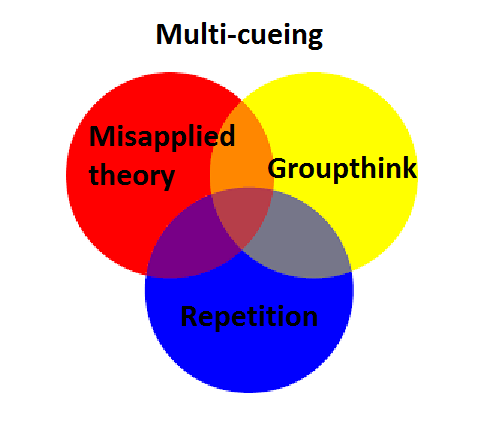
When learning to read, absolute beginners and strugglers have to use almost all their cognitive horsepower just to get words off the page.
Teachers encouraging “multi-cueing” (a term used widely in my local schools, also called “the three-cueing system”, or “searchlights” in the UK), often distract children from the vital early task of building their decoding skills, and encourage the habits of weak readers, not strong readers.
Strong readers and spellers internalise and automatise the links between words’ sounds and their spellings, and eventually can convert speech to print and print to speech at lightning speed without conscious effort. It’s only weak readers who have to guess from pictures, context, syntax or anything else. Context, syntax etc. come into play after a word is identified, in comprehending the text.
Whose three-cueing system?
Dr Marilyn Jager Adams is an internationally-regarded expert on literacy-learning, and author of the landmark book “Beginning to Read: Thinking and Learning about Print”.
In the 1990s when she was a visiting scholar at Harvard University Graduate School of Education, she realised that “the three-cueing system” had become a Thing in education.
She tried to work out whose Thing it was.
Like other reading researchers, Adams knew that poorly developed word recognition skills are the most pervasive and debilitating source of reading difficulty, and that the skilful reader’s deep and ready knowledge of words’ spellings and spelling-to-speech correspondences is what enables swift, efficient word recognition.
She wrote: “During that fraction of a second while the eyes are paused on any given word in a text, its spelling is registered with complete, letter wise precision even as it is instantly and automatically mapped to the speech patterns it represents”.
The process is so over-learned that it happens subconsciously. Skilful readers can no more look at a word and not read it than fly to the moon.
In 1998 she wrote (in this book, now out of print, but in 2019 the Reading League made a video on this topic including lots about it): “Over the last few years, I have spent much time in schools around the country, working with teachers and administrators. My challenge has been to tell them about these lessons from research and their implications with respect to instruction. At some point during such sessions, I am almost inevitably asked how what I have said relates to the three-cueing system.
“The first time I was hit with this question, I naively asked what, specifically, my audience meant by “the three-cueing system”. Whose three-cueing system? Although nobody could provide me with a reference, someone in my audience graciously drew a schematic of the three-cueing system for me”.
I don’t have a copy of that diagram, but I imagine it looked something like this, as this is the sort of multi-cueing venn diagram I’ve seen kicking around schools for decades.

Adams immediately assumed that the diagram referred to the elements that must be present for the meaning of a text to be understood. This made perfect sense and was based on extensive research from the 1970s, some of it her own.
As she spoke about this, she realised from her audience’s faces that what she was saying differed from what they were expecting in a fundamental way.
She started searching the academic literature for the source of the three-cueing system, but came up empty-handed. She asked colleagues around the world, but none of them knew. She gathered up workshop handouts, framework documents and advertisements referring to the three-cueing system, and searched them fruitlessly for references.
A number of people commented that the diagram was a lot like one which will be familiar to anyone who has studied linguistics or Speech Pathology:

The graphic was similar, but the topic was not. Adams kept searching, by now convinced that the three-cueing system was not part of the mainstream academic repertoire.
Eventually she was told that the term “cueing systems” referred to the strategies that readers can use when reading unfamiliar words, how these are integrated, how well they self-correct and what the text means to them. She found a largely-ignored 1976 article and two influential books from 1988 and 1994 by Regie Routman containing versions of the diagram. But no actual research.
Routman wrote that effective readers, “use all three cueing systems interdependently. Ineffective readers tend to rely too heavily upon graphophonic cues” and “that children learn phonics best after they can already read. I am convinced that the reason our good readers are good at phonics is that in their being able to read they can intuitively make sense of phonics”.
Well, it’s very nice to have convictions, but teaching needs to be based on evidence.
Routman and others argued that sounds and spellings are subordinate to meaning and structure in reading, and should be de-emphasised in teaching. They recommended that children should only sound out words as a last resort. Routman created practical tools for teachers to help them encourage reliance on other cues and actively discourage sounding out. Whatever their source, and whoever promoted them, these ideas were widely taken up in education.
Eventually a group of 40 linguists and psycholinguists discovered that the phonics-last philosophy had made it all the way into the Massachusetts Reading Curriculum Framework, and wrote a letter of protest to the Minister for Education, prompting policy change.
Lightbulb moment: the diagram refers to word identification
Marilyn Jager Adams maintained a generous view of the three-cueing Thing for a long time, still believing that it referred to how we understand text. After a number of baffling exchanges with editors, it dawned on her that the diagram was in fact being used as a model of the process of word identification.
She writes: “I finally understood why my audience looked so puzzled on that first run-in with the three-cueing system. They had been operating on the belief that the semantic, syntactic, and pragmatic cues were straightforward and familiar to children, and, because of this, were wholly available for use in finessing the graphophonemic system, which was complicated and unfamiliar. It had never occurred to them that there was much to teach or learn about the semantic, syntactic, and pragmatic cues involved in skillful reading”.

Adams suggests that the three-cueing system probably proliferated via inservices, workshops and conferences in education, in isolation from relevant university courses and researchers. She writes that the belief system the three-cueing diagram has come to represent has wreaked “disaster on students and hardship on teachers” and bred significant distrust and ill-will. Ugh.
You can find a shorter, 2004 article on this topic by Adams here.
How to replace this belief system with understandings based on solid research evidence, and thus prevent the abovementioned disaster and hardship, is the eleventy-billion-dollar question.
I guess we just have to:
- keep discussing good evidence and promoting methodologies based on it, and thus helping close the gap between research and practice in literacy education,
- keep asking for the evidence behind multi-cueing, in all its guises. When none can be produced (and if Marilyn Jager Adams couldn’t find it, I’d suggest nobody can) ask respectfully that its use be discontinued in favour of models and methods based on good evidence, like the Simple View of Reading.
Teachers wanting an update on the best and latest research on how the reading brain works, how children learn to read, what can go wrong in this process, and what going digital might mean for the future of literacy should come to one of the upcoming seminars with Prof Maryanne Wolf in Brisbane (2nd September 2016), Sydney (7 Sept) or Melbourne (9 Sept).
I am busy organising a super-duper trade display of lesser-known good teaching resources for the Melbourne session, including Prof Wolf’s own program RAVE-O, which participants can browse and find out more about during the session breaks. Hope to see you there.
 The Spelfabet shop has affordable, downloadable spelling teaching resources.