DSF Conference – Day 1
8 RepliesAll but one of the Spelfabet team were able to attend this year’s DSF Language, Literacy and Learning conference in Perth (we missed you, Mel!) so it was great both for team-building & professional learning.

Here are some (I thought) interesting ideas and links from the first day.
How we learn maths, and why girls fall behind
Keynote speaker Prof Stanislas Dehaene said to help kids understand maths we should anchor it in humans’ natural numerical and geometric intuitions e.g. even numbers are made up of pairs, an odd number has a spare; square numbers can be represented geometrically in a square; prime numbers can’t form a square or rectangle. Teaching should work from concrete materials to pictures to symbols.
There’s no difference in kids’ maths abilities at school entry, but girls quickly fall behind after starting school. There was no maths gender gap during COVID, so the gender gap is cultural. Girls and boys need to be engaged equally, emphasising the playful aspects of maths and insisting that mistakes help us learn. More details in Dehaene’s book The Number Sense.
Language/literacy difficulties and mental health
Prof. Genevieve McArthur from the Language and Literacy in Young People (LaLYP) research team said poor reading often leads to low reading self-concept, anxiety and reading disengagement. Red flags include talk of being a ‘bad reader’ and feeling scared, worried or sick about reading. The free MOTIF Reading Anxiety Tests and Reader Self-Perception Scale can be used to monitor reading-related mental health. The Black Dog Institute and DSF have been developing reading-related mental health tools.
Dr Samuel Calder discussed his research into the functional impacts of language difficulties, which are necessary for a diagnosis of Developmental Language Disorder (DLD), but require better definition and measurement. Dr Shaun Ziegenfusz said secondary students with DLD find literacy and numeracy difficult, but language and social-emotional tasks less hard. They valued extra time, visuals and individualised supports, and felt connected to school. They thought technology was more helpful than adults did. Shaun’s DLD Project has heaps of high-quality online training about DLD, some of it free.
Dr Adrienne Wilmot emphasised that ‘Talk therapy’ focussed on mental health doesn’t suit language disordered kids. Mental health professionals need to understand language disorder, and personalise students’ mental health care. Dr Emily Jackson said mental health promotion materials for students with DLD should not be ‘language heavy’. She discussed the development of a small group intervention for Year 5, 6 and 7 students called The Code To Me: Cracking the Code to Confidence and Wellbeing. Perth families can click here to find out how to participate in its pilot, and they’ll run an RCT next year.
Dr Elizabeth Hill said Curtin Uni’s Psychology Masters courses now include teaching about language/literacy and mental health needs, emphasising professional cross-collaboration. They also run a Community of Practice on accessible mental health services for people with communication difficulties.
Student-focussed coaching
The La Trobe SOLAR Lab’s Profs Tanya Serry and Pamela Snow and team are researching the impact of teacher Student-Focussed Coaching on early years’ students’ reading and spelling, assisted by Dr Daryl Michel, co-author of the book Student Focused Coaching. 80% of Year 3 students who struggle with literacy continue to struggle, so high-quality early teaching is vital. The 22 schools in this randomised control trial (RCT) all had access to Solar Lab short courses and quality teaching materials. Ten also had fortnightly, in-school coaching. Qualitative data collected showed the importance of relationship-building and leadership buy-in, the high administrative load of coaching, and variability in how coaches work. Teacher knowledge and confidence improved as a result of coaching. A report including student data will be available later this year.
Talk for Reading
Susie Hillard and Janet Gethin from DSF discussed the Talk for Reading approach, which expands language and reading comprehension through a dialogic approach to read-alouds, think-alouds and the development of mental models. Texts such as those on the Australian Reading Spine are used to build the habit of listening, talking, writing and deep thinking about what they read.
Literacy instruction for EAL students
Melbourne-based educational consultant Leah Myers reviewed research on literacy instruction for students learning English as well as their home language. No surprise: evidence-based instructional techniques also work for EAL students, especially MTSS and RtI approaches. Useful resources highlighted included AERO’s How long it takes to learn English while learning the curriculum.
Secondary school literacy intervention checklist
The SOLAR Lab’s Melanie Henry is researching literacy intervention in secondary schools. She has developed, piloted, and is now revising a 2-part checklist which gathers information about (1) classroom setup and resources and (2) instruction, via classroom observation.
The art and science of explaining stuff
Keynote speaker Zach Groshell gave an entertaining summary of key instructional ideas. Explicit instruction. Worked examples, and counter-examples. Reducing cognitive load. Task analysis. Visuals and gesture. I do, we do, you do. Working from isolated to integrated, and supported to independent. You can read more about all these good ideas here.
Early oral language screening and instruction
Lauren Cook from Catholic Education Sandhurst and Lauren Mirabella from Pearson talked about the rollout of OxEd & Assessment’s LanguageScreen and Nuffied Early Language Intervention (NELI) across 52 primary schools. Many children had oral language delays/difficulties at school entry, and thus were at risk of also developing literacy difficulties. These resources were devised by Oxford University Professors Charles Hulme and Maggie Snowling and team using RCTs. They now have Australian and NZ norms. The UK research found that NELI participants made 3-5 months extra language progress in six months.
Starting in 2024 in Sandhurst Diocese schools, the 5-10 minute screener was administered by teachers via iPads. Children identified by the screener as having oral language difficulties then did 20 weeks of NELI oral language intervention (3 X 30 minutes in small groups, and two 15 minute individual sessions), delivered by trained school staff and supported by speech pathologists. Despite timetabling and staffing constraints, and challenges ensuring fidelity of implementation and consistent data use, there are early signs of improved student outcomes, and increased staff confidence and collaboration in supporting language in the classroom.
Lauren Mirabella emphasised Pearson’s commitment to effective, evidence-based teaching, so I asked why they still sell Fountas and Pinnell resources. She said F&P products would be taken off their website in a week. Click here, here and here to see if it’s happened, and send them applause when it has.
Tomorrow: Day 2
Alison Clarke
New, improved phonics playing cards
12 RepliesOur new download-and-print phonics playing cards include 8 free sample decks, the first one of each of 8 sets (90 decks). These first target basic VC and CVC words, then consonant blending, consonant digraphs like ‘sh’ and ‘ng’, several sets targeting vowel spellings, then less common consonant spellings. We now have other games targeting prefixes/suffixes, syllabification and flexing sounds.


Each card deck prints on four sheets of light A4 cardboard, and can be used for any game that uses a standard deck of playing cards (e.g. the games here). We use Sounds-Write and Phonics With Feeling printable decodables as well as Phonic Books, so our card sequence dovetails well with them, but can be reorganised if teaching a different sequence.
Learners focus more on sounds and spellings when words are presented in lists, not sentences. Turning lists into games boosts attention and engagement, two of Stanislas Dehaene’s four pillars of learning.


Our revised cards have:
- Larger print words, facing in only one direction (having words facing both ways confused some kids).
- More common words – word choice based on frequency as well as sound-spelling relationships.
- More polysyllable words, including plenty of Tier 2 words.


| Deck 1 targets | Example words |
| CVC abcghimnopst | can, him, top, bag, sip |
| CVC alphabet less x and y | fed, van, kid, leg, run, jam, win, zip |
| CVC alphabet, x, y, ff, ll, ss, zz | box, yes, off, well, fuss, buzz |
| VCC & CVCC with final mp, nd, nt | and, limp, hint |
| VCC & CVCC with other CCs | act, elf, film, gust, kept, hold, pulp |
| CVCC | cross, drill, glad, plus, slam, trip |
| CCVCC | brand, crisp, frost, print, spent |
| Words with CCC | gifts, midst, script, strum, tempt |
| Deck 2 targets | Example words |
| ch/chin | chip, bunch |
| sh/ship | shot, dish |
| th/that, th/thin | them, thin, width, athletic, seventh |
| ck/back | sack, neck, stick, lock, duck |
| ng/long, n/think | sing, sink |
| qu/quick, wh/when, ve/have | quit, which, live |
| suffixes -ed, -ing | stopped, grabbed, rented, thinking |
| Word-final ch/bunch and tch/catch | lunch, catch |
| compound words | backup, chinstrap, handbag |
| final syllable le | angle, drizzle, middle, settle, uncle |
| j and dge | judge, edge, adjust, gadget, object |
| suffixes -ed, -y | cutter, helper, fuzzy, muddy |
| Deck 3 targets | Example words |
| a + consonant-e (VCe) | tap, tape |
| ee, e + consonant-e (VCe) | meet, me, mete |
| i + consonant-e (VCe) | fin, fine |
| o + consonant-e (VCe) | hop, hope |
| u + consonant-e (VCe) | us, use, rude |
| a + consonant-e (VCe) – 2-syllable | combat, collate |
| ee, e + consonant-e (VCe) – 2-syllable | comet, compete, coffee |
| i + consonant-e (VCe) – 2-syllable | resin, reside |
| o + consonant-e (VCe) – 2-syllable | along, alone |
| u + consonant-e (VCe) – 2-syllable | result, refuse |
| c before e or i | cent, dance |
| g before e or i (sometimes) | gem, singe |
| Deck 4 targets | Example words |
| a/apron | basic, halo, native, stable |
| e/evil | decent, equal, legal, vegan |
| i/item | child, giant, pirate, vibrate |
| o/open | bonus, disco, global, zero |
| u/unit, u/tofu | emu, fluid, music, rural |
| y/very | carry, family, jelly, study |
| er/alert | convert, herb, kernel, servant |
| i/ski | alien, genius, media, studio |
| o/mother | among, cover, love, wonder |
| y/by | cry, lying, sky, typing |
| Deck 5 targets | Example words |
| ai/rain, ay/day | delay, holiday, maintain, train |
| ee/see, ea/sea | each, queen, speech, wheat |
| oa/boat, ow/slow | coach, growth, shadow, toast |
| ir/bird, ur/turn | burger, furnish, sturdy, thirty |
| ea/meant, e/metal | dread, health, itself, plenty |
| ou/out, ow/now | about, flower, mouth, towel |
| oo/too, ue/blue | choose, glue, proof, untrue |
| i/find, igh/night | climate, lion, sight, twilight |
| oo/good, u/put, oul/could | could, wouldn’t, push, look, wood |
| or/horn, aw/saw | awful, forty, morning, straw |
| oi/oil, oy/boy | appoint, destroy, poison, royal |
| ar/car, a/last | basket, father, garden, party |
| air/hair, are/care | beware, dairy, fair, square |
| ear/hear, eer/cheer | clearly, fear, sheer, volunteer |
| Deck 6 targets | Example words |
| sh/shop, ch/chip, tch/catch, th/with, th/then | brush, children, fetch, than, fifth |
| ng/sing, n/think, ck/back, qu/quit | strong, pink, pocket, squint |
| wh/when, le/apple, dge/bridge, ve/have | which, saddle, ledge, solve |
| initial code words with 3-4 syllables | confident, ethical, independent significant |
| er/ever, y/very | every, industry, river, together |
| a/make, a/making, ai/rain, ay/day | came, danger, paint, Sunday |
| ee/see, ea/sea, e/be, y/funny, ey/donkey | deep, jeans, recess, suddenly, valley |
| o/home, o/go, oa/boat, ow/slow | clothes, going, load, shown |
| er/her, ir/bird, ur/turn | expert, girl, return |
| i/time, i/find, y/by, igh/night | fine, lion, reply, tight |
| oo/soon, u/flute, u/truth, ew/grew | balloon, June, ruin, threw |
| or/for, aw/saw, ore/more, a/all | corner, hawk, score, stall |
| Deck 7 targets | Example words |
| a/make, a/making, ai/rain, ay/day, ey/they, ea/great | brake, crazy, paint, maybe, they, break |
| ee/see, ea/sea, e/be, e/these, y/very, ie/chief, ei/ceiling | asleep, easy, believe, please, receive, supreme |
| o/home, o/go, oa/boat, ow/slow, oe/toe | broke, frozen, goat, narrow, heroes |
| er/her, ir/bird, ur/turn, ear/learn, or/work | concern, dirt, return, research, worship |
| ou/out, ow/now, oi/oil, oy/boy | around, power, employ, toilet |
| oo/soon, u/flute, u/truth, ew/grew, ue/blue, ou/soup | choose, include, ruin, jewel, true, youth |
| i/time, i/find, y/by, igh/night, ie/pie | decide, final, myself, slight, tried |
| or/for, aw/saw, ore/more, a/all, al/talk, ough/thought, au/haunt, ar/warm, awe/awesome | also, author, awkward, explore, hall, walk, bought, pause, warn, awe, important |
| air/hair, are/care, ear/bear, ere/there, eir/their | airfare, compare, fairy, pear, where, heir |
| ar/car, a/last, al/half, au/aunt, ear/heart | farther, father, garden, fast, palm, laugh, hearth |
| Deck 8 targets | Example words |
| u/cute, u/stupid, ue/due, ew/dew | attitude, duty, pursue, skewer |
| u/cup, o/front, ou/cousin, oo/blood | hundred, money, southern, flood |
| o/cotton, a/wander, au/fault | dollar, quality, wander, sausage |
| s/sent, c/cent, scent, ss/less, se/house, ce/voice, st/castle | sentence, circus, muscle, process, porpoise, piece, whistle |
| j/jump, g/gem, ge/large, dge/bridge, dj/adjust, gi/region | adjust, change, enjoy, general, hedge, religion |
| f/fifty, ff/office, ph/phone, gh/cough | belief, effort, graph, enough |
| c/cat, k/kit, ck/back, x/box, q/quit, ch/school, que/mosque, qu/conquer, cc/soccer | anchor, boutique, chaos, click, kick, next, liquor, broccoli |
| n/not, nn/bunny, kn/knit, gn/sign | banana, dinner, knives, resign |
| m/mum, mm/hammer, mb/thumb, mn/autumn, gm/paradigm | member, mammal, numb, column, phlegm |
| r/run, r/hurry, wr/wrist, rh/rhubarb, rrh/diarrhoea | different, horrible, wriggle, rhyme, haemorrhage |
| i/city, y/symbol, e/pretty | liquid, myth, English |
| y/yes, i/union, j/hallelujah, ll/tortilla, gn/lasagne, ñ/mañana | canyon, junior, Reykjavik, bouillon, gnocchi, El Niño |
It takes me a couple of minutes to print and laminate a deck of these cards, then eight minutes to cut a deck up while having a cuppa, listening to a podcast or watching telly. I now have a full set in these neat craft storage boxes, for use in word sorts and spelling quizzes as well as games.

We have colour printers, so I often print a deck of phonics playing cards on 4 sheets of light cardboard for a client’s family to cut up and use at home.
If you’re coming to the Perth Language, Literacy and Learning conference next week, please come and try out these and our other games at our exhibition stand.
Thanks once again to now-Dr Caitlin Stephenson (applause!) who had the original idea for these games.
Revised Affixit 20 game
4 RepliesAs soon as you finish making something, you think of ways to improve it. Always. Sigh.
Affixit game 20 was meant to focus on building words like music-musician, magic-magician, and Egypt-Egyptian, but there weren’t enough suitable words, so -al/-ial as in centre-central, deny-denial, finance-financial became the focus. While making the label for our Affixit games storage boxes (download it free here if you like), I realised -al/-ial was already in Affixit game 17. Gah.

This meant I had to make a new Affixit game 20, which teaches how words ending in ‘mit’ change to ‘miss’ (as in admit-admission, permit-permissible, submit-submissive) before some suffixes (Latin ones). The wonderful Saoirse helped me make a video to demonstrate the new game:
You can download this new game free here.
I’m now stopping myself from thinking about ways to improve the Affixit games so I can focus on revising our phonics playing cards (more compact sets with larger font, words facing one way, difficult words replaced, and extra game instructions). Always ways to improve…
Alison Clarke
Speech Pathologist
Free Affixit game
6 RepliesHooray, you can now download and print Game 1 of our new Affixit word-building games for $0. Players build and spell words by adding suffixes -s, -ed or -ing to base words, doubling final consonants when necessary (e.g. stop-stopped), and knowing when not to double (e.g. mend-mending, back-backs).

Base words are spelt in basic/initial code – the alphabet plus ff, ll, sh, ch, th, ng and ck – and are CVC, CCVC or CVCC words, with one CCCVC word (‘strum’). Many common one-syllable verbs like ‘win’, ‘swim’ and ‘bend’ have irregular past forms, so don’t take suffix -ed, and these were excluded. We don’t want to confuse kids with language delay/disorder who still sometimes say things like ‘swimmed’ and ‘runned’.
Game 1 targets the suffixes and juncture changes taught in Foundation Term 4 of my state’s Phonics Plus teaching sequence. Our Term 4 starts today, so I hope this game is well-timed and widely used. It should also slot neatly into other phonics teaching sequences, towards the end of the basic/initial code.
Here’s a video of me playing Affixit 1 with student Saoirse (thanks, Saoirse!):
Sorry about my messy handwriting, I was trying not to bump our wonky tripod (very hi-tech here, not).
There are 24 Affixit games in total, grouped in two sets. They target almost all the prefixes and suffixes in Phonics Plus (I’m still thinking about prefixes sub-, non- and mis-), and a few extras. They should be easy to slot into other phonics sequences, as base word spelling complexity increases gradually, and each game only targets a small number of affixes. The games took weeks to develop and test, aiming to maximise the number of common words players can build and spell in each game.
All the Affixit games are available in two download-and-print sets of a dozen from www.spelfabet.com.au/product-category/games/affixit. They cost two Australian dollars per game (plus GST if you’re in Australia) which is about USD$1.30. Each game prints on three sheets of A4 light card. We printed ours on photo paper, so we didn’t have to laminate them (quicker and less plastic, yay!). They fit neatly into two craft storage boxes we got from a hardware store, here’s what they look like:


I’ve put videos demonstrating each game on YouTube, just click on these links:
Affixit game 1 Affixit game 2 Affixit game 3 Affixit game 4
Affixit game 5 Affixit game 6 Affixit game 7 Affixit game 8
Affixit game 9 Affixit game 10 Affixit game 11 Affixit game 12
Affixit game 13 Affixit game 14 Affixit game 15 Affixit game 16
Affixit game 17 Affixit game 18 Affixit game 19 Affixit game 20
Affixit game 21 Affixit game 22 Affixit game 23 Affixit game 24
Georgina Ryan devised the original version of this game, with help of Elle Holloway.
Feel free to print multiple copies of any Spelfabet games purchased for your own class/students. I hope this makes them an affordable way to provide lots of well-targeted reading/spelling skills practice, cleverly disguised as fun. Please don’t share them across a school or school system. They take time and expertise to make, and their sales help pay for the Spelfabet website.
Alison Clarke
New polysyllable word games
7 Replies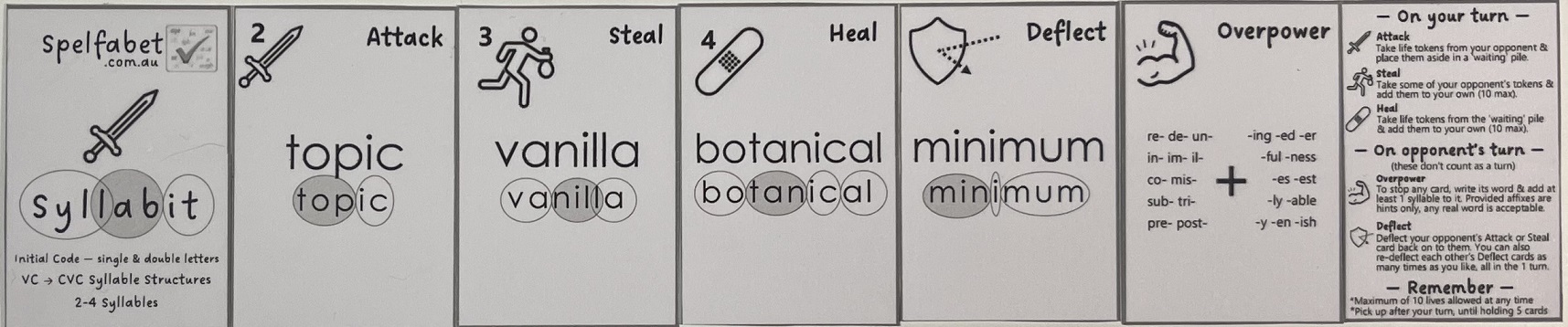
Do you know a learner who is struggling to read polysyllable words? Try our new, download-and-print card games, called Syl-lab-it.
A free game, with the easiest words, is here, and the full set is here.
Elle Holloway, Spelfabet’s expert at turning work into fun, explains the game in this 6 minute video:
2-4 syllable words are printed on the cards, and players must read them as they’re played. Smaller-print versions of each word have syllables circled and stressed syllables shaded. Sometimes, syllable circles overlap, as there’s often more than one way to break a word up (e.g. by sound or word structure. Skilled readers think about both), and coarticulation happens between syllables, not just within them.
The circles and shading make it easy to show learners that a syllable can be represented by a vowel letter alone, or a vowel letter/spelling plus one or more consonants. This is useful when teaching learners to read one syllable at a time, and adjust word stress.

There are five types of cards, three of which are used on your own turn (attack, steal, heal) and two of which are used to spoil your opponent’s turn (deflect, overpower). This game is for two players who each start with five cards and ten tokens (counters, coins, whatever). Play continues until someone loses all their tokens, and thus the game.
The free sample game targets words with simple syllables and spelling patterns, such as on the cards depicted above. The other 12 games target the following syllable structures and sound-spelling relationships:
- CVCC and CCVC syllables, e.g. ‘suspect’, ‘umbrella’ and ‘experiment’,
- Three adjacent consonants (CCC) like ‘splendid’, ‘nondescript’ and ‘unrestricted’,
- Consonant digraphs like ‘jacket’, ‘marathon’ and ‘establishment’,
- Very common suffixes like ‘risky’, ‘talented’ and ‘abandoning’,
- VCe (‘split vowel’) syllable endings like ‘suppose’, ‘hesitate’ and ‘misfortune’.
- The sound /ae/ as in ‘betray’, ‘repainted’ and ‘complicated’,
- The sound /ee/ as in ‘medium’, ‘easily’ and ‘convenient’,
- The sound /oe/ as in ‘shadow’, ‘nobody’ and ‘overloaded’,
- The sound /er/ as in ‘hurting’, ‘thirstily’ and ‘personally’,
- The sound /ou/ as in ‘without’, ‘astounding’ and ‘powerhouses’
- The sound /ie/ as in ‘direct’, ‘justify’ and ‘insightful’,
- The sound /oo/ as in ‘cartoon’, ‘screwdriver’ and ‘absolutely’.
There’s a choice of single or double-sided card version of each game, the latter in case your Syl-lab-it decks might get jumbled. Print each game on 3 sheets of A4 light card or paper (at ~110% if your printer can manage narrow margins), laminate and cut up into cards. Sorry we can’t do that for you, but we timed it and each deck takes about 10 minutes to cut up neatly with scissors, and less with a guillotine.
We hope your learners enjoy the games, and learn to read polysyllable words confidently and well.
7-11 April holiday phonics groups
2 Replies
Do you know a Melbourne* child in their first three years of schooling who needs a phonemic awareness and phonics boost?
During school holidays, the Speech Pathologists at Spelfabet in North Fitzroy run intensive explicit, systematic synthetic phonics therapy groups for children in their first three years of schooling needing extra help with learning to read and spell.

Each group runs for an hour a day for a week, plus daily homework activities. We provide all necessary resources, including sets of quality decodable readers. Children are carefully matched, with a maximum ratio of four children per Speech Pathologist, allowing for a high-intensity session.
The groups run at a fast pace with a mix of activities, and include plenty of games, fun and opportunities to make friends. On 7-11 April 2025, children will practise building, spelling and reading:

- VC and CVC words like ‘at’, ‘in’, ‘hop’, ‘bus’, ‘jet’, ‘fan’ and ‘zip’. Starting time: 8am.
- CVCC, CCVC, CCVCC, CCCVC and CVCCC words like ‘help’, ‘drop’, ‘crust’, ‘stamp’ and ‘bends’. Starting time: 10am.
- Words containing consonant digraphs like ‘fresh’, ‘champ’, ‘thing’, ‘quack’, and ‘when’. Starting time: 1.30pm.
Children not already on our caseload need to attend a short screening session before the end of term to check if our groups would suit them, and if so, which one. Please contact admin@spelfabet.com.au, call (03) 8528 0138 to book in, or see www.spelfabet.com.au/groups for more information.
* For overseas readers, we’re in an inner northern suburb of Melbourne, Victoria, Australia.
Ten cheers for our new Children’s Laureate!
0 Replies
I was so excited to be invited to the launch of Sally Rippin’s two year program as Australian Children’s Laureate on Tuesday, though surprised to spot a former colleague in the crowd who was once staunchly anti-phonics and pro Reading Recovery/Fountas and Pinnell.
Then I realised: Sally is the Perzackly Perfect Person to cheer people off the sinking Balanced Literacy ship (especially since the Grattan Institute’s Reading Guarantee report), and onto ship Structured Literacy, so all kids can hurry up and start enjoying wonderful stories.
Sally isn’t just an author of great kids’ books, she’s the mum of a neurodivergent kid who struggled to read and spell, and a staunch advocate of making sure all kids are taught to crack our spelling code, instead of being encouraged to memorise and guess words. Her book for adults about this, Wild Things: how we learn to read, and what can happen if we don’t, should be in every school and local library. Here she is at the launch with queen of our activist dyslexia mums, Dyslexia Victoria Support founder Heidi Gregory.

Sally’s term as Children’s Laureate is the perfect time for a strong push to dump dross like predictable/repetitive texts and rote-memorisation of high frequency word lists, and promote things like decodable texts and systematic, explicit phonics teaching in Years F-2. It’s also the perfect time to improve early identification and intervention for neurodivergent kids in schools, and knock down barriers to reading for all kids.
The Grattan Institute report (there’s a podcast about it here, and a 20-minute YouTube summary here) says kids with poor literacy currently in school could cost taxpayers $40 billion over their lifetimes, not to mention the personal cost to those kids. I cannot think of a better use of my taxes than ensuring all schools use literacy-teaching methods that are based on the best available evidence, and that struggling and neurodiverse kids whose parents can’t afford high-quality private intervention don’t miss out on it.

At the launch I also got a copy of Come Over To My House, a picture book co-authored by Eliza Hull, full of stories about making the world more accessible for everyone. It’s perfect for our waiting room. I also got some School Of Monsters compilations for our lending library, signed by Sally and illustrator Chris Kennett (who also drew little bats on them). Chris taught everyone at the launch how to draw a monster, which was rather hilarious.
Sally will be travelling all over Australia in the next two years, so make sure you find out when she is coming to a town or city near you (the ACLF newsletter and social media information is here), and spread the word. It’s a story well worth telling.
 The Spelfabet shop has affordable, downloadable spelling teaching resources.