Controversial dyslexia therapies
17 Replies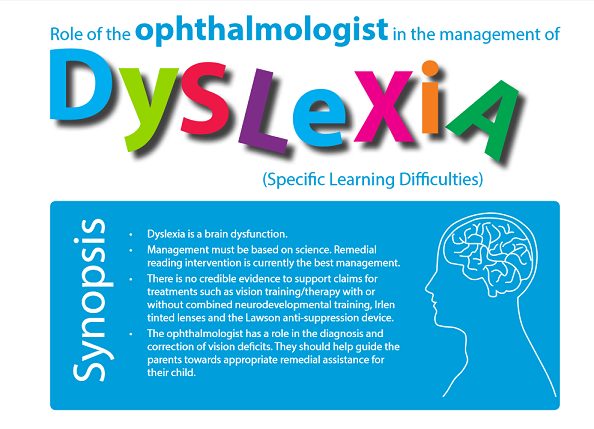
Parents often tell me they wasted precious time and money on controversial reading/spelling/dyslexia therapies that didn’t work.
The time wasted is even more of a worry than the money. The more a child falls behind, the more she or he becomes likely to never be able to catch up.
I’ve written a few blog posts about various controversial therapies, but not a summary one that might be easily found by an anxious, googling parent. So here goes.
A comprehensive reference on the topic of choosing interventions, including a section on reading/spelling interventions, is Pam Snow and Caroline Bowen’s book “Making Sense of Interventions for Children With Developmental Disorders”.
Most readers of this blog will already know about the MUSEC Briefings, which summarised the research on a large number of special needs interventions, many of them controversial. These are no longer being produced or updated, but similar briefings are now being produced as Nomanis Notes.
Another useful source of information about controversial therapies is a 2015 NZ article called Behavioural Interventions to Remediate Learning Disorders, which reviews Arrowsmith, Brain Gym, Cellfield, Cogmed, Davis, Dore, Fast ForWord, Lexia, Lumosity, Slingerland, Tomatis and several other programs.
The 2007 Santiago Declaration by prominent neuroscientists pointed out that “Neuroscientific research, at this stage in its development, does not offer scientific guidelines for policy, practice, or parenting.” Which is polite scientist speak for “neuro and brain-based interventions are mostly bunkum”. You can read more about this here, here and here. (more…)
Filling the gaps in teacher knowledge and skills
8 Replies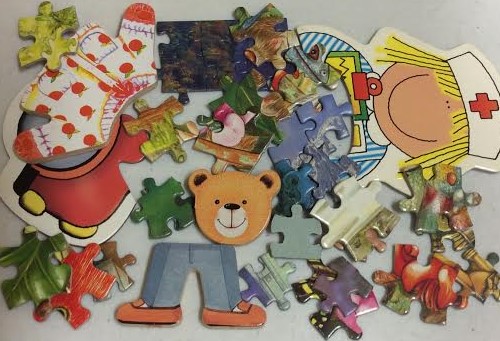
I’m the final speaker at the Maryanne Wolf seminar tomorrow in Melbourne, and am just finishing off obsessively polishing my talk.
I don’t have any handouts for the session – I’m wrapping up quite a long day and don’t want to make anyone’s head explode with lots of new information. However, I do have quite a few links I’d like to share, so I thought I’d make them available via this blog post.
Here’s a summary of what I am planning to say, and the links.
The Beautiful Picture
The title of this talk makes it sound like teacher knowledge and skills are like a neat jigsaw puzzle with just a few pieces missing. All we have to do is find the missing bits, put them in to create a Beautiful Picture in which everyone learns to read and spell to the best of their ability, and the average age of diagnosis of dyslexia is five or six, not nine.
Our long tail of literacy underachievement puts us a long way from this Beautiful Picture now. PISA 2012 told us that 14% of Australian 15-year-olds (9% of girls, 18% of boys) were low performers in reading literacy. Improving teacher knowledge and skills is critical to changing that.
The Beautiful Picture we need to create has:
- Knowledgeable, skilled and confident teachers.
- Best-evidence-based teaching in all three of classrooms, small groups and 1:1 intervention.
- Well-equipped schools.
- At least 95% of kids reading/spelling at or above 30th percentile.
12 reasons you should come to Prof Maryanne Wolf’s seminar
0 Replies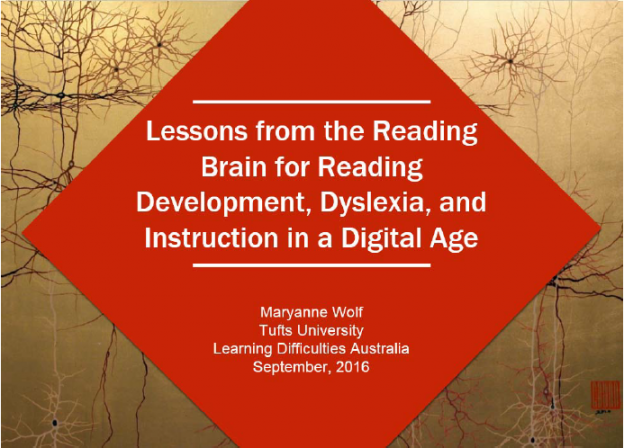
Professor Maryanne Wolf, an international expert on the reading brain and dyslexia, will give a seminar at Collingwood Town Hall on 9th September 2016.
 Prof Wolf is from the Centre for Reading and Language Research at Tufts University in the US. Her seminar will be called, “Lessons from the Reading Brain for Reading Development, Dyslexia and Instruction in a Digital Age”.
I’m helping organise the session with my LDA hat on, so I’ve read her book “Proust and the Squid: The Story and Science of the Reading Brain”, and am really looking forward to using my new copy of her test of Rapid Automatised Naming, the RAN/RAS.
Now I want all the professionals and keen-on-science parents who read this blog to come and hear her speak (she’ll also speak in Brisbane on 2 Sept and Sydney on 9th Sept). It’s going to be great. (more…)
Is the new Victorian learning difficulties screening assessment any good?
14 Replies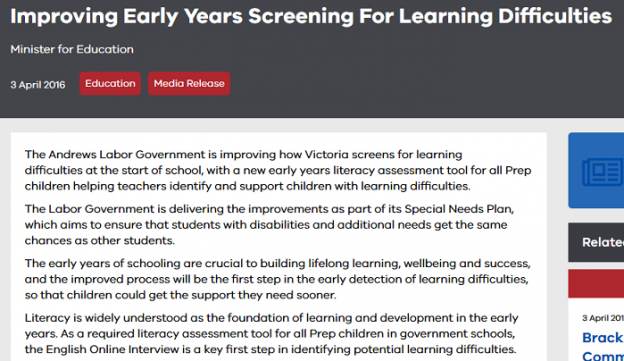
From the end of this year, all children starting school in this state will be screened for learning difficulties.
The Minister’s media release says, “…the improved process will be the first step in the early detection of learning difficulties, so that children could get the support they need sooner” and that the policy means “properly supporting students with additional learning needs so they get the opportunity at a great education.” (Does poor grammar in the Minister for Education’s media releases make you feel a bit despairing, too?)
A useful free online document called Selecting Screening Instruments explains why school entry screening is a worthwhile thing to do: “The goal of universal, early reading screening is to identify children at risk of future failure before that failure actually occurs. By doing so, we create the opportunity to intervene early when we are most likely to be more effective and efficient. Therefore, the key to effective screening is maximizing the ability to predict future difficulties”.
What are the features of a good early reading screening test?
A good early reading screening test measures things that matter over time (i.e. is valid and predicts well) and gives consistent results (i.e. is reliable).
It sorts out the kids who are going to be fine from the kids who are going to struggle, without too many false positives (worrying about kids who are actually going to be fine) or false negatives (failing to identify kids who are actually going to struggle).
It has norms which allow any child’s performance to be compared with the typical performance of their peers. (more…)
I haven’t got my glasses: the adult literacy challenge
1 Replies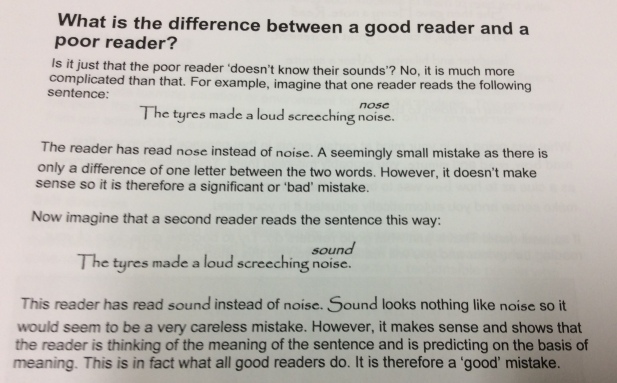
Hooray for ABC Radio National’s Life Matters program, this morning banging the literacy drum again. Today they were talking about adult literacy, starting from the fact that almost half the adult population does not have the literacy skills to take advantage of the exciting economic opportunities our Prime Minister continually spruiks.
I expected the program to refer to earlier discussions about the gap between research and teaching practice in early and remedial literacy education (here and here). To say that we have a lot of adults who aren’t very literate BECAUSE a lot of children were not taught how to get words on and off the page in a systematic, sequential, explicit way when they were at school. But to my surprise these links weren’t made.
The program mentioned the national strategy launched in September 2012 with the aim of fixing our adult literacy problem by 2022, yet didn’t discuss the evidence required for adult literacy programs funded under this strategy, or how outcomes are being measured and reported. (more…)
How can I get my child’s literacy problem taken more seriously at school?
27 Replies
A parent from the Dyslexia Victoria Support Group tells me the title of this blog post is one of the main questions asked on their Facebook page.
Sad, eh? But teachers are good people, and the system fails them too. How frustrating to have kids in your class who you’ve never been taught how to teach to read/spell, year after year! So let’s just get on with fixing this problem, so we can put this question out to pasture.
Normalising failure
Most teachers are taught and equipped to teach early literacy in ways that set up around 20% of students to fail. The most common approach is called “Balanced Literacy“, a dog’s breakfast of approaches that contradict each other, don’t make much linguistic sense and aren’t based on the best evidence.
Years of “Balanced Literacy” and its even-worse predecessor, “Whole Language”, in our schools mean that it’s now considered completely normal for about one in five children to not learn to read for a whole year or more, despite trying their hardest. As Dr Louisa Moats says, we need to be outraged about this. (more…)
Alison Lawson clinics
9 Replies
My 2015 blog post about the Alison Lawson clinics has now been superseded by an excellent article in the magazine of the the Royal Australian and New Zealand College of Opthamologists called, “The Role of the Opthamologist in the management of dyslexia”.
Its most relevant paragraph says:
“Therapies including the Lawson anti-suppression device, syntonics, applied kinesiology, megavitamins and mega oils, the use of trace elements and psychostimulants have all been claimed to improve the reading of dyslexics. The Lawson anti-suppression device, as used in the Alison Lawson clinics, offers a quick fix with 10 one-hour treatments aimed at stimulating the visual cortex. This treatment is based on the false premise that the visual cortex is responsible for reading. There are no controlled trials to support the claims of efficacy of any of the fringe therapies. Their claim to success is based on anecdotal evidence”.
Please refer to the Spring 2016 edition of “Eye to eye”, the magazine of the Royal Australian and New Zealand College of Ophthamologists, especially page 57, column 1.
In the face of this clear statement in the magazine of the peak body of Australasian eye experts, I don’t think there’s any need for further comment from me on the Alison Lawson clinics.
However, if you’d like further information, the RANZCO statement on Learning Disabilities, Dyslexia and Vision can be found here. The American Academy of Opthamology’s statement on Learning Disabilities, Dyslexia and Vision can be found here.
Last updated 18/1/2021
 The Spelfabet shop has affordable, downloadable spelling teaching resources.