
MSL Club 2018
6 Replies
The MSL Club is a four-day non-residential camp for children in Years 1 to 8 with, or at risk of, reading and spelling difficulties. Many, but not all, have dyslexia diagnoses.
Such kids can often feel a bit like a fish out of water in mainstream schools, especially if they don’t know other kids their age with similar difficulties.
It can be a great relief to meet many other kids just like them, learn and play together and form friendships.
The camp aims to help these children feel less isolated, and more supported and celebrated. (more…)
Alternative facts about phonics
14 Replies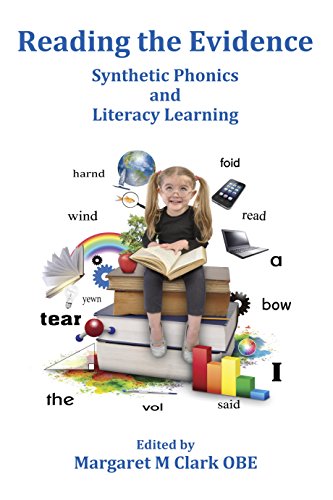
I’ve just read a new e-book called Reading the Evidence: Synthetic Phonics and Literacy Learning, edited by Margaret M Clark OBE, a UK Visiting and Emeritus Professor who the About The Editor section says “has undertaken research on a wide range of topics and has developed innovate (sic) courses”.
Its announcement elicited some e-eye-rolling from members of the Developmental Disorders of Language and Literacy Network, and jovial suggestions that others buy, read and comment on it, but apparently I’m the only one with nothing more important to do (sigh).
Also on my reading list at the moment is The Influential Mind, about how to persuade people in the face of Confirmation Bias, our tendency to ignore or dismiss evidence that’s not consistent with what we already believe. Confirmation Bias is why presenting scientific data to the climate sceptic in your life never works. You can watch a video about it here.
Reading the Clark et al e-book thus also became an interesting exercise in thinking about my own thoughts. I’d set aside time to read the book in order to write what I hoped would be a thoughtful, informed response, but my brain kept coming up with other ideas. Did it keep switching off because of my own confirmation bias, or because of the standard of what I was reading? (more…)
Write this word backwards
3 Replies
Looking for a fresh early-level spelling activity? Inspired by the old board game “Backwords”, lately we’ve been having competitions to write words backwards.
For example, I say “write nip backwards” and learners have to write “pin”. This requires and builds awareness of the sounds in words (phonemic awareness) which is crucial for spelling.
Sometimes we use paper and pencil, and sometimes mini whiteboards, which are often somehow more exciting (novelty, I guess). For the hardline “I’m not picking up a pencil” brigade I also have an embarrassment of colourful and novelty pens and pencils, and coloured paper.
If working on four sound words, words like “spin” (nips) and “nuts” (stun) can be reversed. (more…)
Pip and Tim decodable books from Little Learners Love Literacy
6 Replies
Before I buy a book, I like to pick it up and look through it properly myself.
I also like to hear about it from independent reviewers, not rely on information from those selling it. They’re hardly going to tell me if there’s something wrong with it.
Unfortunately, a lot of excellent books and other resources to help kids learn to read and spell aren’t readily available in mainstream shops.
They’re only available online, or from specialist shops that aren’t always easy to visit. So they’re hard to leaf through, and it’s also difficult to find independent reviews of them.
I’m thus using this blog to help get the message out about good resources I use and recommend from publishers and specialist stores without huge marketing budgets.
I hope this helps more learners get access to them, plus helps those selling them compete with huge companies peddling nasty look-at-the-picture-and-guess books and other dross.
Here’s a video I’ve made about the Pip and Tim decodable books from Little Learners Love Literacy, which I think are perfect for Aussie 4-6 year olds. I use them with some 7-year-old strugglers too. They’re cute, funny and designed to help kids learn to sound out words quickly and well. They’re also available very affordably as iPad apps.
No, I don’t sell these books or get paid any commission on them. I just like them a lot, and hope that (if you have 4-7 year-old literacy learners in your life) you do too.
Balanced Literacy: phonics lipstick is not enough
32 Replies
The ACARA media release on the latest NAPLAN data says, “compared with 2016, there is no improvement in average results across the country that is significant”.
Sigh. So many teachers working so hard to improve results, and still 10% of Australian kids are not meeting basic minimum standards. Add to that the many strugglers who didn’t even sit the NAPLAN tests. Sigh.
Teacher-blogger Greg Ashman writes, “The blame for this situation lies squarely with a widespread adherence to bad ideas“. Whole Language – the idea that literacy is “caught not taught” – was a massively bad idea, inculcated into almost our entire teaching workforce at university, but now thoroughly discredited.
What-works-in-education expert John Hattie even puts Whole Language on his pedagogical “disasters” list, see slide 11 here, whereas Phonics Instruction is on slide 21’s “winners” list.
However, the Whole Language pig still has not been put out to pasture where it belongs. Our literacy education brains trust simply applied a bit of phonics lipstick, changed its name to Balanced Literacy, and carried on much as before. (more…)
New Spelfabet workbooks and other resources, 30% off till June 30 2017
0 Replies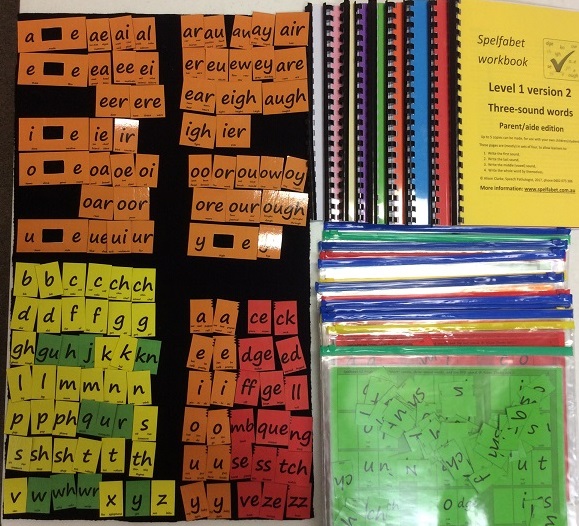
I’ve finally put all my Version 2 workbooks, games and two moveable alphabets into my shop, and made videos about all of them so you can see what they’re like before deciding whether they would be useful to you.
Everything is now available at 30% discount till 30 June 2017. Just enter this coupon code when you get to the shop checkout:
EOFY2017
The main differences between the new and previous versions are:

Workbook overhaul
There are now nine workbooks, since I’ve combined the old workbooks 2 and 3 into a single workbook 2, and added a workbook 3 which provides a gentle introduction to vowel spellings and syllable types before diving into their full complexity in Workbooks 4 and 5. I’ve added more words with more than one syllable to Workbooks 4 and 5, and Workbook 6 covers additional consonant spellings much more extensively than the old version, and takes out the overlaps section, which is more about reading than spelling.
Workbook 7 covers homophones and prefixes, Workbook 8 covers suffixes including stuff like changing y to i and Latin suffixes, and workbook 9 deals with additional Latin and Greek word parts. So there is much more about long words and morphology in this version. There are video tours of all the new workbooks here. You can download the first few pages of each one to check out the table of contents and instructions, and try out some pages with your learner(s) here. (more…)
Questions about the ALEA PETAA infomercial on the Year 1 Phonics test
8 Replies
The Australian Literacy Educators Association (ALEA) and the Primary English Teaching Association Australia (PETAA) have just released an “infomercial” about the proposed Year 1 Phonics test. They oppose it, but watching their infomercial left me with more questions than answers.
What’s the point of the Year 1 Phonics test?
Given the way NAPLAN data have been used to encourage schools to compete not collaborate, and teachers’ often crazy workloads, I completely understand that many teachers are wary of yet another mandatory test.
However, the point of the Year 1 Phonics test is to help teachers better identify which children are struggling to read words, in order to provide early, well-targeted intervention. NAPLAN only starts in Year 3, so can’t do this.
Nonsense words are included on the phonics test because they clearly show which children can crack words open by matching sounds to letters/spellings and then blending, and which can’t. Not having ever seen the words before, kids can only tackle them by sounding out.
Early years teachers can try such a test for themselves by downloading the 2016 UK version, available free online. Many Aussie teachers already are, apparently. (more…)
 The Spelfabet shop has affordable, downloadable spelling teaching resources.
