Renaming letters
0 Replies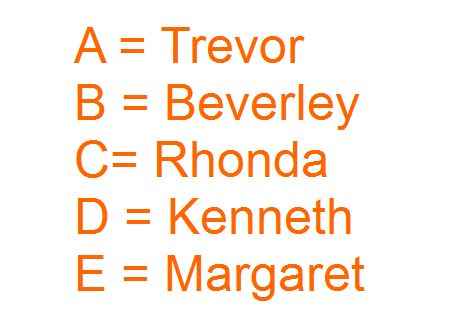
Letter names have recently been the topic of discussion on a US email list I subscribe to, and today someone reframed the discussion in an interesting way.
US Psychologist Steve Dykstra pointed out that if we renamed all the letters of the alphabet – for example, if we decided to call the letter A not "ay" but "Mary", the letter B "Fred" and the letter C "Juanita", and so on – it would make absolutely no difference to whether we could read.
That is, we would still be able to use the letters.
We just wouldn't be able to talk about them. For that, you need to know the names.
Writing is like swimming
2 Replies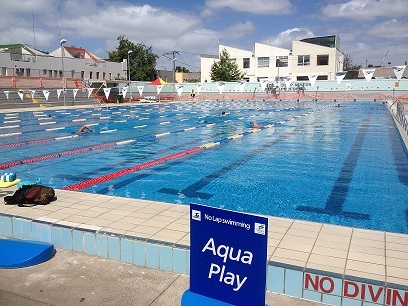
I’ve been doing a lot of swimming lately because I’m a cyclist, but that doesn’t deflab your upper arms. I live near a glorious outdoor swimming pool (saved from closure by a community occupation, so we love it all the more) and work near its newly-refurbished indoor sister pool. They were offering cheap summer memberships, so I dove in.
I’ve never been much good at swimming. I had swimming lessons as a young child, but was timid and asthmatic, and made slow progress. We had a little Clark Rubber backyard pool, but it was for flopping around in on hot days, not actual swimming anywhere.
It was only when I was twelve and realised the cool kids were swimming across the local swimming hole and having a wonderful time jumping out of trees and from a jerrybuilt flying fox into the water, and I couldn’t, that I really focussed properly on the task, and taught myself.
How words cast their spell
1 Replies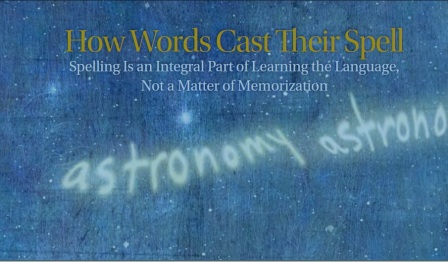
I recently joined the US-based SpellTalk email list, and it was having an interesting discussion about which articles they recommend for student teachers’ reading lists.
This fattened up my Articles I Must Read folder considerably, and yesterday the sun was out, the birds were singing, my chores were done, and the little kids next door were playing doctors and nurses (too funny!), so I put up the hammock and got reading, of course interspersed with a little bit of eavesdropping on the surgical dramas unfolding through the hedge.
The article I’m going to write about today says that spelling is the abandoned stepchild in the family of language arts, but that knowledge of spelling is closely related to reading, writing and vocabulary development, as they all rely on the same underlying language abilities.
It’s called: “How Words Cast Their Spell: Spelling Is an Integral Part of Learning the Language, Not a Matter of Memorisation”, and as its subheadings are also magnificently capitalised, I’ll use them below.
(more…)iPad spelling apps
3 Replies
I’ve been working with a little boy on “long” vowel spellings – the “a…e” in “make”, “save” and “face”, the “ai” in “rain”, “sail” and “chain” and the “ay” in “day”, “say” and “way”, using my moveable alphabet, Workbook 4 and a…e Race game, but as he’s a little pre-geek who keeps wanting to use my iPad, I’ve been trying to find ways to incorporate it into our sessions.
He has skills beyond most of the apps I wrote about in this previous blog post, but unfortunately there aren’t a lot of good apps to help teach vowel digraphs and other, more complex spelling patterns. The phonics ones I use most when working on “long” vowels are:
(more…)Underlining spellings
3 Replies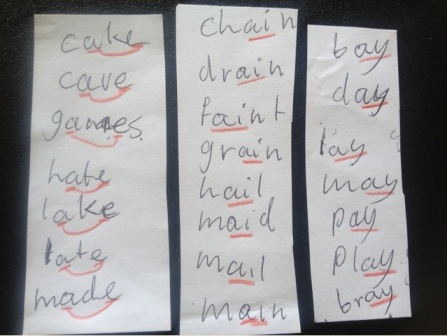
When teaching spellings while writing, getting learners to mentally group letters which represent a single sound and think of them as a single “chunk” (grapheme) can be tricky.
One way to focus their attention on a target spelling is by asking learners to underline it, for example:
spout out cloud
learn heard pearl
fought brought bought
(more…)Teaching spelling
0 Replies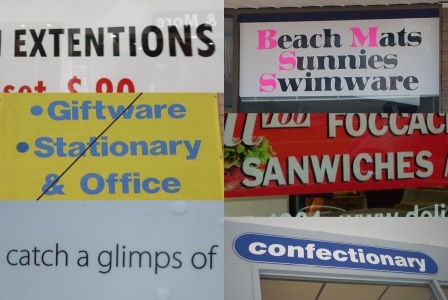
In a Grade Prep classroom recently, I wondered why the teacher was getting the children to repeat the following sentence:
“Big elephants can’t always understand small elephants”.
Then I realised she was teaching five-year-olds a mnemonic for the spelling of the word “because”. Big elephants often can’t understand little elephants? Some days in schools, my jaw drops more than others.
Teaching spelling the word “because”
The word “because” only has one sound spelt unusually. The rest of it is perfectly sound-outable, including the “se”, typically used after a vowel digraph, see this list).
The tricky spelling is the “au”, which usually represents the sound “aw” as in “launch” (click here for more words), but in the word “because” represents the sound “o” as in “fault”, “auction”, “sausage” (and some other words, see a list here).
Spelling collection video
0 Replies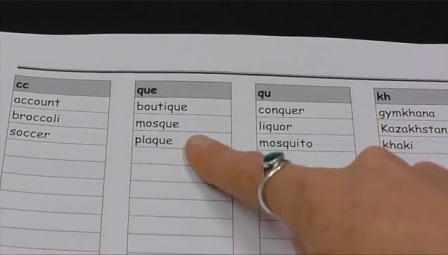
I've just made a three-minute video about my download-and-print Spelling Collection, and put it on my YouTube channel.
It's designed to give learners a framework for organising words by spelling pattern, and thus helps make learning English spelling finite and do-able.
 The Spelfabet shop has affordable, downloadable spelling teaching resources.