
Free phonological awareness test
17 Replies
Dr Jerome Rosner’s Test of Auditory Analysis Skills has been around forever, and is a simple, quick, plain-English test of how well a child in the early years of schooling can hear the identity, order and number of syllables and sounds in words.
These skills are nowadays known as Phonological Awareness. A child’s Phonological Awareness is one of the strongest predictors of his or her literacy achievement.
Who can use the TAAS, with whom, and how long does it take?
The Rosner TAAS is designed for use with children in the early years of schooling, so from about four or five – when children start to be able to grasp the idea that words are made of sounds – up till about age eight, though it can be used with older struggling learners too.
It has 13 questions and takes about three minutes to administer. The instructions and scoring system are simple and straightforward, and there’s a table that shows you how many items you’d expect a child to get right at Kindergarten/Prep level and Grades 1, 2 and 3.
It’s thus a handy screening tool for parents and teachers at this time of year, when everyone’s trying to work out who’s doing OK with early literacy, and who might need a bit of extra help.
It can help bring possible difficulties with Phonological Awareness to your attention.
You don’t need a PhD or special materials to administer the Rosner TAAS, and you can get it right now for $0 just by clicking here.
(more…)The unstressed vowel
6 Replies
One of the hardest things about spelling words with more than one syllable is managing the unstressed vowel (called “schwa” by linguists).
The unstressed vowel is the little “uh” sound we say in “weak” syllables, like the “er” in “water”, the “ar” in “liar”, the “or” in “tractor” or the “a” in “China”. It can be spelt using just about any vowel spelling.
If learners are introduced to long words too quickly, before they have grasped the major vowel spellings in one-syllable words, they can think that this vowel is an “u” sound as in “cut”.
This can make them very confused about how to spell this sound, and how to spell long words generally, since this sound seems to be everywhere in long words.
Another thing which can be really confusing when learning to spell words with more than one syllable is identifying syllable boundaries.
A syllable can be just one letter, or it can be half a dozen or more. Learners need to familiarise themselves with which patterns indicate the end of a syllable, and how to munch their way through long words just one mouthful/syllable at a time, not try to swallow words whole.
Counting syllables
0 Replies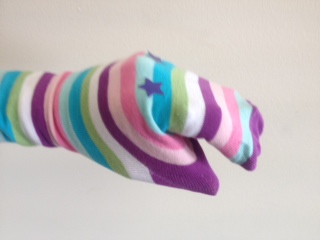
When teaching children to be aware of syllables in words, teachers and therapists often get children counting syllables by clapping or tapping them.
It makes more sense to me to use hand puppets with movable mouths. These could be commercially available ones, ones made out of socks, or just using your hands to "talk" as though they were puppets. You can draw eyes on the knuckles first, or use stickers as eyes, if you like.
Three reasons
There are three reasons for counting syllables like this.
Firstly, puppets are more fun than tapping or clapping.
Secondly, syllables are mouthfuls of sound, so it makes sense to use something that has a "mouth" when teaching children the skills of identifying and counting syllables.
Puppets (hopefully, like people) keep their mouths closed when they are not talking. Each time a puppet says a syllable, it opens and closes its mouth once. You can watch this, and count how many times the mouth opens and closes. So a puppet with a mouth is just a more relevant way to teach counting syllables than tapping or clapping.
The third reason for counting syllables with puppets relates to the types of vowels in English, of which there are three, which have names like strange unpronounceable undergarments:
- Monophthongs: static, single vowels – your mouth doesn't move when you say them,
- Diphthongs: your mouth starts in one position but then moves to another position, so they are technically two vowels,
- Triphthongs: your mouth starts in one position but then moves to two other positions, so they are technically three vowels.
Vowels and consonants
0 Replies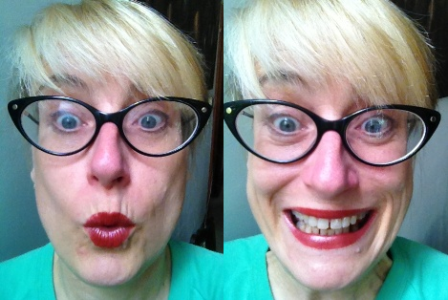
I'll be working with my first Uyghur student this year, so have been doing a bit of background research, to better understand where she's coming from, and make sure I don't commit any major cultural fox paws.
The Uyghur are a Turkic people most of whom live in Western China. They're mostly Sunni Muslims, and their language is written in a script a bit like Arabic.
Westerners tend to pronounce "Uyghur" as "Wee-gur" but thanks to the internet and having learnt the International Phonetic Alphabet at uni, I've figured out it's more correct to say something like "ooh-ee-goo-uh".
I've been practicing this, lying on the couch with my laptop (as you do), and it's made me think about the considerable overlap between the sounds and letters "u" and "w", between "ee" and "y", and overlap between vowels and consonants more generally.
"ooh" is almost "w"
Westerners muck up the pronunciation of Uyghur because the vowel sound "ooh" (as in "too") and the consonant sound "w" (as in "wet") are just about identical. In fact, in linguistics, "w" is classified as a semivowel.
Try saying "too wet" slowly and concentrate on the transition between these two sounds. Not much, eh? Now try "two eggs", officially without a "w" sound. You still get quite a bit of lip rounding and w-ish-ness going on between the words.
We're also constantly writing the letter u to represent the sound "w".
We routinely write qu and gu (not kw/cw or gw) at word and syllable beginnings, as in "quit", "queen" and "squint", "guava", "language" and "penguin".
Food coops and chicken coops
0 Replies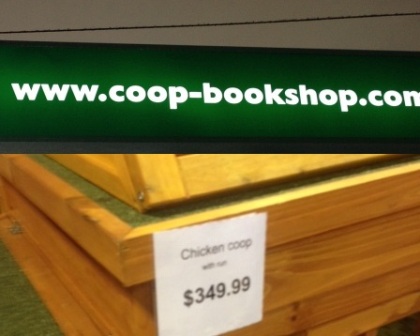
When I was of an age to watch Sesame St, the buzz word for children was "cooperation" (nowadays it seems to be "resilience").
It always puzzled me why this word had "oo" that didn't sound the usual way, as in "boot" or "book", and then later I wondered why it had no hyphen on TV the way I'd seen it sometimes on paper.
Years later when I joined a bread-making co-op (super-healthy wholegrain loaves, hard as rocks, delivered by bicycle. Such hippies) I would insist on segmenting "co-op" with a hyphen, not "coop". A coop was always a place to keep chickens, in my book.
The food co-op where I refill my shampoo and detergent bottles (yup, still a bit of a hippie) still has a hypen, but hyphens are dropping out of this and other words fast elsewhere, giving us potential segment-ups like reelect, prearrange and microorganism.
However, hyphens are still essential for segmenting many other words – you can't really write "co-own" or "anti-inflammatory" or "re-sorting" without one. I would like to add a something to segment the syllables in "skiing" and "Shiite", but I'm not sure what. And if I'm working with you, please don't call me your "coworker", I grew up on a dairy farm.
Teach one-syllable words first
1 Replies
Whole-language approaches to literacy-teaching generally include two-syllable words in the first handful of words children are expected to rote-learn. For example, “away”, “funny”, “little” and “yellow” are all in the “Pre-primer” Dolch words.
Analytic phonics approaches also present beginners with many words of more than one syllable – A is for aardvark, abacus, above, acorn, actor, adult, aeroplane, almond, August, Australia…ten words starting with seven different sounds.
These are both good ways to overload beginners and confuse them about sound-letter relationships.
There’s quite enough complexity in the spelling patterns of English one-syllable words to keep beginners very busy, without adding all the extra patterns that appear in longer words, like the “y” in funny, the “le” in little, the “aer” in aeroplane, the two different “au”s in “August” and “Australia”, and the biggest spelling hurdle in longer words, the unstressed vowel.
Schwa – the unstressed vowel
In many words with more than one syllable, one or more of the spoken vowels/syllables is typically produced without stress, as the unstressed or weak vowel. In linguistics this vowel is called schwa.
Schwa is kind of like a little grunt, a very short “uh” sound. It’s the final syllable in the spoken words sofa, butter, actor, dollar, tapir, thorough, cheetah, colour, centre, murmur, nature and martyr. It’s the first syllable in above, elect, aesthetic, oesophagus and Olympics. And it’s a poor neglected middle syllable, spelt using just about any vowel spelling, in thousands and thousands of words.
Elkonin boxes
2 Replies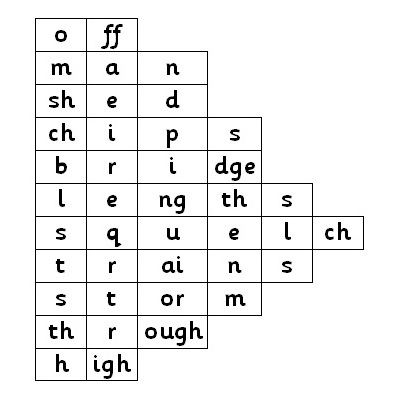
Elkonin boxes are boxes drawn to represent sounds in words, or sometimes syllables in words.
They're named after a Russian psychologist who first used them to help learners segment spoken words into sounds. However, traditionally they're used without letters, and just tokens are put into the boxes to represent sounds.
These days we know that there's no reason to hear sounds in words other than to spell them with letters, and that it's best to knit letters and sounds together right from the start, so most people write letters/spellings in their Elkonin boxes.
They're a great idea for helping learners "chunk" words into sounds and their associated spellings. And they're not too hard to prepare in an ordinary word processor with a table function, or just draw them on the board.
 The Spelfabet shop has affordable, downloadable spelling teaching resources.
