
Just Right books
1 Replies
One of the literacy buzz-words in my local schools is the “Just Right book”.
Kids pillaging the library are always looking for one, preferably a funny one. A book that’s not too easy and not too hard. But this seems to mean slightly different things to different people.
Choosing a Just Right book
For the ~80% of kids who don’t struggle to learn to read, it’s fine for parents to pick something that looks like it might interest them, decide by eyeballing it whether it’s about the right level, then listen to them reading a page and count the errors to work out what’s a Just Right book.
The errors rule of thumb is:leev
- If a learner can read 19 out of 20 words (95%) in a book, it’s suitable for independent reading.
- If a learner can read 9 out of 10 words (90%), it’s suitable for him or her to read with adult help.
- If learners get less than 9 out of 10 words, but they’re still interested in a book, read it to them.
Two reading cultures
2 Replies
Like most professionals I know, I keep a folder called Articles I Must Read, which help keep up my levels of professional guilt, and many of which I get via the Developmental Disorders of Language and Literacy network. I recently read one that rang a lot of bells, so thought I'd summarise it's key points as a blog post.
It's called The Science of Reading and Its Educational Implications, by Mark S Seidenberg from the University of Wisconsin-Madison.
He writes that reading is very well-understood from a scientific point of view, yet there are still far too many people who read poorly – about 24-30% of the US population (the Australian Bureau of Statistics has just released new data on adult literacy which paint a similar picture).
His article examines three possible contributing factors: our opaque spelling system, the cultural divide between science and education and/or language variability. I found his discussion about cultural differences between science and education most interesting, so will focus on that.
Reading Eggs Eggy Phonics
2 Replies
Reading Eggs is a popular Australian children's reading program, sold by the commercial arm of our respected public broadcaster, the ABC.
Most kids without literacy difficulties seem to really enjoy Reading Eggs, and it includes some phonics activities.
However, it's not a synthetic phonics program, and I'm not aware of any scientific research demonstrating its effectiveness, so don't use it myself.
In a procrastinatory mood the other day, I noticed that there are a couple of apps for the iPad called Eggy Phonics. Since they cost a grand total of $5, I couldn't resist downloading them to have a look.
Free inclusion online training for teachers
3 Replies
I recently went to a talk at Melbourne’s Royal Children’s Hospital, and over the tea and cake that followed ran into the lovely Mary Kanaris, who studied Speech Pathology with me back in the dark ages, after which we both worked in western suburbs schools.
Mary is now the Inclusion Online Lead Tutor and Coordinator for the More Support for Students with Disabilities National Partnership in the Student Inclusion and Engagement Division of the Early Childhood and School Education Group of the Department of Education and Early Childhood Development.
This both impresses me and reminds me why I left the Department years ago, while she sensibly stayed and got Long Service Leave. Hierarchy and bureaucracy always make me want to stand up and sing Court Of King Caractacus in meetings, in fact in the 1990s I invented a rudimentary form of B-S Bingo during a long, compulsory-attendance, mind-bogglingly boring departmental briefing full of acronyms and edubabble. But I digress.
The resilient Mary is now involved in running free online training on disability topics for Victorian government school employees, and one of the courses is called Understanding Dyslexia and Significant Difficulties in Reading. This course is also available in Qld, NSW, SA and Tasmania.
Oxford Owl free ebooks
2 Replies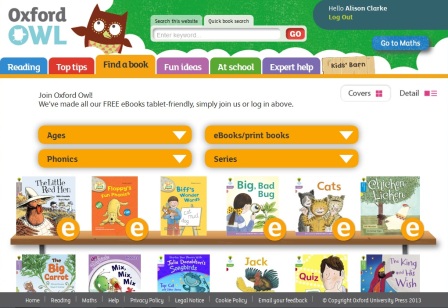
I was pretty excited to discover recently that free eBooks are available on the Oxford Owl website, including a category called "phonics". Finding enough quality, affordable decodable books for some of my learners can be a bit of a challenge, and I do love a freebie, don't you?
I set up an Oxford Owl account, logged in, and selected the "250 FREE EBOOKS, now tablet friendly". How exciting. OK, that's slightly tragic, but I was thinking of a few iPad obsessed reluctant readers I know.

I clicked on the "Book Type" dropdown menu and chose "Phonics".
iPad spelling apps
3 Replies
I’ve been working with a little boy on “long” vowel spellings – the “a…e” in “make”, “save” and “face”, the “ai” in “rain”, “sail” and “chain” and the “ay” in “day”, “say” and “way”, using my movable alphabet, Workbook 4 and a…e Race game, but as he’s a little pre-geek who keeps wanting to use my iPad, I’ve been trying to find ways to incorporate it into our sessions.
He has skills beyond most of the apps I wrote about in this previous blog post, but unfortunately there aren’t a lot of good apps to help teach vowel digraphs and other, more complex spelling patterns. The phonics ones I use most when working on “long” vowels are:
Underlining spellings
3 Replies
When teaching spellings while writing, getting learners to mentally group letters which represent a single sound and think of them as a single “chunk” (grapheme) can be tricky.
One way to focus their attention on a target spelling is by asking learners to underline it, for example:
spout out cloud
learn heard pearl
fought brought bought
 The Spelfabet shop has affordable, downloadable spelling teaching resources.
