
100 word spelling test
5 Replies
I put some pseudoword spelling tests up on my website ages ago, hoping they would help people work out which of my workbooks and other materials might best meet their needs.
What is a pseudoword?
A pseudoword is a potential word in a given language, as it has allowable sound and spelling combinations, for example, "flernish" is an English pseudoword, but "wstoepfteg" is not. It doesn't sound or look remotely English.
Pseudowords are great for testing encoding skills/spelling, because they eliminate the possibility that the test words have been memorised as wholes, and require learners to sound out (i.e. use their phonemic awareness and knowledge of phoneme-grapheme correspondences) to spell all the words.
For young children and older ones who haven't been able to build their vocabularies through reading, most of the words in English are pseudowords. In fact, none of us know every word in the language – think of how many words are allowed in Scrabble that you've never heard of. So learners are not phased by being asked to write pseudowords. From their perspective, they have to do it all the time. When you google pseudowords, you find that most of them really do mean something to someone, somewhere. "Google", "blog" and the ubiquitous "selfie" were all pseudowords not long ago.
An abbreviated, 100 word spelling test
I haven't had much feedback about the spelling tests currently on my website, so I don't think they are being used much. Perhaps this is because they are far too long (I don't even use them in full these days) and in video form, requiring internet access. It's not easy to print them off and only use parts of them, or control the rate of presentation of words.
Below is an abbreviated, 100 word spelling test (or the printable version can be downloaded here) – on which I'd love your feedback.
There are no norms for this test, it's just intended as a tool to explore what a learner does and doesn't know about spelling. I usually try a two or three words from each section and then if it's clearly too easy, skip up to the next section, till I find a group of words that contain spellings which are clearly too difficult.
Before we do this test, I usually tell kids that I'm going to ask them to write some alien names and words from an alien language written in English. Sometimes I draw a few aliens – four eyes, six tentacles, some slime etc, and since my drawing skills are atrocious, kids laugh, which helps make the task seem less formal and stressful. Then off we go. No need for special equipment or expensive test forms, just pencils and paper, plus a way to block the view of other people's work for anyone inclined to copy.
Three-sound words
I start with just one letter = one sound in three-sound words (CVCs or Consonant-Vowel-Consonant words):
Four sound words
If these are a problem, try Workbook 3. But if they can spell CCVCs, try some "long" vowel spellings in both open and closed syllables.
Vowel spellings
The possible correct answers multiply here because each sound has several spellings:
Multisyllable words
How the brain learns to read
6 Replies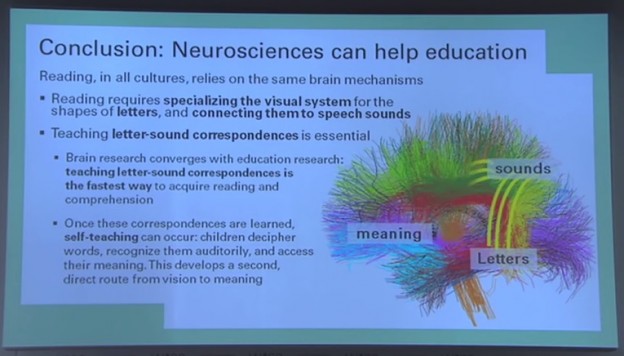
I’ve just found a great 20-minute talk on YouTube by Stanislas Dehaene, a French cognitive neuroscientist, called “How the brain learns to read”. He wrote a classic book called “Reading in the Brain” that I occasionally reread bits of when I want to feel wholly inadequate.
“Neuro” language is often used to make questionable or worse programs and products seem more scientific and impressive, but the things Dehaene says in this video are straightforward and consistent with the classroom research on how to teach literacy fast and well. So I hope his pictures of brains don’t put anyone off, he’s not selling anything or trying to get anyone to suspend their critical faculties.
What are the 44 sounds of English?
1 Replies
For a long time I've been looking for a good, short, video about the 44 sounds of English, in my dialect, and organised by sound class not alphabetically. I haven't been able to find one, so now I've made my own.
Brain training
3 Replies
I was pretty surprised last week to read in The Age newspaper* that our Premier and state Education Minister launched a pilot of the Arrowsmith program at a Catholic school here in Melbourne, and that there was no mention in the article of the controversy surrounding this and other “brain training” programs.
The Arrowsmith program’s website states that it is “founded on neuroscience research”, the first type of which has shown that “different areas of the brain working together are responsible for complex mental activities, such as reading or writing, and that a weakness in one area can affect a number of different learning processes”. But so what? That doesn’t mean that teaching skills that involve the same brain areas as reading and writing will help reading and writing.
 The Spelfabet shop has affordable, downloadable spelling teaching resources.
