Reorganising high-frequency word lists
9 Replies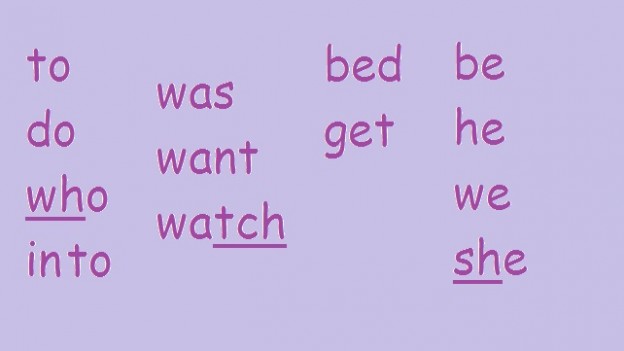
Literacy beginners and strugglers are often given high-frequency words to rote memorise, drawing them from the Oxford, Magic, Dolch, Fry or some other high-frequency word list.
These lists treat written words as things to be visually memorised, rather than sounded out.
They work from most to least common words without regard to spelling complexity or word structure, and include a mixture of simple, more complex and unusual spellings.
Teaching high-frequency words in order of frequency reinforces the impression children get from reading repetitive texts that English spelling is a dog’s breakfast, by obscuring rather than illuminating the spelling patterns.
Visually memorising regularly-spelt words is also highly inefficient, and can give children with weak awareness of sounds in words the idea that written words are lumpy wholes without reusable component parts.
I agree that frequency matters, but it’s not more important than complexity.
(more…)Spelling list signal to noise ratios
5 Replies
I’m tearing my hair out again about the spelling lists some of my students are being asked to learn for spelling tests.
They’re all noise and no signal.
A spelling list should help students learn something about spelling. They should demonstrate a clear pattern students can apply to their reading and writing.
Because teachers are not usually taught much about spelling, the main message their spelling lists often send to students is that spelling is very difficult.
I wish teachers designing spelling lists would identify a single, clear spelling signal for each list, and then choose words which focus their students’ attention on this signal, and minimise background noise.
Example spelling lists
For young children, such a list might go like this: quads, squad, swamp, swan, swap, swat, wand, want, was, wasp, wash, watch.
This list makes the spelling point that after the sound “w”, the sound “o” (as in “got”) is spelt with a letter A.
Predictable or repetitive texts
6 Replies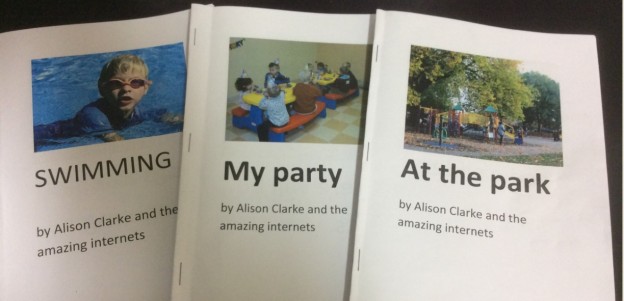
I've made a new video about predictable texts, sometimes called repetitive texts.
These are short books typically given to little kids when they first start school, and which they take home to read with their parents.
Each page usually contains a sentence and a picture. The same sentence frame repeats on each page, with just one or two words changed to reflect the new picture.
Children often "read" these books by guessing from pictures, first letters and context, i.e. they engage in reading-like behaviour, but they're not actually reading. Often it's only when texts get more complex that adults notice that they can't actually decode.
Let's have a look at some example repetitive, predictable texts, and compare their spelling patterns and syllable structures with decodable texts, and see what they look like to a beginning reader.
If you get this blog post by email and the embedded video below has dropped out, click here to view it online.
To find a list of decodable books, click here.
The Great Australian Spelling Bee
5 Replies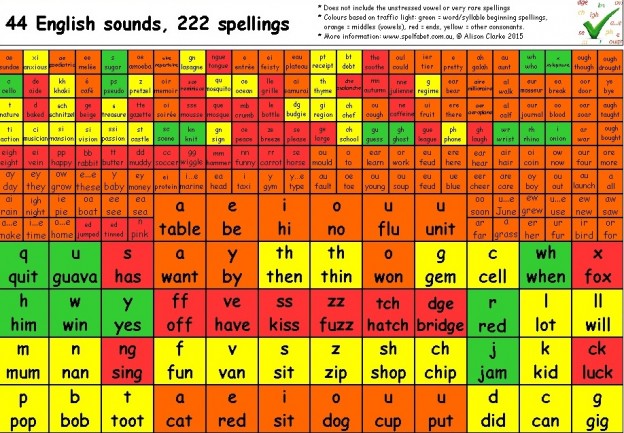
There was an interesting interview on Radio National about spelling today, inspired by new TV quiz sensation the Great Australian Spelling Bee.
In the GASB (as I’m sure we’ll all soon be calling it), children aged 8 to 13 start off spelling words like “lousy”, “voyage”, “kelpie” and “gravel”, which get progressively harder, till the live audience goes mad ape bonkers at their brilliance, they can spell cretaceous! OMG.

GASB has tension-building music, a “Spelling Gate”, timers, a leader-board, Challenges, a Pronouncer/Judge who leaves long, hold-your-breath pauses before intoning “CORRECT” or “INCORRECT”, dinosaurs, tasers, hugging, tears, you name it, and of course lots of interviews with adorable, clever children with butterflies in their tummies, who while being fiercely competitive wish each other the best of luck and want to be friends forever. Everyone simply loves it.
I’ve only been able to watch it from between my fingers, because I find game shows excruciating (sadly I’m more of a Radio National type), and because I suspect the extreme excitement about children being able to spell might be partly because children, or people generally, who can spell really well are the exception, not the rule. It’s (IMHO) unarguably the most undervalued and poorly taught key skill on the curriculum, and has been for a long time.
Seminar on improving school outcomes
0 Replies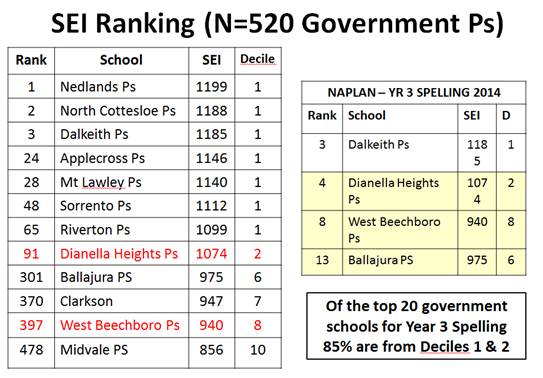
Western Australia has 520 government schools.
In socio-economic terms, WA’s Dianella Heights PS ranks at number 91. On the NAPLAN Spelling test it ranks at number 4.
WA’s West Beechboro PS ranks at 397 socio-economically. On NAPLAN Spelling it ranks at number 8.
Great, eh? I imagine all their teachers look like this:

Of course, NAPLAN is not the only way of measuring how well a school is doing, not by a long shot.
(more…)
 The Spelfabet shop has affordable, downloadable spelling teaching resources.