
PETAA’s Authentic Texts to Support Teaching Phonics
9 Replies
The Primary English Teaching Association of Australia has produced a new, downloadable list of Authentic Texts To Support Teaching Phonics, which:
“…maps examples of rich authentic texts to the Federal Government’s Literacy Hub phonics progression, which presents a structured sequence of letter–sound correspondences and phonics skills for development across Foundation to Year 2. This free download provides early years teachers around Australia with a quality text list for teacher read alouds that support the phonics instruction that they’ve done that day/week.”
The guide is a downloadable spreadsheet listing phonics targets and books to support them. Here’s a screenshot of how it starts:

I’m so happy that PETAA recognises ‘Systematic, direct and explicit teaching of phonemic awareness and phonics is more likely to result in successful literacy outcomes’, so I was keen to see what kind of books they recommend to support this teaching. I popped into my local kids’ bookshop and bought three of the first six titles on their list.
PETAA recommends these books to support teaching of the the earliest sound-letter relationships in the Literacy Hub phonics teaching sequence, which I write as s/snake, a/apple, t/tiger, p/penguin, i/insect and n/noodles (AKA satpin, I use the reference words from our Embedded Picture Mnemonics, which help little kids remember sound-letter links). These are the first sound-letter relationships taught to five-year-olds in VC and CVC words (V=vowel, C=consonant) in this teaching sequence, and several others. Children are also taught four high-frequency words in this Phase: ‘is’, ‘a’, ‘I’ and ‘the’.
I did some word counts so I could figure out how many words a child taught these phonics and high-frequency word targets should be able to read in each of the three books I bought.
Hedgehog or Echidna?
- 573 total words
- 11 Decodable VC words (2 X ‘at’, 3 X ‘it’, and 6 X ‘in’)
- 0 decodable CVC words
- 57 pre-taught high-frequency words: 57 (14 X ‘is’, 19 X ‘a’, 12 X ‘I’, 12 X ‘the’).
Turbo Turtle
- 973 total words
- 31 decodable VC words (9 X ‘at’, 1 X ‘an’, 10 X ‘it’, 11 X ‘in’)
- 0 decodable CVC words
- 71 pre-taught high-frequency words (5 X ‘is’, 17 X ‘a’, 2 X “I”, 47 ‘the’).
Give me some Space!
- 1007 total words
- 47 decodable VC words (5 X ‘at’, 8 X ‘an’, 11 X ‘it’, 23 X ‘in’)
- 0 decodable CVC words
- 88 pre-taught high-frequency words (18 X ‘is’, 17 X ‘a’, 8 X “I”, 45 X ‘the’).
The only readable words in these books for the target beginners are prepositions, pronouns, articles and auxiliary verbs, i.e. unstressed function words that glue sentences together, but don’t mean much on their own. Interrupting a rollicking story to allow children to read such words just seems tedious and confusing.
A young child focussing on a storybook’s print (which young kids are disinclined to do) and thinking about phonics, rather than looking at the pictures and listening to the story, will be able to see lots of letters ‘s’, ‘a’, ‘t’, ‘p’, ‘i’ and ‘n’ in any book. But can they connect these letters to sounds in spoken words at story pace? When nobody is pointing to each word as it’s read? Srsly?
Stopping a good story to talk about phonics seems more likely to annoy children than help them, but anyway, let’s keep thinking about this. The PETAA list of Authentic texts to support teaching phonics includes example words which illustrate letter-sound relationships. Here’s a screenshot of the list for teaching about s/snake, a/apple, t/tiger, p/penguin, i/insect and n/noodles (in that order):

As you can see, the list includes s/scent, a/astronomical, a/gravity, a/intergalactic, t/turbo-charged, t/nectar, i/cylindrical, i/familiar, p/palomino, p/pinto, and n/nectar again. Interrupting a good story to talk about a letter-sound relationship in a probably-unfamiliar and/or polysyllabic word? Hmm. Not likely to win anyone Most Favoured Teacher Status.

You might have also noticed ‘a/astronauting’ on the list, which the Macquarie Dictionary says is not a real word. The list also suggests that a/after is pronounced like a/apple in Australian English (it’s not), that there’s a t/tiger sound in ‘clutched’* (there isn’t), and that we say/hear an i/insect sound in the second, unstressed syllables of ‘rabbit’ and ‘hermit’ (nope, it’s a schwa).
Teachers should read great storybooks aloud to little kids to boost their oral language skills and share knowledge and enjoyment.
They should give little kids decodable text so they can practise the skills taught in phonics lessons.
There’s no need to mix up these two very different types of books.

* If you’ve studied phonology, you’ll know that the sound /ch/ starts off as /t/ and is released as /sh/, so technically it does contain a /t/ sound, but that’s slicing it too finely for children. For them, ‘tch’ is just the main way we spell /ch/ after a ‘short’ or ‘checked’ vowel, as in batch, fetch, itch, scotch, hutch. You can see what the Macquarie Dictionary says about the pronunciation of ‘clutch’ at right.
Revised Affixit 20 game
4 RepliesAs soon as you finish making something, you think of ways to improve it. Always. Sigh.
Affixit game 20 was meant to focus on building words like music-musician, magic-magician, and Egypt-Egyptian, but there weren’t enough suitable words, so -al/-ial as in centre-central, deny-denial, finance-financial became the focus. While making the label for our Affixit games storage boxes (download it free here if you like), I realised -al/-ial was already in Affixit game 17. Gah.

This meant I had to make a new Affixit game 20, which teaches how words ending in ‘mit’ change to ‘miss’ (as in admit-admission, permit-permissible, submit-submissive) before some suffixes (Latin ones). The wonderful Saoirse helped me make a video to demonstrate the new game:
You can download this new game free here.
I’m now stopping myself from thinking about ways to improve the Affixit games so I can focus on revising our phonics playing cards (more compact sets with larger font, words facing one way, difficult words replaced, and extra game instructions). Always ways to improve…
Alison Clarke
Speech Pathologist
Free Affixit game
6 RepliesHooray, you can now download and print Game 1 of our new Affixit word-building games for $0. Players build and spell words by adding suffixes -s, -ed or -ing to base words, doubling final consonants when necessary (e.g. stop-stopped), and knowing when not to double (e.g. mend-mending, back-backs).

Base words are spelt in basic/initial code – the alphabet plus ff, ll, sh, ch, th, ng and ck – and are CVC, CCVC or CVCC words, with one CCCVC word (‘strum’). Many common one-syllable verbs like ‘win’, ‘swim’ and ‘bend’ have irregular past forms, so don’t take suffix -ed, and these were excluded. We don’t want to confuse kids with language delay/disorder who still sometimes say things like ‘swimmed’ and ‘runned’.
Game 1 targets the suffixes and juncture changes taught in Foundation Term 4 of my state’s Phonics Plus teaching sequence. Our Term 4 starts today, so I hope this game is well-timed and widely used. It should also slot neatly into other phonics teaching sequences, towards the end of the basic/initial code.
Here’s a video of me playing Affixit 1 with student Saoirse (thanks, Saoirse!):
Sorry about my messy handwriting, I was trying not to bump our wonky tripod (very hi-tech here, not).
There are 24 Affixit games in total, grouped in two sets. They target almost all the prefixes and suffixes in Phonics Plus (I’m still thinking about prefixes sub-, non- and mis-), and a few extras. They should be easy to slot into other phonics sequences, as base word spelling complexity increases gradually, and each game only targets a small number of affixes. The games took weeks to develop and test, aiming to maximise the number of common words players can build and spell in each game.
All the Affixit games are available in two download-and-print sets of a dozen from www.spelfabet.com.au/product-category/games/affixit. They cost two Australian dollars per game (plus GST if you’re in Australia) which is about USD$1.30. Each game prints on three sheets of A4 light card. We printed ours on photo paper, so we didn’t have to laminate them (quicker and less plastic, yay!). They fit neatly into two craft storage boxes we got from a hardware store, here’s what they look like:


I’ve put videos demonstrating each game on YouTube, just click on these links:
Affixit game 1 Affixit game 2 Affixit game 3 Affixit game 4
Affixit game 5 Affixit game 6 Affixit game 7 Affixit game 8
Affixit game 9 Affixit game 10 Affixit game 11 Affixit game 12
Affixit game 13 Affixit game 14 Affixit game 15 Affixit game 16
Affixit game 17 Affixit game 18 Affixit game 19 Affixit game 20
Affixit game 21 Affixit game 22 Affixit game 23 Affixit game 24
Georgina Ryan devised the original version of this game, with help of Elle Holloway.
Feel free to print multiple copies of any Spelfabet games purchased for your own class/students. I hope this makes them an affordable way to provide lots of well-targeted reading/spelling skills practice, cleverly disguised as fun. Please don’t share them across a school or school system. They take time and expertise to make, and their sales help pay for the Spelfabet website.
Alison Clarke
When are professional reports TL;DR?
6 Replies
Today I spent over an hour reading and summarising ten reports and letters about a complex new client, to prepare for our first session. The longest report was 15 pages, but some professional reports contain 50 or more pages. Gah. Paediatricians’ reports are usually only one or two pages, while the really long reports tend to be by Psychologists.
Reading takes time. Everyone’s time-poor. How fast can a skilled reader read and understand a complex professional report? There’s a great, 54-page study guide to the first half of Mark Seidenberg’s important (though not very succinctly-titled) book “Language at the Speed of Sight: How We Read, Why So Many Can’t, and What Can Be Done About It” which says:
If you are a good reader, texts can be comprehended more rapidly than speech. Listeners are at the mercy of speakers who control how rapidly they talk and how clearly ideas are expressed. Reading can go faster because readers control how fast they read: there’s no “speaker” to wait for.
The catch, however, is that the visual system imposes hard limits on how fast we can read. Properties of the eye limit how much can be seen at a time, creating a major bottleneck. The perceptual span–the amount of information that registers during an eye fixation–is surprisingly limited, with only 2 or 3 words clearly visible, at best. Our eyes don’t allow us to take in entire lines of text at a time.
Reading consists of a succession of fixations (pauses) and saccades (jumps to the next fixation). Most words in texts are fixated at least once, with the exception of short words like ‘of’ and ‘an’. Many words are skipped when we skim a text, which results in shallower comprehension.
Good readers average about 4-5 words per second (240-300 words per minute). People do not read faster by making fewer fixations or larger saccades. Rather, faster readers spend less time on each fixation because they recognize and comprehend words more rapidly.
Reading speed also depends on the difficulty of the text, the reader’s familiarity with the topic, and how deeply the text is read (one’s goal in reading it).
The 15-page report I read today contains 5,167 words, so at 300 words per minute, it takes 17.22 minutes to read. That seems fairly reasonable, especially since it contains clear sections/headings and tables. SPELD-Vic literacy assessment reports are also now clear and succinct, with appendices and attachments containing extra information only relevant to some readers (they’re also now running an online course for Psychologists about SLD assessment). But a 48-page report I received recently contains 16,605 words, or at least 55 minutes of reading. TL,DR. I just skimmed it, and I’m sure teachers did the same.
Too often, quantity seems to displace quality in exceptionally long reports, with cut-and-paste errors (e.g. wrong names or pronouns – a boy was suddenly called Grace in one I read the other day – or duplicate sections) and typos, suggesting that even the authors didn’t read them. Sometimes very long reports discuss a client’s learning style (not a Thing), recommend coloured overlays, or include pages of very general lists of resources which may or may not be suitable. I’ve seen Dandelion readers, most suitable for 4-7 year olds, suggested for tweens or teens. Another sigh.
I suggest parents ask professionals to keep their reports under 5000-6000 words, including a maximum of a couple of pages of recommendations, and to only recommend specific resources/programs if they are confident they’re directly relevant. There’s no point paying $1000+ for a report nobody will read, or lots of poorly-targeted recommendations. Besides, reading difficulties run in families, and many parents of struggling readers also struggle to read long, complex reports.
The inimitable Anita Archer has many concise, compelling sayings about teaching, and one of her best is “Teach the stuff and cut the fluff”. I’d love not to find myself paraphrasing this as “write the stuff and cut the fluff” when reading some professional reports.
Alison Clarke
PS Thanks to Cathy Basterfield of Access Easy English for pointing out Speech Pathologist Harmony Turnbull’s blog on the accessibility of allied health reports. Lots of useful links and great food for thought!
Phonics Intervention Symposium: Day 4
4 Replies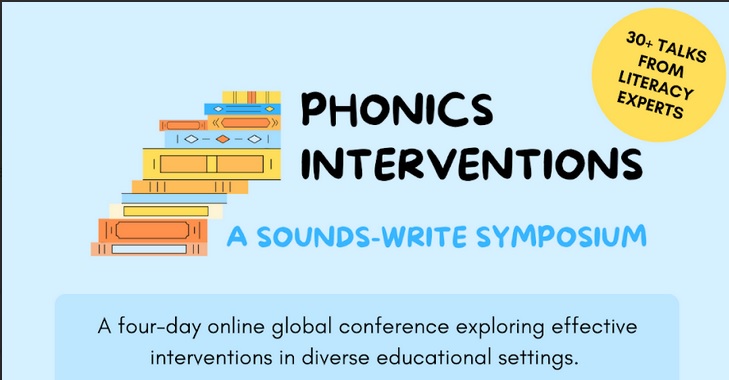
Sadly, I was too busy to attend the recent international Sounds-Write Phonics Interventions Symposium while it was live and free online. Happily, it was all recorded. A great thing about recordings is that you can watch them at high speed, slowing down and rewinding the best bits, and learn a lot quickly.
It’s school holidays here, so I’ve started working my way through the presentations, starting with the most recent, and helping myself focus by writing notes/thoughts for this blog post. I find restaurant menu codes (V, GF etc) helpful, so have made up codes to suggest who might be most interested/benefit most from each presentation (which could be wrong, so feel free to ignore them):
- SL = school leaders;
- T1 = early years classroom teachers (Tier 1);
- T2 = early years small group/keep up intervention providers (Tier 2);
- T3 = individual intervention providers for older/catch up and neurodivergent learners (Tier 3).
I’ll also note the length of each speaker’s actual presentation, minus the (often very interesting) Q&A.

Laila Sadler succinctly summarises things UK schools are doing to ensure all their kids learn to read. Engaged school leaders and shared belief systems are key, as well as type and timing of teaching/intervention. (SL, 26 minutes)

Lindsay Springer talks about 4-year, school-based research in Canada showing they’re preventing reading failure with screening, high-quality teaching and early intervention. Includes classroom videos and teacher interviews, graphs like this one (applause!), attention to kids’ academic self-concept and agency, and gorgeous quotes from kids at the end (SL, T1, T2, 33 minutes).

Wendy Bowen is from the Orkney Islands, which had close to Scotland’s worst reading results in 2018-2019. Then they read books by Diane McGuinness, trained teachers in Sounds-Write, got decodable books, started gathering data, organised small group and 1:1 intervention, and overcame various obstacles. Now their reading and spelling results are among the best in the country, and fewer kids need intervention (SL, T1, T2, 29 minutes). P.S. Wendy has a wonderful accent.

UK intervention teacher Sarah Horner talks about overcoming the dread forgetting curve with a team approach to little-and-often practice sessions. Each child has a Follow Up Folder, and everyone available, including volunteers, office staff and capable peers, is roped in to grab the folder and help the child do a few minutes’ practice (read a book, play a game, do some writing etc) whenever they can (T3, 15 minutes).

The UK’s Tricia Millar talks about delivering fast, shame-free, life-changing intervention to teenagers in secondary schools, giving them a sense of belonging and the ability to participate. My main thoughts were 1. OMG I need to make time to do That Reading Thing/That Spelling Thing training (yeek, I’ve been saying that for years), 2. Everyone who is interested in literacy in secondary schools should watch this, and 3. I need to find out about the Powell Phonics Checker. (SL, T3, 34 minutes).

Krystal Brady works in an Australian school that had devastating 2021 NAPLAN results. All their teachers, including casuals, were trained in Sounds-Write in 2022, which was rolled out across the school in 2023. At first their focus was Tier 1, but they also ran Keep Up and Catch Up groups, collected DIBELS data, did formative assessment, instructional coaching, collaborative planning, all the good things. They have reaped the rewards, both in student skills and staff satisfaction. More applause! (SL, T1, T2, T3, 39 minutes).

Gail Williams is Principal of an Australian secondary school for students with intellectual disability which uses the Sounds-Write phonics program. She says her school presumes student competence, including for nonspeaking students, and that “The term ‘presuming competence’ is most commonly associated with the work of Anne Donnellan and Douglas Biklen”. Eeek. Biklen promoted facilitated communication (FC), a discredited and unethical Augmentative and Alternative Communication approach, and googling suggests Donnellan condoned it. Happily, there is no mention of FC or its derivatives in this presentation. People with intellectual disability who can understand spoken language can usually learn at least basic literacy skills when these are taught well. They are very useful life skills, so it’s great to see explicit, systematic phonics being taught in a special school. (SL, T3, 27 minutes).

Sue White is an Australian writer and mum of a neurodivergent son who wasn’t learning to read at school. Realising he wasn’t being taught effectively, she tried tutoring, then started homeschooling him at age 7. Jacinda Vaughan from Sounds-Write supported her, and they used age-appropriate decodable books (starting with good old Magic Belt). He’s now 11 and reads Harry Potter. A fun, heartwarming session, full of useful tips for parents of neurodivergent striving readers/spellers (e.g. break it up, stay active, work in the car if need be), and their intervention providers. (T3, 40 minutes).

New Zealand Speech Pathologist and literacy consultant Emma Nahna discusses measuring students’ literacy skill growth precisely and efficiently with free DIBELS 8 assessments. Whole classes do benchmark assessments three times a year, and intervention students are monitored more frequently e.g. fortnightly. One minute Nonsense Word Fluency and Oral Reading Fluency (ORF) subtests are especially useful. A child’s ‘goal line’ is graphed by marking their start point and peers’ average skills at the end of the year/intervention period, and joining the dots. Many children are highly motivated to reach or exceed their goal lines. This talk includes when and how to adjust intervention; strategies for scaffolding fluency and access to text; and links to amazing progress monitoring resources and free training. Wow. (SL, T2, T3, 51 minutes).

UK educational leader Sonia Thompson uses the EEF’s Reading House (a bit like Pam Snow’s Language and Literacy House without the social-emotional aspects) as a framework for discussing the importance of phonics in achieving fluency, and thus reading comprehension. Her overview covers a wide range of important literacy topics including oral language, cognitive load, general knowledge, feedback, prosody, and comprehension strategies. (SL, T1, 52 minutes).
OMG DISK FULL of things to think about and follow up, and that was just the last day. Thanks so much to the good folk at Sounds-Write for organising this event. We’re now on school holidays, so I’m hoping to get through and write up at least Day 3’s presentations in the next week or two. I also hope this post helps others who missed the realtime sessions decide whether to get an All Access or Group Pass to all the 2025 Symposium recordings, and whiz through the whole thing, finding the best bits from your POV. If you do, please share your thoughts in the comments!
Alison Clarke
Speech Pathologist
New polysyllable word games
7 Replies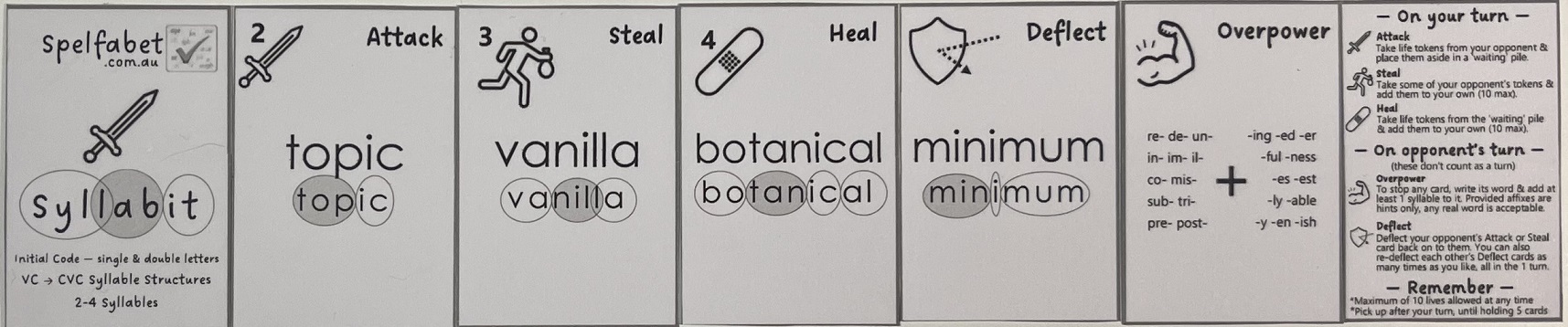
Do you know a learner who is struggling to read polysyllable words? Try our new, download-and-print card games, called Syl-lab-it.
A free game, with the easiest words, is here, and the full set is here.
Elle Holloway, Spelfabet’s expert at turning work into fun, explains the game in this 6 minute video:
2-4 syllable words are printed on the cards, and players must read them as they’re played. Smaller-print versions of each word have syllables circled and stressed syllables shaded. Sometimes, syllable circles overlap, as there’s often more than one way to break a word up (e.g. by sound or word structure. Skilled readers think about both), and coarticulation happens between syllables, not just within them.
The circles and shading make it easy to show learners that a syllable can be represented by a vowel letter alone, or a vowel letter/spelling plus one or more consonants. This is useful when teaching learners to read one syllable at a time, and adjust word stress.

There are five types of cards, three of which are used on your own turn (attack, steal, heal) and two of which are used to spoil your opponent’s turn (deflect, overpower). This game is for two players who each start with five cards and ten tokens (counters, coins, whatever). Play continues until someone loses all their tokens, and thus the game.
The free sample game targets words with simple syllables and spelling patterns, such as on the cards depicted above. The other 12 games target the following syllable structures and sound-spelling relationships:
- CVCC and CCVC syllables, e.g. ‘suspect’, ‘umbrella’ and ‘experiment’,
- Three adjacent consonants (CCC) like ‘splendid’, ‘nondescript’ and ‘unrestricted’,
- Consonant digraphs like ‘jacket’, ‘marathon’ and ‘establishment’,
- Very common suffixes like ‘risky’, ‘talented’ and ‘abandoning’,
- VCe (‘split vowel’) syllable endings like ‘suppose’, ‘hesitate’ and ‘misfortune’.
- The sound /ae/ as in ‘betray’, ‘repainted’ and ‘complicated’,
- The sound /ee/ as in ‘medium’, ‘easily’ and ‘convenient’,
- The sound /oe/ as in ‘shadow’, ‘nobody’ and ‘overloaded’,
- The sound /er/ as in ‘hurting’, ‘thirstily’ and ‘personally’,
- The sound /ou/ as in ‘without’, ‘astounding’ and ‘powerhouses’
- The sound /ie/ as in ‘direct’, ‘justify’ and ‘insightful’,
- The sound /oo/ as in ‘cartoon’, ‘screwdriver’ and ‘absolutely’.
There’s a choice of single or double-sided card version of each game, the latter in case your Syl-lab-it decks might get jumbled. Print each game on 3 sheets of A4 light card or paper (at ~110% if your printer can manage narrow margins), laminate and cut up into cards. Sorry we can’t do that for you, but we timed it and each deck takes about 10 minutes to cut up neatly with scissors, and less with a guillotine.
We hope your learners enjoy the games, and learn to read polysyllable words confidently and well.
New moveable alphabet with embedded picture mnemonics, and free sound swaps
9 Replies
The download-and-print Spelfabet moveable alphabet and affixes now has embedded picture mnemonic tiles, and is useful for showing learners how to take words apart into sounds (phonemes), spelling patterns (graphemes) and meaningful parts (morphemes), manipulate their parts, and learn how all these parts are related.
This is the alphabet I use in my presentation for today’s free Sounds-Write symposium, hope you enjoy it.
There’s now a new n/noodles mnemonic that looks like Asian noodles (not pasta!). There are versions for Aussie, UK/formal Australian and US speakers e.g. with e/echo and o/octopus for US English, and k/kangaroo for rural Aussie kids who know more about wildlife than keys.
Just over half the tiles are designed to be double-sided so they can be flipped to show spelling variations. The set comes with 55 A4 pages of sound swaps/word chains to make, the first set of which can be downloaded free here, so you can check/try them out. Inflectional morphemes plus suffix -y (boss-bossy) and agent noun -er (swim-swimmer) are introduced early in the sound swaps.
There are embedded picture mnemonics for each phoneme except the unstressed vowel and the /zh/ in beige, vision and treasure, not needed for early word-building. These help beginners remember sound-letter relationships. As a sound for each letter is learnt, its tile is flipped over to show just the letter and (an) example word(s) illustrating how it is pronounced (but kids can and do flip it back if they forget):

The mnemonics for additional sounds are great for making it clear that our language has more sounds than letters, e.g. these consonant sounds don’t have their own letters:

Extra mnemonics for vowels also make it clear that some spellings represent more than one sound, for example:

Learners need to know that letters which follow a vowel often show us how to say it e.g. ‘back‘ versus ‘bake‘. Instead of ‘split’ vowel spellings, the set now has extra red consonant-e spellings, and the extended code sound swaps include switching between ‘short’ and ‘long’ vowels by changing word-final spellings. There are still single consonant tiles with doubled consonants on the flip side e.g ‘t’ with ‘tt’ on the flip side, making it easy to show that ‘cut’ gains an extra ‘t’ letter (but not an extra sound) when a vowel suffix makes it into ‘cutter’ (not ‘cuter’, which is formed by building c+u+te and then knocking off the ‘e’ with the vowel suffix, making relevant ‘kapow’ noises).
The same traffic-light based colour coding (green = start/word beginnings, orange = caution, red = stop/word endings) for graphemes. Yellow spellings are used either side of a vowel. The set has pink prefixes and blue suffixes, and includes all the high-utility affixes in this Lane et al (2019) research. There are little chameleons on assimilated prefixes, to show that their last sound and/or letter often changes to better match what follows (e.g. in + mature = immature, con + relate = correlate). Colour coding lets you help kids narrow down their visual search for a tile, as you can say e.g. ‘use a red one’ or ‘use an orange one’.
There are now twelve pages of tiles to print, grouped from basic to advanced, so they can be assembled in stages, and you don’t get scissor-and-glue-gun RSI. If you don’t need magnetic tiles for a whiteboard, just print the first eight pages double-sided, the rest single-sided, laminate and cut them up for use on a tabletop. Easy peasy. Otherwise, assemble them with magnets (instructions are included) and display them in groups on a whiteboard like this, with duplicate tiles stacked to reduce visual clutter:

Only download and print the version most suitable for the English your learners speak, but if you want to mix and match them or use a mnemonic from an earlier set (e.g. if you prefer g/girl to g/goose or y/yoga to y/yawn), you can get the picture files and print your own extra tiles. If you want a version created for the English you speak (NZ? Canada? India? elsewhere?), let me know what it is and what you suggest adding/changing/removing.
A while ago I was working with a student with a flair for chemistry who called this product ‘the periodic table of spelling’. I hope you agree that it now demonstrates all the main elements (spellements?).
P.S I’m still updating the other embedded picture mnemonic products with the new ‘n/noodles’, and we’ll shortly be releasing new Syl-lab-it card games targeting polysyllable words, cleverly designed by our gamification (5 syllables, is that a Thing?) whiz, Elle Holloway, and often requested by kids we see. Stay tuned!
Alison Clarke
PS2 The Spelfabet Embedded Picture Mnemonic pictures are drawn by and © Cat MacInnes.
 The Spelfabet shop has affordable, downloadable spelling teaching resources.
