Vowels and consonants
0 Replies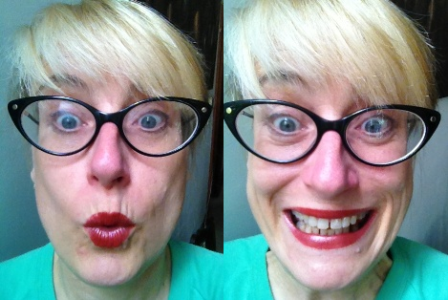
I'll be working with my first Uyghur student this year, so have been doing a bit of background research, to better understand where she's coming from, and make sure I don't commit any major cultural fox paws.
The Uyghur are a Turkic people most of whom live in Western China. They're mostly Sunni Muslims, and their language is written in a script a bit like Arabic.
Westerners tend to pronounce "Uyghur" as "Wee-gur" but thanks to the internet and having learnt the International Phonetic Alphabet at uni, I've figured out it's more correct to say something like "ooh-ee-goo-uh".
I've been practicing this, lying on the couch with my laptop (as you do), and it's made me think about the considerable overlap between the sounds and letters "u" and "w", between "ee" and "y", and overlap between vowels and consonants more generally.
"ooh" is almost "w"
Westerners muck up the pronunciation of Uyghur because the vowel sound "ooh" (as in "too") and the consonant sound "w" (as in "wet") are just about identical. In fact, in linguistics, "w" is classified as a semivowel.
Try saying "too wet" slowly and concentrate on the transition between these two sounds. Not much, eh? Now try "two eggs", officially without a "w" sound. You still get quite a bit of lip rounding and w-ish-ness going on between the words.
We're also constantly writing the letter u to represent the sound "w".
We routinely write qu and gu (not kw/cw or gw) at word and syllable beginnings, as in "quit", "queen" and "squint", "guava", "language" and "penguin".
Food coops and chicken coops
0 Replies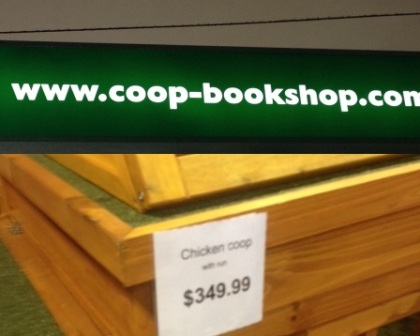
When I was of an age to watch Sesame St, the buzz word for children was "cooperation" (nowadays it seems to be "resilience").
It always puzzled me why this word had "oo" that didn't sound the usual way, as in "boot" or "book", and then later I wondered why it had no hyphen on TV the way I'd seen it sometimes on paper.
Years later when I joined a bread-making co-op (super-healthy wholegrain loaves, hard as rocks, delivered by bicycle. Such hippies) I would insist on segmenting "co-op" with a hyphen, not "coop". A coop was always a place to keep chickens, in my book.
The food co-op where I refill my shampoo and detergent bottles (yup, still a bit of a hippie) still has a hypen, but hyphens are dropping out of this and other words fast elsewhere, giving us potential segment-ups like reelect, prearrange and microorganism.
However, hyphens are still essential for segmenting many other words – you can't really write "co-own" or "anti-inflammatory" or "re-sorting" without one. I would like to add a something to segment the syllables in "skiing" and "Shiite", but I'm not sure what. And if I'm working with you, please don't call me your "coworker", I grew up on a dairy farm.
Spelling word attack
0 Replies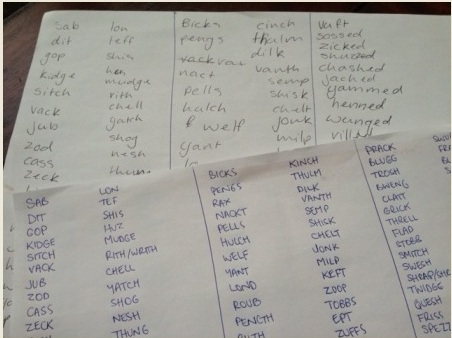
Good readers and spellers tackle spelling new words from several angles.
My teenage nieces have been visiting (yes! excuses to go ice-skating, to the drive-in and 3D movies, theatre, swimming, galleries and do lots of feasting and lounging around laughing) so I got them to agree to play guinea pigs for some of my nonsense word spelling tests.
Most available nonsense word tests don’t test all the important letter-sound links more than once, and thus it’s sometimes a little tricky to get a clear picture of precisely where learners’ skills are breaking down, and exactly which spelling patterns they need to practise. So I’ve made up my own tests, which you can try here. (in 2025 these are obsolete, here are the more recent ones)
Four main strategies
My nieces used three main strategies to tackle new words on my spelling tests:
1. Sounding out,
2. Using grammatical information, such as whether the new word was used as a noun or a verb,
3. Thinking of a word containing the new word,
4. Rhyming with/analogies to known words.
For example, when asked to write the new word “vuft”, if I said an example sentence like “I saw a vuft” (i.e. used the word as a noun) they wrote “vuft”. If I said “Here is a rax”, they wrote “rax”.
However if I said, “I got vuft by an alien” or “he vuft the exam” (i.e. used it as a verb), they tended to write “vuffed”. If I said “Here are two vax”, they wrote “vacks”.
When I asked for “chelt”, the niece from Sydney said “That’s easy, because of Cheltenham”, and the other one said “oh yeah” and they both got it right (good girls).
To double or not to double
They disagreed about whether “shiss” should have double “s”, with the older one saying “it’s like ‘kiss’ and ‘miss'” but the younger one saying “but it’s like ‘this'”.
Let’s not sing our ABCs
7 Replies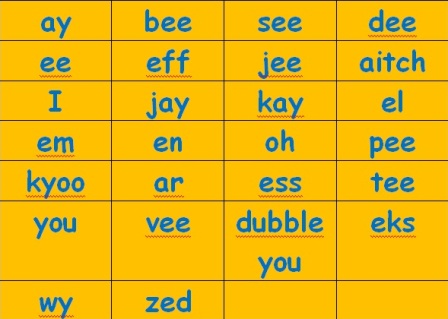
About 15 years ago I went to live in Mexico because I wanted to learn Spanish. A year on, I was still merrily mangling Spanish verbs, and my vocabulary was pretty basic, but I could get by in Spanish, both spoken and written.
A couple of years later I was living in London, and rang a hotel in Spain to make a holiday booking. The person who answered spoke no English (I’m not into fancy hotels) but we understood each other fine until she asked me to spell my name.
Blank. I couldn’t. I didn't know the names of the letters of the Spanish alphabet. In a whole year of listening, speaking, reading and writing in Spanish, I'd never needed to learn them.
Letter sounds first, letter names later
Letter names are only important when you have to spell words aloud. In face-to-face conversations, if you can show someone how to write a word, they are unnecessary. Even when you're up to your elbows in dishes or dough, you can often write in water or flour on the bench for the small, nagging person who wants help with spelling right now.
Teach one-syllable words first
1 Replies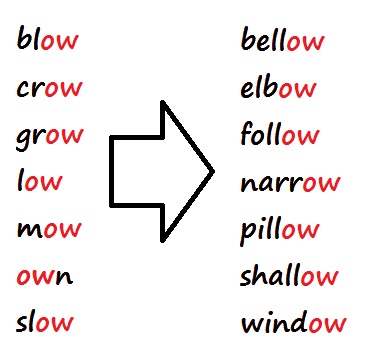
Whole-language approaches to literacy-teaching generally include two-syllable words in the first handful of words children are expected to rote-learn. For example, “away”, “funny”, “little” and “yellow” are all in the “Pre-primer” Dolch words.
Analytic phonics approaches also present beginners with many words of more than one syllable – A is for aardvark, abacus, above, acorn, actor, adult, aeroplane, almond, August, Australia…ten words starting with seven different sounds.
These are both good ways to overload beginners and confuse them about sound-letter relationships.
There’s quite enough complexity in the spelling patterns of English one-syllable words to keep beginners very busy, without adding all the extra patterns that appear in longer words, like the “y” in funny, the “le” in little, the “aer” in aeroplane, the two different “au”s in “August” and “Australia”, and the biggest spelling hurdle in longer words, the unstressed vowel.
Schwa – the unstressed vowel
In many words with more than one syllable, one or more of the spoken vowels/syllables is typically produced without stress, as the unstressed or weak vowel. In linguistics this vowel is called schwa.
Schwa is kind of like a little grunt, a very short “uh” sound. It’s the final syllable in the spoken words sofa, butter, actor, dollar, tapir, thorough, cheetah, colour, centre, murmur, nature and martyr. It’s the first syllable in above, elect, aesthetic, oesophagus and Olympics. And it’s a poor neglected middle syllable, spelt using just about any vowel spelling, in thousands and thousands of words.
Elkonin boxes
2 Replies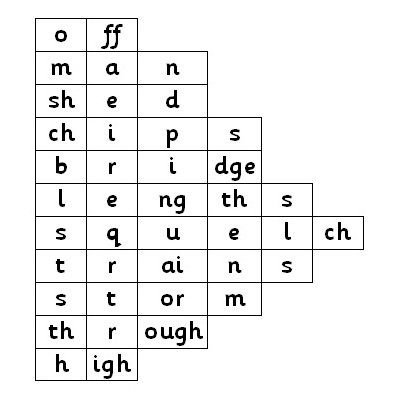
Elkonin boxes are boxes drawn to represent sounds in words, or sometimes syllables in words.
They're named after a Russian psychologist who first used them to help learners segment spoken words into sounds. However, traditionally they're used without letters, and just tokens are put into the boxes to represent sounds.
These days we know that there's no reason to hear sounds in words other than to spell them with letters, and that it's best to knit letters and sounds together right from the start, so most people write letters/spellings in their Elkonin boxes.
They're a great idea for helping learners "chunk" words into sounds and their associated spellings. And they're not too hard to prepare in an ordinary word processor with a table function, or just draw them on the board.
Consonant clusters
1 RepliesIn English, sequences of up to four consonant sounds can be run together into consonant clusters, with no vowel between them.
Consider words like scrunched, sprints, squints, strands, texts, sixths (the letter x represents two sounds, “k” and “s”), twelfths, glimpsed and angsts.
As languages go, the frequency and length of our consonant clusters is high, thanks to the good old Angles, Saxons and Jutes.
By contrast, some languages require vowels between most consonants, which is why Japanese visitors tend to say “Sydeney” and “Melabourne” and invite you to meet their “girlafarenaduh”.
 The Spelfabet shop has affordable, downloadable spelling teaching resources.