Teach your child to read in 100 easy lessons
19 Replies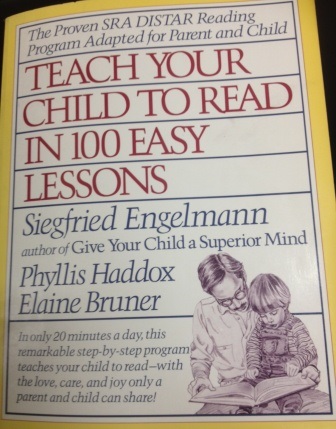
I’ve recently been trying to like the book Teach Your Child To Read In 100 Easy Lessons, co-authored by Direct Instruction guru Siegfried Engelmann.
I bought this book years ago, but I confess I’ve never used it.
It just always looked too strange and difficult, with its detailed scripts, funny-looking dots, arrows and diacritics and nothing that looks much like a beginner’s reader or a meaningful writing opportunity. Here’s what the text for learners to read looks like:
(more…)Just Right books
1 Replies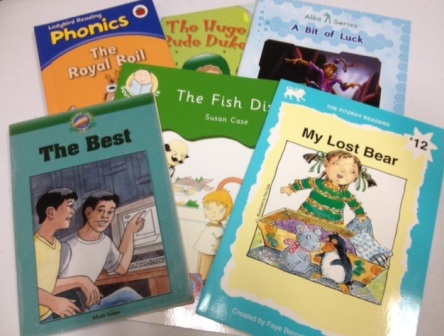
One of the literacy buzz-words in my local schools is the “Just Right book”.
Kids pillaging the library are always looking for one, preferably a funny one. A book that’s not too easy and not too hard. But this seems to mean slightly different things to different people.
Choosing a Just Right book
For the ~80% of kids who don’t struggle to learn to read, it’s fine for parents to pick something that looks like it might interest them, decide by eyeballing it whether it’s about the right level, then listen to them reading a page and count the errors to work out what’s a Just Right book.
The errors rule of thumb is:leev
- If a learner can read 19 out of 20 words (95%) in a book, it’s suitable for independent reading.
- If a learner can read 9 out of 10 words (90%), it’s suitable for him or her to read with adult help.
- If learners get less than 9 out of 10 words, but they’re still interested in a book, read it to them.
Oxford Owl free ebooks
2 Replies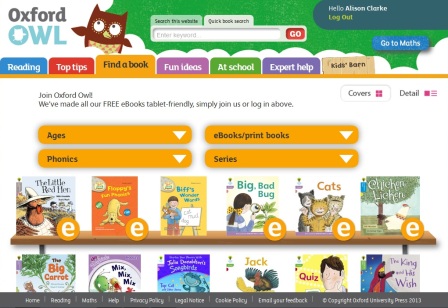
I was pretty excited to discover recently that free eBooks are available on the Oxford Owl website, including a category called "phonics". Finding enough quality, affordable decodable books for some of my learners can be a bit of a challenge, and I do love a freebie, don't you?
I set up an Oxford Owl account, logged in, and selected the "250 FREE EBOOKS, now tablet friendly". How exciting. OK, that's slightly tragic, but I was thinking of a few iPad obsessed reluctant readers I know.

I clicked on the "Book Type" dropdown menu and chose "Phonics".
Phonic books – compare prices
0 Replies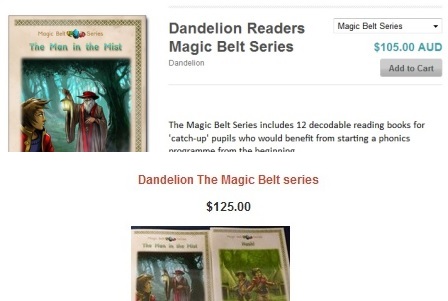
This is a blog post for Australian readers, following on from yesterday’s post in which I only mentioned one of the four Australian suppliers of the Magic Belt Books (mea maxima culpa, and thanks to reader Ruth for pointing this out).
To make up for it, here’s a price comparison between Australian suppliers for Phonic Books readers and workbooks suitable for struggling and reluctant readers aged 8-14, as of July 2013 website information. Please use these only as a guide, and check with suppliers before purchasing.
Magic Belt books
1 Replies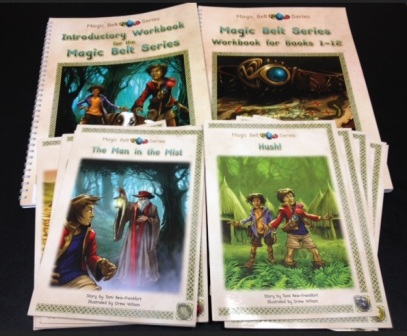
I’ve had more fun than one really should at work lately, trying out a shiny new set of Magic Belt books with various struggling and reluctant readers. These are good-looking and well-written decodable books for 8-14 year old struggling and reluctant readers.
I showed them to an eight-year-old in clinic the other day, who easily and willingly read the first one, and was reaching for the second one when I said we didn’t have time to read it that session.
Well. He was not happy, and we heard about it. Once he realised I meant what I said and I said what I meant, he started madly leafing through the books trying to work out how the story ends, and demanding that his mother quickly read him the last book.
Not bad for a struggling reader who’s not terribly interested in books.
Magic Belt illustrations
Today at school, we had a lovely time talking about magic, wizards, danger, excitement, giant crabs, rock mosters, goblins, earthquakes, dung beetles and cauldrons. That was just while looking through the front covers of the Magic Belt books- click here to see them yourself.
(more…)Words Their Way
38 Replies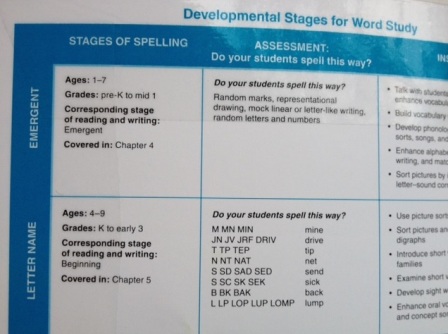
I've been pushing for an early years Synthetic Phonics program at one of the schools I work in, but sadly I'm just a far-too-busy part-time contractor and outsider, who doesn't get to go to the meetings where such things are decided, so I haven't succeeded.
Oh well, I guess it means they'll always generate plenty of work for a Speech Pathologist with literacy expertise (she said, through gritted teeth).
The literacy program they've chosen to use is called Words Their Way, which in the early years essentially puts a layer of initial and analytic phonics over what remains at its core a Whole Language program.
People I know and respect say it is better than the standard "give them a bath in written language and they will magically catch on" Whole Language fare, but its conceptual framework still sees literacy as natural and developmental and a bit mysterious, to be "facilitated" as it "emerges", not an artificial skill to be pulled apart and actively and systematically taught.
"Emergent Spellers"
Words Their Way calls anyone aged one to seven who is writing random marks on paper, drawing pictures, doing "mock linear or letter like writing" or writing random letters and numbers an "Emergent Speller".
Actually, I call someone aged one who is making any sort of recognisable marks on paper a baby genius. Most one-year-olds are more likely to suck the pencil or throw it at you.
On the other hand, anyone in our education system who can only write random letters at age seven is well behind, and probably well aware of this, and highly distressed about it.
(more…)
Download free ebooks
1 Replies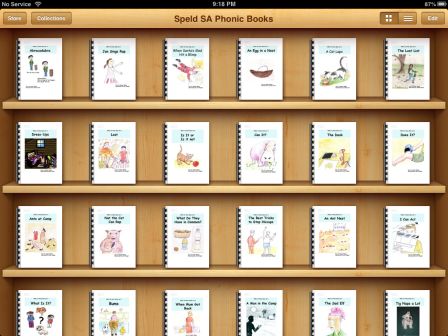
I wrote a previous blog post about the wonderful 125 SPELD-SA free decodable e-books, but someone has asked me whether these can be downloaded onto an iPad for use away from the internet.
I didn't know the answer, so tried it myself, and it was incredibly easy. I now have all 125 books at my fingertips on my iPad, for use in any therapy session anywhere, Wifi or no Wifi.
Here's how you download them.
 First, go to the Apps store and download the iBooks app, if you don't already have it.
This is the icon for it, and it's free. There must be a similar app for Android devices, but sorry to say I don't know what it is. Maybe someone who does know can put it in a comment.
Next, you go to the SPELD-SA website, and click on Services, then SPELD-SA Phonic books.
 The Spelfabet shop has affordable, downloadable spelling teaching resources.