New moveable alphabet with embedded picture mnemonics, and free sound swaps
9 Replies
The download-and-print Spelfabet moveable alphabet and affixes now has embedded picture mnemonic tiles, and is useful for showing learners how to take words apart into sounds (phonemes), spelling patterns (graphemes) and meaningful parts (morphemes), manipulate their parts, and learn how all these parts are related.
This is the alphabet I use in my presentation for today’s free Sounds-Write symposium, hope you enjoy it.
There’s now a new n/noodles mnemonic that looks like Asian noodles (not pasta!). There are versions for Aussie, UK/formal Australian and US speakers e.g. with e/echo and o/octopus for US English, and k/kangaroo for rural Aussie kids who know more about wildlife than keys.
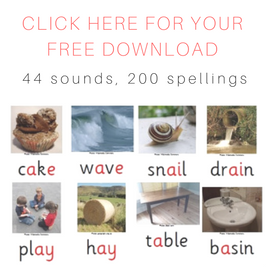
Just over half the tiles are designed to be double-sided so they can be flipped to show spelling variations. The set comes with 55 A4 pages of sound swaps/word chains to make, the first set of which can be downloaded free here, so you can check/try them out. Inflectional morphemes plus suffix -y (boss-bossy) and agent noun -er (swim-swimmer) are introduced early in the sound swaps.
There are embedded picture mnemonics for each phoneme except the unstressed vowel and the /zh/ in beige, vision and treasure, not needed for early word-building. These help beginners remember sound-letter relationships. As a sound for each letter is learnt, its tile is flipped over to show just the letter and (an) example word(s) illustrating how it is pronounced (but kids can and do flip it back if they forget):

The mnemonics for additional sounds are great for making it clear that our language has more sounds than letters, e.g. these consonant sounds don’t have their own letters:

Extra mnemonics for vowels also make it clear that some spellings represent more than one sound, for example:

Learners need to know that letters which follow a vowel often show us how to say it e.g. ‘back‘ versus ‘bake‘. Instead of ‘split’ vowel spellings, the set now has extra red consonant-e spellings, and the extended code sound swaps include switching between ‘short’ and ‘long’ vowels by changing word-final spellings. There are still single consonant tiles with doubled consonants on the flip side e.g ‘t’ with ‘tt’ on the flip side, making it easy to show that ‘cut’ gains an extra ‘t’ letter (but not an extra sound) when a vowel suffix makes it into ‘cutter’ (not ‘cuter’, which is formed by building c+u+te and then knocking off the ‘e’ with the vowel suffix, making relevant ‘kapow’ noises).
The same traffic-light based colour coding (green = start/word beginnings, orange = caution, red = stop/word endings) for graphemes. Yellow spellings are used either side of a vowel. The set has pink prefixes and blue suffixes, and includes all the high-utility affixes in this Lane et al (2019) research. There are little chameleons on assimilated prefixes, to show that their last sound and/or letter often changes to better match what follows (e.g. in + mature = immature, con + relate = correlate). Colour coding lets you help kids narrow down their visual search for a tile, as you can say e.g. ‘use a red one’ or ‘use an orange one’.
There are now twelve pages of tiles to print, grouped from basic to advanced, so they can be assembled in stages, and you don’t get scissor-and-glue-gun RSI. If you don’t need magnetic tiles for a whiteboard, just print the first eight pages double-sided, the rest single-sided, laminate and cut them up for use on a tabletop. Easy peasy. Otherwise, assemble them with magnets (instructions are included) and display them in groups on a whiteboard like this, with duplicate tiles stacked to reduce visual clutter:

Only download and print the version most suitable for the English your learners speak, but if you want to mix and match them or use a mnemonic from an earlier set (e.g. if you prefer g/girl to g/goose or y/yoga to y/yawn), you can get the picture files and print your own extra tiles. If you want a version created for the English you speak (NZ? Canada? India? elsewhere?), let me know what it is and what you suggest adding/changing/removing.
A while ago I was working with a student with a flair for chemistry who called this product ‘the periodic table of spelling’. I hope you agree that it now demonstrates all the main elements (spellements?).
P.S I’m still updating the other embedded picture mnemonic products with the new ‘n/noodles’, and we’ll shortly be releasing new Syl-lab-it card games targeting polysyllable words, cleverly designed by our gamification (5 syllables, is that a Thing?) whiz, Elle Holloway, and often requested by kids we see. Stay tuned!
Alison Clarke
PS2 The Spelfabet Embedded Picture Mnemonic pictures are drawn by and © Cat MacInnes.
New Flex-It games
4 RepliesIntroducing our new, affordable, download-and-print set of games for explicitly teaching and practising Set for Variability skills: Flex It. There are 15 games so far, but more to come soon:

Dr Marnie Ginsberg of Reading Simplified gives a great explanation of the importance of Set for Variability in reading here, including references, or you can listen to her on the Triple R Teaching podcast. So here’s a quick version, please see hers for more details (and yes, I’ve sent Marnie the games and she’s happy to share the term ‘Flex-it’).
Many letters/spellings can represent more than one sound, e.g. the:
- ‘a’ in ‘atom’ and ‘apron’,
- ‘e’ in ‘even’ and ‘ever’,
- ‘i’ in ‘item’ and ‘index’,
- ‘ow’ in ‘show’ and ‘shower’,
- ‘g’ in ‘goblin’ and ‘giant’.
Kids thus often include an incorrect but plausible sound in a word when they sound it out. They say things like ‘joblin’ for ‘goblin’ and ‘eever’ for ‘ever’. Kids with strong Set for Variability skills can often then correct themselves, and get the word right. Other learners need to be explicitly taught how to do this.
Our “Flex It” games contain words with a shared spelling that represents two sounds (or three in the case of the o/solve, o/stove, o/some game). Most words on the cards contain two syllables. For example, here are some of the cards for the a/atom, a/apron game:

Here’s how to play Flex-It, this time with the o/often, o/open cards:
You can get the games now from the Spelfabet shop. Download and print each game on three A4 sheets of light cardboard, laminate, cut cards up or ask some helpful older students who’ve finished their work to show off their scissor skills. Repurpose vegetable-bunch elastic bands to hold each deck together for extra good karma.
Show learners the words on the cards and remind them that they’ve learnt that (whatever) letter/spelling can represent both (whatever) sound and (whatever other) sound. Model trying both sounds in a few less-common words in the deck e.g. ‘fragrant’ and ‘flagon’, putting any unfamiliar words in sentences, and maybe showing them a picture (hooray for instant internet pictures of flagons etc.)
Shuffle your deck and deal 5 cards to each player, put the rest face down in the middle, turn over the top card and take turns to play cards with the same colour or symbol, or a ‘change’ card, until someone wins by running out of cards. Learners must read the word on each card as they play it. If a learner mispronounces the target sound in a word, ask them to try the other sound. Just tell them the sound if it’s slipped their mind. Provide lots of specific praise when learners correct their mispronunciations.
Thanks to Elle Holloway for the idea, and setting up the template, so I could just nerd on the words.
Myself and other Spelfabet staff will have a table at the SOTLA event with Emily Hanford in Melbourne this Saturday (squee, when we’re not lining up for a selfie with Emily), if anyone there wants to try out these games.
Hope they help lots of kids to tackle reading words flexibly and successfully.
Alison Clarke
“Can I halp you?” The Salary-Celery merger
0 Replies
If you’re in south-eastern Australia or New Zealand, you’ve probably noticed kids pronouncing words with /e/ (as in ‘egg’) more like /a/ (as in ‘at’) before the sound /l/.
They say things like ‘Can I halp you?’, ‘I falt a bit sick’ and ‘I can do it mysalf’. They pronounce ‘salary’ and ‘celery’ as homophones, hence the name linguists have given this vowel shift: the Salary-Celery merger.
The ‘a’ before /l/ in ‘asphalt’ was being pronounced /e/ when I was scraping my knees on it at school, but ‘a’ pronounced /e/ mainly occurs before /n/, as in ‘any’, ‘many’, ‘secondary’ and ‘dromedary’.
Several other vowels have also morphed a bit before /l/, consider:
- all, ball, call, fall, gall, hall, mall, also, almost, always etc (but not ‘shall’, ‘ally’, ‘alley’, ‘ballad’, ‘gallop’, ‘pallet’, ‘tally’ or ‘alas’).
- walk, talk, chalk, stalk, and baulk (US balk) and caulk (US calk).
- half/halve, calf/calve, behalf (but not ‘salve’ or ‘valve’).
- salt, halt, malt, gestalt, alter, exalt, Walter (but not ‘shalt’).
- fault, vault, cauldron, assault, cauliflower, hydraulic, somersault (but not ‘haul’ or ‘maul’).
The sound /l/ has a vowel-like quality and tends to ‘colour’ the preceding vowel. This is useful for teachers to know, so they can give any confused kids plenty of practice spelling affected words (there’s lots of opportunities to practice writing ‘short vowels’ in a range of phonetic contexts, including before /l/, in Spelfabet Workbook 1)
When kids insist that they hear an /a/ (as in ‘cat’) in ‘halp’, I ask them to say the word in their ‘spelling voice’ (as it’s written), with /e/ (as in ‘red’). Good spellers often say that they pronounce odd spellings a bit weirdly when writing them (Wed-nes-day, bus-i-ness), as a kind of mnemonic. Spelling pronunciations sometimes crop up in comedy too, for example the kniggits in Monty Python and the Holy Grail.

US reading/spelling guru Professor Linnea Ehri was recently here in Melbourne courtesy of Learning Difficulties Australia (the selfie at right proves we met her), and talked about this strategy, which she calls the “Spelling Pronunciation Strategy”. She says that in Connectionist theory, to put a word’s spelling into long-term memory, the letters must be connected to ‘phoneme mates’ in the pronunciations of the word.
To use the Spelling Pronunciation Strategy (AKA “Spelling Voice” in the program Sounds-Write) you separate and say each syllable with stress, and pronounce all the letters. Prof Ehri’s examples were “ex cell ent ”, “lis ten”, “choc o late”, and “Feb ru ary”. She cited two studies (Drake & Ehri, 1984 and Ocal & Ehri, 2017) showing that assigning spelling pronunciations enhanced memory for spellings, in 4th graders and college students.
So in summary, it’s not just harmless to say words in a slightly funny way to halp, sorry, help yourself remember their spellings. It’s officially evidence-based.
Phonics With Feeling Set 10 now available
1 Replies
I’ve just put six brand new Set 10 Phonics With Feeling printable decodable readers into the Spelfabet website shop. Like all these books, they cost 40c per print to make 5 copies, or 20c per print to make 30 copies. You provide the paper/card, printer and assembly time, which of course adds to the real cost, but if you’re short of funds, these are a very affordable way to boost your library of decodable text.
(more…)What sounds did you SAY (not just hear) in that word?
0 Replies
If you haven’t listened to the US Reading League’s podcast with Dr Jeannine Herron, or watched it on YouTube, I highly recommend it. She’s an inspiration, the perfect tonic if you’re feeling a bit wearied by swimming-through-COVID-mud, as I am.
At 84, she has a wonderful laugh, rogue chickens, and is planning to write a new program, not resting on her life’s laurels as a teacher, activist, research scientist, adventurer, writer, editor, and a program and software developer.
(more…)New printable decodable books, including an extra free one
2 Replies
To celebrate the removal of predictable texts and multicueing from the Australian National Curriculum (yippee!), more Phonics with Feeling printable decodable books are now available from the Spelfabet website.
These provide an affordable way to help Year 1 and 2 students, advanced Foundation students, and slightly older strugglers to build decoding skills. They are longer than most decodable books, allowing for cohesive narratives, entertaining plots, engaging characters, and themes worth talking about.
(more…)New 2 ways to spell vowels cards, including a free deck
0 Replies
Some students need smaller-than-average steps and extra practice to get spelling patterns into long-term memory. Games are a great, nag-free way to get in lots of targeted, extra repetitions.
The newest set of download-and-print Spelfabet phonics playing cards has 14 decks, each with one vowel sound spelt two ways, and includes a free sample deck:
(more…)
 The Spelfabet shop has affordable, downloadable spelling teaching resources.