Phonic books – compare prices
0 Replies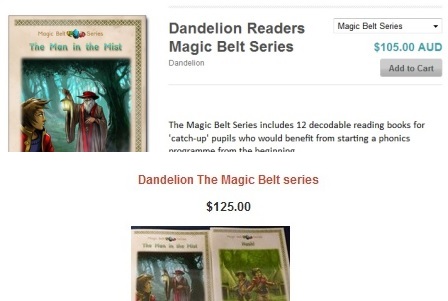
This is a blog post for Australian readers, following on from yesterday’s post in which I only mentioned one of the four Australian suppliers of the Magic Belt Books (mea maxima culpa, and thanks to reader Ruth for pointing this out).
To make up for it, here’s a price comparison between Australian suppliers for Phonic Books readers and workbooks suitable for struggling and reluctant readers aged 8-14, as of July 2013 website information. Please use these only as a guide, and check with suppliers before purchasing.
Magic Belt books
1 Replies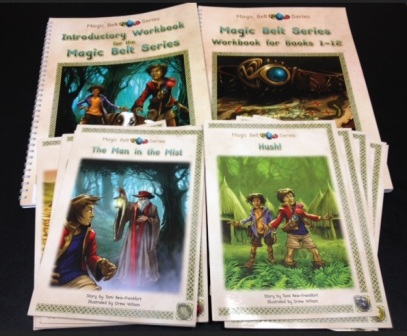
I’ve had more fun than one really should at work lately, trying out a shiny new set of Magic Belt books with various struggling and reluctant readers. These are good-looking and well-written decodable books for 8-14 year old struggling and reluctant readers.
I showed them to an eight-year-old in clinic the other day, who easily and willingly read the first one, and was reaching for the second one when I said we didn’t have time to read it that session.
Well. He was not happy, and we heard about it. Once he realised I meant what I said and I said what I meant, he started madly leafing through the books trying to work out how the story ends, and demanding that his mother quickly read him the last book.
Not bad for a struggling reader who’s not terribly interested in books.
Magic Belt illustrations
Today at school, we had a lovely time talking about magic, wizards, danger, excitement, giant crabs, rock mosters, goblins, earthquakes, dung beetles and cauldrons. That was just while looking through the front covers of the Magic Belt books- click here to see them yourself.
(more…)Dyslexia cure
12 RepliesThere’s been a recent flurry of activity on the Australian Developmental Disorders of Language and Literacy (DDOLL) email network about the above article in a local newspaper, entitled “New word order for dyslectics” (sic).
This article promotes a new local business offering the “David Dyslexia Correction program”, which it says gets people with reading difficulties to visualise words and build associations with each one, and aims to cure dyslexia.
The DDOLL Network includes lots of Professors and people with PhDs in language and literacy, I am about the most ornery person on it, so usually keep quiet. Today they were first wondering whether this “dyslexia cure” is actually the Davis “Gift of Dyslexia” program, made up by a person called Ron Davis. Davis claims to have overcome dyslexia as well as autism, and his program reportedly involves, among other things, modelling letters and other symbols in clay, hopping on a balance beam and throwing a Nerf ball.
Free synthetic phonics worksheets
2 Replies
I recently made a few synthetic phonics worksheets from each of my workbooks available for free, so people can try them out with their learner(s) before deciding whether to buy the relevant workbook.
These worksheets are all under "Free stuff" in this site's shop.
The worksheets should always be done with supervision, not unsupervised, to ensure that the learner says every sound as she/he writes it, and that mistakes are immediately corrected, and not memorised.
In the Level 1-3 worksheets, the support person's job is to say the words slowly (if you're not sure of one, look on the next page), and run their finger across the word on the page as they produce each sound.
Spelling collection video
0 Replies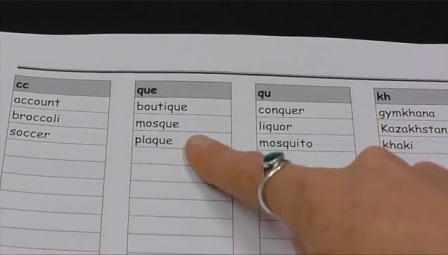
I've just made a three-minute video about my download-and-print Spelling Collection, and put it on my YouTube channel.
It's designed to give learners a framework for organising words by spelling pattern, and thus helps make learning English spelling finite and do-able.
Dyslexia support and intervention
3 Replies
UK reading expert Professor Maggie Snowling has an excellent 5-minute talk on YouTube about how to help children with dyslexia – not always a term used in Australia, but this talk is relevant to any child who is at risk or struggling to learn reading and spelling for no obvious reason.
Here's a quick summary of the video, but feel free to skip it and just watch the video below:
- In the preschool years children with oral language difficulties should receive early intervention from a Speech and Language Therapist (in Australia called Speech Pathologists – click here to find one, or if you're outside Australia, see this page).
- In preschool it's also wise to teach children about letters and the sounds they represent, just one or two letters at a time, to tune them into the notion that letters and sounds are related.
- Once they start school, parents should be aware of how their child is going relative to other children, and because systematic Synthetic Phonics is now mandatory in the early years of primary school in the UK, teachers should also be very aware of who's not catching on to sounds and letters. In Australia most early years classrooms aren't yet using systematic Synthetic Phonics, but most early years teachers can still tell you who in their classes is struggling by about the middle of the first year of school.
- Schools should have an action plan for quickly helping children who are not catching on to sounds and letter, firstly working in small groups, using one of the many catch-up programs now available.
- If children are then still struggling, the school should provide them with individualised help.
- Prof. Snowling says parents should not be doing all the remedial work themselves, as they have a vital parenting role, supporting their child emotionally, building their strengths and praising them for their abilities. Parents should be supporting literacy intervention but not taking on the role of teacher.
- She highlights the importance of not mixing up reading for pleasure (reading to children) and reading for instruction (children reading themselves), so that children who are struggling still have access to quality literature, narrative structure, vocabulary, discussion of stories etc and to fuel their creativity, while still building their decoding skills to the point where they can read these stories independently one day.
Oz Phonics 3
0 Replies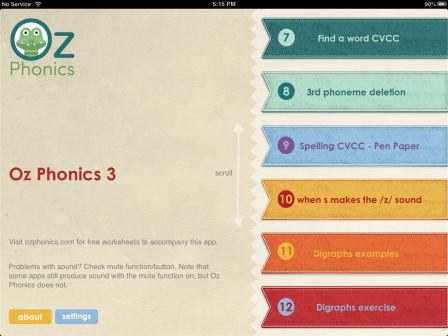
There's a new Oz Phonics app out, and the nice chap who made it sent me a code so I could download it and check it out (thanks, Steve!), and save breaking the bank on the $2.99 purchase price.
In the course of emailing Steve my feedback on Oz Phonics 3, I discovered something embarrassing.
I've only been using half the previous two apps, Oz Phonics 1 and 2.
I didn't notice they had a little scroll thing next to the menu.
 The Spelfabet shop has affordable, downloadable spelling teaching resources.