
New polysyllable word games
7 Replies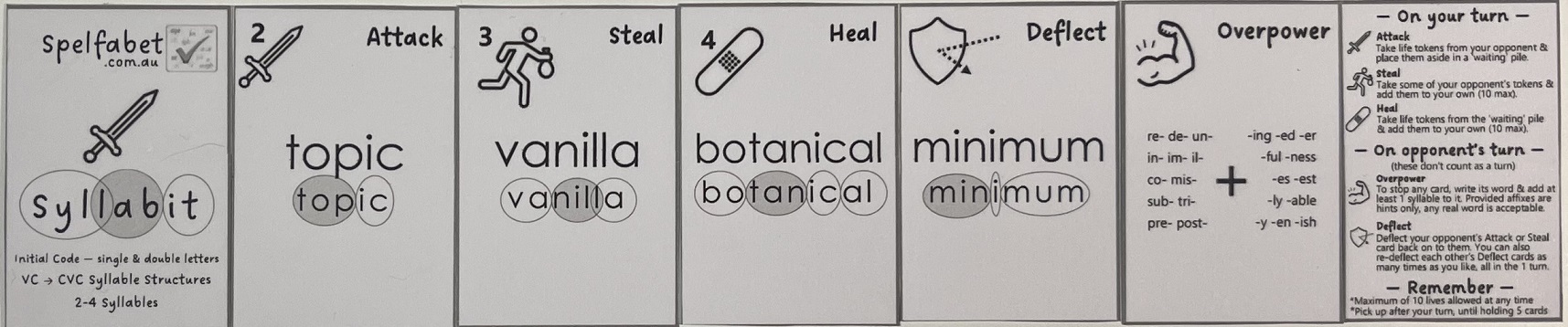
Do you know a learner who is struggling to read polysyllable words? Try our new, download-and-print card games, called Syl-lab-it.
A free game, with the easiest words, is here, and the full set is here.
Elle Holloway, Spelfabet’s expert at turning work into fun, explains the game in this 6 minute video:
2-4 syllable words are printed on the cards, and players must read them as they’re played. Smaller-print versions of each word have syllables circled and stressed syllables shaded. Sometimes, syllable circles overlap, as there’s often more than one way to break a word up (e.g. by sound or word structure. Skilled readers think about both), and coarticulation happens between syllables, not just within them.
The circles and shading make it easy to show learners that a syllable can be represented by a vowel letter alone, or a vowel letter/spelling plus one or more consonants. This is useful when teaching learners to read one syllable at a time, and adjust word stress.

There are five types of cards, three of which are used on your own turn (attack, steal, heal) and two of which are used to spoil your opponent’s turn (deflect, overpower). This game is for two players who each start with five cards and ten tokens (counters, coins, whatever). Play continues until someone loses all their tokens, and thus the game.
The free sample game targets words with simple syllables and spelling patterns, such as on the cards depicted above. The other 12 games target the following syllable structures and sound-spelling relationships:
- CVCC and CCVC syllables, e.g. ‘suspect’, ‘umbrella’ and ‘experiment’,
- Three adjacent consonants (CCC) like ‘splendid’, ‘nondescript’ and ‘unrestricted’,
- Consonant digraphs like ‘jacket’, ‘marathon’ and ‘establishment’,
- Very common suffixes like ‘risky’, ‘talented’ and ‘abandoning’,
- VCe (‘split vowel’) syllable endings like ‘suppose’, ‘hesitate’ and ‘misfortune’.
- The sound /ae/ as in ‘betray’, ‘repainted’ and ‘complicated’,
- The sound /ee/ as in ‘medium’, ‘easily’ and ‘convenient’,
- The sound /oe/ as in ‘shadow’, ‘nobody’ and ‘overloaded’,
- The sound /er/ as in ‘hurting’, ‘thirstily’ and ‘personally’,
- The sound /ou/ as in ‘without’, ‘astounding’ and ‘powerhouses’
- The sound /ie/ as in ‘direct’, ‘justify’ and ‘insightful’,
- The sound /oo/ as in ‘cartoon’, ‘screwdriver’ and ‘absolutely’.
There’s a choice of single or double-sided card version of each game, the latter in case your Syl-lab-it decks might get jumbled. Print each game on 3 sheets of A4 light card or paper (at ~110% if your printer can manage narrow margins), laminate and cut up into cards. Sorry we can’t do that for you, but we timed it and each deck takes about 10 minutes to cut up neatly with scissors, and less with a guillotine.
We hope your learners enjoy the games, and learn to read polysyllable words confidently and well.
Free Flex-It game, holiday assessments and spelling boosters
0 Replies
It’s the last week before our school holidays, a good time to play educational games, so I’ve just put a free sample Flex-It game in the Spelfabet shop.
Download and print it on 3 sheets of light card, laminate it if you like, and cut it up. Use it to explicitly teach learners to approach the letter ‘a’ flexibly in words of more than one syllable, trying the sound in ‘apron’ if the sound in ‘apple’ doesn’t yield a real word. The ability to think flexibly and try other plausible sounds is essential for successfully sounding out long words.
Hope you and your learners like it!
(The next part of this blog post is only relevant to people in Victoria, Australia)
Holiday assessments
The Spelfabet Speech Pathologists in North Fitzroy have some availability to do speech and language assessments in the school holidays, if you need a report to accompany a funding application, or are just concerned that a child might have listening/speaking difficulties. We can also screen a child’s hearing using the Sound Scouts app, and assess phonological processing and word-level reading/spelling skills.
We know there can be a long wait for school-based Speech Pathology services, and that many applications for extra support at school are due soon. Assessment cost depends on session length, but reflects the NDIS rate for therapists. Private health insurance rebates may apply, or GPs may provide Medicare Care Plans. Click here to make a referral.
Spelling boosters
It’s hard to enjoy writing when you’re struggling with spelling. Also in the school holidays, we’re offering a small number of three-hour individualised spelling booster sessions, to clear up misconceptions about spelling evident from writing samples and/or standardised tests, build spelling skills and confidence, play some games and have some fun. The cost is $650 including a report. Again, rebates may apply if you have health insurance or a Medicare Care Plan. Click here to make a referral.
That’s it! I’m learning to write short blog posts! Happy holidays!
Alison Clarke, Speech Pathologist
Holiday groups, new games, 30% off sale
0 RepliesA quick blog post about three things: therapy groups for Melbourne F-2 children in January 2025, 15 more Flex-It card games to teach Set for Variability/pronunciation correction in polysyllable words, and a bumper end of year Spelfabet online shop sale (use the code “Happy Holidays!” at the checkout for 30% off).
January therapy groups
We still have a few places in our 20-24th January therapy groups for young struggling readers/spellers (2024 Foundation to Year 2 children). If you know a young child in Melbourne whose school report says they’re not keeping up with peers on literacy, and who might like to join an intensive group, please let them know. More details are here.
We now have a bunch of kids who have been coming back most holidays, as young children are often too tired to do therapy outside school hours during term. Groups can be more fun than individual sessions, and allow children to make friends with peers who are also finding reading/spelling a bit tricky.

More Flex-It card games
A second tranche of 15 Flex-It card download-and-print games are now in the website shop, you can find them here. These games give children controlled practice trying a different target sound for a target spelling (Set for Variability/pronunciation correction), if their first attempt at sounding out a word isn’t successful, e.g. if they rhyme ‘very’ with ‘furry’ instead of ‘berry’.
Each printable game costs an Aussie dollar (or 70c for the rest of 2024) plus GST. Each prints in colour on three sheets of A4 cardboard. Print and laminate what you need, cut them up (or helpful older kids might like to flex their scissor skills) and you’re ready to play. The original 15 Flex-It games have also been improved slightly, so if you already have the first set, log back into the shop to download the new files (go to My Account, reset your password if it’s forgotten).
30% off everything in the Spelfabet shop
To congratulate everyone for getting through the year, we’re having a bumper 30% off everything sale in the Spelfabet online shop until the end of 2024.
Choose the things you want from the shop – embedded picture mnemonics, decodable books, games, quizzes, workbooks, whatever – then type “Happy Holidays!” into the coupon box at the checkout for the discount. If you dislike laminating and cutting up, we probably can’t post the printed Short Vowels game in the video below to you before Christmas, but postage on a class set costs the same as a single game, and would arrive anywhere in Australia before the 2025 school year (sorry we don’t mail them overseas).
May your festive season be full of rest, fun and love, from everyone at Spelfabet.
New Flex-It games
4 RepliesIntroducing our new, affordable, download-and-print set of games for explicitly teaching and practising Set for Variability skills: Flex It. There are 15 games so far, but more to come soon:

Dr Marnie Ginsberg of Reading Simplified gives a great explanation of the importance of Set for Variability in reading here, including references, or you can listen to her on the Triple R Teaching podcast. So here’s a quick version, please see hers for more details (and yes, I’ve sent Marnie the games and she’s happy to share the term ‘Flex-it’).
Many letters/spellings can represent more than one sound, e.g. the:
- ‘a’ in ‘atom’ and ‘apron’,
- ‘e’ in ‘even’ and ‘ever’,
- ‘i’ in ‘item’ and ‘index’,
- ‘ow’ in ‘show’ and ‘shower’,
- ‘g’ in ‘goblin’ and ‘giant’.
Kids thus often include an incorrect but plausible sound in a word when they sound it out. They say things like ‘joblin’ for ‘goblin’ and ‘eever’ for ‘ever’. Kids with strong Set for Variability skills can often then correct themselves, and get the word right. Other learners need to be explicitly taught how to do this.
Our “Flex It” games contain words with a shared spelling that represents two sounds (or three in the case of the o/solve, o/stove, o/some game). Most words on the cards contain two syllables. For example, here are some of the cards for the a/atom, a/apron game:

Here’s how to play Flex-It, this time with the o/often, o/open cards:
You can get the games now from the Spelfabet shop. Download and print each game on three A4 sheets of light cardboard, laminate, cut cards up or ask some helpful older students who’ve finished their work to show off their scissor skills. Repurpose vegetable-bunch elastic bands to hold each deck together for extra good karma.
Show learners the words on the cards and remind them that they’ve learnt that (whatever) letter/spelling can represent both (whatever) sound and (whatever other) sound. Model trying both sounds in a few less-common words in the deck e.g. ‘fragrant’ and ‘flagon’, putting any unfamiliar words in sentences, and maybe showing them a picture (hooray for instant internet pictures of flagons etc.)
Shuffle your deck and deal 5 cards to each player, put the rest face down in the middle, turn over the top card and take turns to play cards with the same colour or symbol, or a ‘change’ card, until someone wins by running out of cards. Learners must read the word on each card as they play it. If a learner mispronounces the target sound in a word, ask them to try the other sound. Just tell them the sound if it’s slipped their mind. Provide lots of specific praise when learners correct their mispronunciations.
Thanks to Elle Holloway for the idea, and setting up the template, so I could just nerd on the words.
Myself and other Spelfabet staff will have a table at the SOTLA event with Emily Hanford in Melbourne this Saturday (squee, when we’re not lining up for a selfie with Emily), if anyone there wants to try out these games.
Hope they help lots of kids to tackle reading words flexibly and successfully.
Alison Clarke
New 2 ways to spell vowels cards, including a free deck
0 Replies
Some students need smaller-than-average steps and extra practice to get spelling patterns into long-term memory. Games are a great, nag-free way to get in lots of targeted, extra repetitions.
The newest set of download-and-print Spelfabet phonics playing cards has 14 decks, each with one vowel sound spelt two ways, and includes a free sample deck:
(more…)Affordable basic phonics kit
6 Replies
Thanks to the pandemic, many children seem to have done year or more of disrupted schooling without having learnt to read or spell much. A new batch of Australian five-year-olds start school soon, where many will (happily) be taught the systematic, explicit phonics that’s helpful for all, harmful for none and crucial for some*, but many won’t.
The download-and-print Spelfabet Level 1 kit aims to equip you to help beginners and strugglers of any age learn to read and spell one-syllable words with up to seven sounds. The kit follows this teaching sequence (the same as the Sounds-Write program):

The kit contents are a workbook, quizzes, moveable alphabet, word-building sequences, playing cards, reading journal and phonics picture book. The only difference between the parent/aide kit and the teacher/clinician kit is how many copies of the workbook you may print (5 or 30 copies).
All the items in this kit are available separately from the Spelfabet website, except the simplified Moveable Alphabet, which contains only the spellings needed for Level 1. However, it’s cheaper to get the kit than each item separately ($55 including GST for the parent/aide version and $65 for the teacher/clinician one).
Decodable books for reading practice which follow the same teaching sequence include the Units 1-10 Sounds Write books including free e-books, the Units 1-10 Dandelion and Moon Dogs books from Phonic Books, and the printable Drop In Series Levels 1 and 2.
If this kit is too basic for your learner(s), more difficult kits will be available soon.
* See article by Catherine Snow and Connie Juel (2005) at https://psycnet.apa.org/record/2005-06969-026
1000 decodable quiz questions
7 RepliesAt last, our 100 download-and-print phonics quizzes for beginning readers are available here. Each has ten questions, and fits on an A4 page. Most questions have pictures. You can download a free sample of ten of them here. Here’s a 2 minute video about them.
Kids aren’t usually keen on tests, but enjoy quizzes, just as adults enjoy trivia nights. Reading and understanding a sentence at a time can be less daunting than reading, remembering and understanding a book, even a short one.
These quizzes follow the same teaching sequence as Sounds-Write Units 1-10, and the early Phonic Books and Forward With Phonics resources, since our client base is mostly struggling older learners. If you’re using a slightly different phonics teaching sequence, just check that you’ve taught all the sound-spelling relationships in each quiz before using it, perhaps as a review activity.
Writing decodable text is hard work. The literate adult brain constantly wants to focus on meaning not structure. It takes lots of discipline to think of good questions that don’t contain words that are too hard, especially at the early levels. The whole Spelfabet team has been involved in writing these quizzes, and have been extremely tolerant of my initially vague ideas and constant revisions. It’s taken much longer than expected.
We haven’t included an answer key because we hope the quizzes motivate children to ask questions and propose alternative answers/interpretations, argue for a ‘maybe/it depends’ option and otherwise think and talk. You can act as judge, assign a judging panel, or go with the majority view. Right and wrong answers are not as important as prompting children to read accurately and successfully.
We hope beginning and struggling readers enjoy and request these quizzes, and that they help build children’s reading ‘muscle’.
 The Spelfabet shop has affordable, downloadable spelling teaching resources.
