PETAA’s Authentic Texts to Support Teaching Phonics
9 Replies
The Primary English Teaching Association of Australia has produced a new, downloadable list of Authentic Texts To Support Teaching Phonics, which:
“…maps examples of rich authentic texts to the Federal Government’s Literacy Hub phonics progression, which presents a structured sequence of letter–sound correspondences and phonics skills for development across Foundation to Year 2. This free download provides early years teachers around Australia with a quality text list for teacher read alouds that support the phonics instruction that they’ve done that day/week.”
The guide is a downloadable spreadsheet listing phonics targets and books to support them. Here’s a screenshot of how it starts:

I’m so happy that PETAA recognises ‘Systematic, direct and explicit teaching of phonemic awareness and phonics is more likely to result in successful literacy outcomes’, so I was keen to see what kind of books they recommend to support this teaching. I popped into my local kids’ bookshop and bought three of the first six titles on their list.
PETAA recommends these books to support teaching of the the earliest sound-letter relationships in the Literacy Hub phonics teaching sequence, which I write as s/snake, a/apple, t/tiger, p/penguin, i/insect and n/noodles (AKA satpin, I use the reference words from our Embedded Picture Mnemonics, which help little kids remember sound-letter links). These are the first sound-letter relationships taught to five-year-olds in VC and CVC words (V=vowel, C=consonant) in this teaching sequence, and several others. Children are also taught four high-frequency words in this Phase: ‘is’, ‘a’, ‘I’ and ‘the’.
I did some word counts so I could figure out how many words a child taught these phonics and high-frequency word targets should be able to read in each of the three books I bought.
Hedgehog or Echidna?
- 573 total words
- 11 Decodable VC words (2 X ‘at’, 3 X ‘it’, and 6 X ‘in’)
- 0 decodable CVC words
- 57 pre-taught high-frequency words: 57 (14 X ‘is’, 19 X ‘a’, 12 X ‘I’, 12 X ‘the’).
Turbo Turtle
- 973 total words
- 31 decodable VC words (9 X ‘at’, 1 X ‘an’, 10 X ‘it’, 11 X ‘in’)
- 0 decodable CVC words
- 71 pre-taught high-frequency words (5 X ‘is’, 17 X ‘a’, 2 X “I”, 47 ‘the’).
Give me some Space!
- 1007 total words
- 47 decodable VC words (5 X ‘at’, 8 X ‘an’, 11 X ‘it’, 23 X ‘in’)
- 0 decodable CVC words
- 88 pre-taught high-frequency words (18 X ‘is’, 17 X ‘a’, 8 X “I”, 45 X ‘the’).
The only readable words in these books for the target beginners are prepositions, pronouns, articles and auxiliary verbs, i.e. unstressed function words that glue sentences together, but don’t mean much on their own. Interrupting a rollicking story to allow children to read such words just seems tedious and confusing.
A young child focussing on a storybook’s print (which young kids are disinclined to do) and thinking about phonics, rather than looking at the pictures and listening to the story, will be able to see lots of letters ‘s’, ‘a’, ‘t’, ‘p’, ‘i’ and ‘n’ in any book. But can they connect these letters to sounds in spoken words at story pace? When nobody is pointing to each word as it’s read? Srsly?
Stopping a good story to talk about phonics seems more likely to annoy children than help them, but anyway, let’s keep thinking about this. The PETAA list of Authentic texts to support teaching phonics includes example words which illustrate letter-sound relationships. Here’s a screenshot of the list for teaching about s/snake, a/apple, t/tiger, p/penguin, i/insect and n/noodles (in that order):

As you can see, the list includes s/scent, a/astronomical, a/gravity, a/intergalactic, t/turbo-charged, t/nectar, i/cylindrical, i/familiar, p/palomino, p/pinto, and n/nectar again. Interrupting a good story to talk about a letter-sound relationship in a probably-unfamiliar and/or polysyllabic word? Hmm. Not likely to win anyone Most Favoured Teacher Status.

You might have also noticed ‘a/astronauting’ on the list, which the Macquarie Dictionary says is not a real word. The list also suggests that a/after is pronounced like a/apple in Australian English (it’s not), that there’s a t/tiger sound in ‘clutched’* (there isn’t), and that we say/hear an i/insect sound in the second, unstressed syllables of ‘rabbit’ and ‘hermit’ (nope, it’s a schwa).
Teachers should read great storybooks aloud to little kids to boost their oral language skills and share knowledge and enjoyment.
They should give little kids decodable text so they can practise the skills taught in phonics lessons.
There’s no need to mix up these two very different types of books.

* If you’ve studied phonology, you’ll know that the sound /ch/ starts off as /t/ and is released as /sh/, so technically it does contain a /t/ sound, but that’s slicing it too finely for children. For them, ‘tch’ is just the main way we spell /ch/ after a ‘short’ or ‘checked’ vowel, as in batch, fetch, itch, scotch, hutch. You can see what the Macquarie Dictionary says about the pronunciation of ‘clutch’ at right.
New moveable alphabet with embedded picture mnemonics, and free sound swaps
9 Replies
The download-and-print Spelfabet moveable alphabet and affixes now has embedded picture mnemonic tiles, and is useful for showing learners how to take words apart into sounds (phonemes), spelling patterns (graphemes) and meaningful parts (morphemes), manipulate their parts, and learn how all these parts are related.
This is the alphabet I use in my presentation for today’s free Sounds-Write symposium, hope you enjoy it.
There’s now a new n/noodles mnemonic that looks like Asian noodles (not pasta!). There are versions for Aussie, UK/formal Australian and US speakers e.g. with e/echo and o/octopus for US English, and k/kangaroo for rural Aussie kids who know more about wildlife than keys.
Just over half the tiles are designed to be double-sided so they can be flipped to show spelling variations. The set comes with 55 A4 pages of sound swaps/word chains to make, the first set of which can be downloaded free here, so you can check/try them out. Inflectional morphemes plus suffix -y (boss-bossy) and agent noun -er (swim-swimmer) are introduced early in the sound swaps.
There are embedded picture mnemonics for each phoneme except the unstressed vowel and the /zh/ in beige, vision and treasure, not needed for early word-building. These help beginners remember sound-letter relationships. As a sound for each letter is learnt, its tile is flipped over to show just the letter and (an) example word(s) illustrating how it is pronounced (but kids can and do flip it back if they forget):

The mnemonics for additional sounds are great for making it clear that our language has more sounds than letters, e.g. these consonant sounds don’t have their own letters:

Extra mnemonics for vowels also make it clear that some spellings represent more than one sound, for example:

Learners need to know that letters which follow a vowel often show us how to say it e.g. ‘back‘ versus ‘bake‘. Instead of ‘split’ vowel spellings, the set now has extra red consonant-e spellings, and the extended code sound swaps include switching between ‘short’ and ‘long’ vowels by changing word-final spellings. There are still single consonant tiles with doubled consonants on the flip side e.g ‘t’ with ‘tt’ on the flip side, making it easy to show that ‘cut’ gains an extra ‘t’ letter (but not an extra sound) when a vowel suffix makes it into ‘cutter’ (not ‘cuter’, which is formed by building c+u+te and then knocking off the ‘e’ with the vowel suffix, making relevant ‘kapow’ noises).
The same traffic-light based colour coding (green = start/word beginnings, orange = caution, red = stop/word endings) for graphemes. Yellow spellings are used either side of a vowel. The set has pink prefixes and blue suffixes, and includes all the high-utility affixes in this Lane et al (2019) research. There are little chameleons on assimilated prefixes, to show that their last sound and/or letter often changes to better match what follows (e.g. in + mature = immature, con + relate = correlate). Colour coding lets you help kids narrow down their visual search for a tile, as you can say e.g. ‘use a red one’ or ‘use an orange one’.
There are now twelve pages of tiles to print, grouped from basic to advanced, so they can be assembled in stages, and you don’t get scissor-and-glue-gun RSI. If you don’t need magnetic tiles for a whiteboard, just print the first eight pages double-sided, the rest single-sided, laminate and cut them up for use on a tabletop. Easy peasy. Otherwise, assemble them with magnets (instructions are included) and display them in groups on a whiteboard like this, with duplicate tiles stacked to reduce visual clutter:

Only download and print the version most suitable for the English your learners speak, but if you want to mix and match them or use a mnemonic from an earlier set (e.g. if you prefer g/girl to g/goose or y/yoga to y/yawn), you can get the picture files and print your own extra tiles. If you want a version created for the English you speak (NZ? Canada? India? elsewhere?), let me know what it is and what you suggest adding/changing/removing.
A while ago I was working with a student with a flair for chemistry who called this product ‘the periodic table of spelling’. I hope you agree that it now demonstrates all the main elements (spellements?).
P.S I’m still updating the other embedded picture mnemonic products with the new ‘n/noodles’, and we’ll shortly be releasing new Syl-lab-it card games targeting polysyllable words, cleverly designed by our gamification (5 syllables, is that a Thing?) whiz, Elle Holloway, and often requested by kids we see. Stay tuned!
Alison Clarke
PS2 The Spelfabet Embedded Picture Mnemonic pictures are drawn by and © Cat MacInnes.
Holiday groups, new games, 30% off sale
0 RepliesA quick blog post about three things: therapy groups for Melbourne F-2 children in January 2025, 15 more Flex-It card games to teach Set for Variability/pronunciation correction in polysyllable words, and a bumper end of year Spelfabet online shop sale (use the code “Happy Holidays!” at the checkout for 30% off).
January therapy groups
We still have a few places in our 20-24th January therapy groups for young struggling readers/spellers (2024 Foundation to Year 2 children). If you know a young child in Melbourne whose school report says they’re not keeping up with peers on literacy, and who might like to join an intensive group, please let them know. More details are here.
We now have a bunch of kids who have been coming back most holidays, as young children are often too tired to do therapy outside school hours during term. Groups can be more fun than individual sessions, and allow children to make friends with peers who are also finding reading/spelling a bit tricky.

More Flex-It card games
A second tranche of 15 Flex-It card download-and-print games are now in the website shop, you can find them here. These games give children controlled practice trying a different target sound for a target spelling (Set for Variability/pronunciation correction), if their first attempt at sounding out a word isn’t successful, e.g. if they rhyme ‘very’ with ‘furry’ instead of ‘berry’.
Each printable game costs an Aussie dollar (or 70c for the rest of 2024) plus GST. Each prints in colour on three sheets of A4 cardboard. Print and laminate what you need, cut them up (or helpful older kids might like to flex their scissor skills) and you’re ready to play. The original 15 Flex-It games have also been improved slightly, so if you already have the first set, log back into the shop to download the new files (go to My Account, reset your password if it’s forgotten).
30% off everything in the Spelfabet shop
To congratulate everyone for getting through the year, we’re having a bumper 30% off everything sale in the Spelfabet online shop until the end of 2024.
Choose the things you want from the shop – embedded picture mnemonics, decodable books, games, quizzes, workbooks, whatever – then type “Happy Holidays!” into the coupon box at the checkout for the discount. If you dislike laminating and cutting up, we probably can’t post the printed Short Vowels game in the video below to you before Christmas, but postage on a class set costs the same as a single game, and would arrive anywhere in Australia before the 2025 school year (sorry we don’t mail them overseas).
May your festive season be full of rest, fun and love, from everyone at Spelfabet.
Choosing a phonics sequence & decodable books
13 Replies
Phonics teaching sequences give an outline of which sound-spelling relationships are to be taught, and in what order. Most of them also include work on word-building with prefixes and suffixes. Schools in my state (Victoria, Australia) without a phonics teaching sequence must choose one this year, thanks to the Making Best Practice Common Practice announcement (applause).
A good phonics sequence works from simple to complex, separating similar sounds/spellings (like b/d), and targeting high-impact patterns first. Ideally, there are matching, high-quality teaching materials, and excellent training and support, readily available at a reasonable price.
Decodable texts allow children to practise what they’ve been taught in phonics lessons, without being tripped up by a whole lot of harder spellings. What we practise, we learn. The type of reading material given to young children can have at least as big an impact on their reading habits as what they’re taught in class (see this article, or this book), so decodable texts must be chosen carefully and wisely. This blog post aims to help with this decision-making.
Things supplier websites won’t tell you
Supplier websites provide lots of great information about decodables, but don’t say that some books offer limited opportunities to practise some targets, or include words that are quite hard for their intended readership. The ERA Books Phonics Decodables 1.0 and 1.1 Set 4 books ($8.95 each, so $35.80 for all 4) list ‘k’, ‘h’, ‘f’, ‘l’ and ‘j’ as letter-sound targets. The words suitable for absolute beginners in these four books are: ‘Kim’, ‘Kip’, ‘kid’, ‘him’, ‘had’, ‘hen’, ‘hug’, ‘hat’, ‘fit’, ‘fun’, ‘fed’, ‘lid’, ‘log’, ‘Jim’, ‘jam’, ‘jug’, and ‘jet’ (17 unique words, 44 total words). Some other words also contain the targets, but in difficult-for-beginners CVCC, CVCC, CCVCC or CVCCC* words: ‘help’, ‘frog’, ‘fits’, ‘lift’, ‘just’, ‘sink’, ‘help’, ‘milk’, ‘flips’, ‘lifts’, ‘jumps’ and ‘like’.
The Sunshine Decodables Series 1 Set 3 book “Mud fun” lists the following targets on its back cover: ‘c’, ‘k’, ‘ck’, ‘j’, ‘qu’, ‘v’, ‘w’, ‘y’, ‘z’, ‘zz’, ‘ff’, ‘ll’, and ‘ss’. The only words containing these spellings I can find in the book are: ‘van’, ‘will’, ‘job’, ‘off’, ‘wets’, ‘wax’, and ‘kids’. No ‘c’, ‘ck’, ‘qu’, ‘y’, ‘z’, ‘zz’, or ‘ss’ words. The only ‘y’ words I can find in all ten Set 3 books are: ‘yes’ (two instances), and ‘yum’ (one instance). I wonder why they couldn’t work ‘yam’, ‘yap’, ‘yell’, ‘yet’ and ‘yuck’ in too. Writing good decodable books is hard work, and everyone who attempts it deserves some credit, but (call me old-fashioned) the phonics targets listed on the back of a book should actually be in that book, and in more than one or two words.
Free decodable book evaluation form
I’ve made a free decodable book evaluation form which I use in the 45 minute video below to evaluate a few of the many books which follow the Letters and Sounds phonics teaching sequence. This sequence was published by the UK government in 2007. I hope the form and video are useful to anyone feeling baffled by the confusopoly of decodable books now available, and needing a system to help them find lovely books that help their learners thrive. Sorry it’s quite a long video. If you’re time-poor and fairly familiar with the topic, crank up the speed using the little cog at bottom right, then just switch it back to normal speed for the most interesting bits. Making people sound like chipmunks also adds a bit of fun to the day.
Here are some examples of early years phonics teaching sequences, with links to matching decodable books and training providers. There’s no such thing as a perfect sequence, so please explore a variety of them, and related teaching materials and training, before choosing. Inclusion in this table does not constitute endorsement.
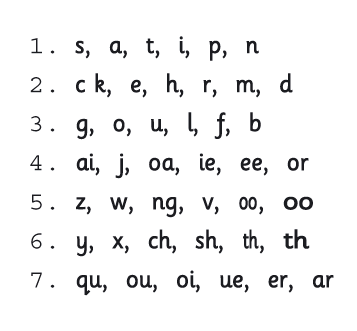
If you have a mixture of decodable books from various publishers/sequences, the NSW SPELD decodable book selectors can help you organise them into your preferred sequence. There’s also a free video training called Implementing a Systematic Synthetic Phonics approach on the government-funded Literacy Hub website, which has its own phonics sequence, but no decodable texts. Jocelyn Seamer runs early years phonics training and has program-agnostic resources. Free recordings of 2018 Victorian Dept of Ed webinars on synthetic phonics and related topics are also still available. The Five from Five website is also an amazing resource.
I hope all this is helpful to people choosing a phonics teaching sequence. I’m running small, hands-on workshops where you can have a Proper Look at a range of decodable books at the Spelfabet office in North Fitzroy this term, and try out my evaluation form on some (here’s the link to it again). Sorry it’s taken a while to get the workshops off the ground (life keeps thwacking me). Tickets to the sessions are not yet all in the website shop because of software glitches, but they will be by the end of the week.
Alison Clarke
PS The Spelfabet shop doesn’t sell decodable books suitable for absolute beginners, but has beginners’ quizzes, and Phonics with Feeling download-and-print decodables for kids in their second and third years of school (or later Foundation students). Also embedded picture mnemonics to help tinies learn basic sound-letter relationships, that two letters can represent a sound (sh/shell, oo/food), and that some sounds have shared spellings e.g. u/up (or u/undies, if you prefer) and u/unicorn.
* C = consonant, V = vowel. VC words include ‘in’, ‘at’ and ‘up. CVC words include ‘hot’, ‘sun’ and ‘fed’. CVCC words include ‘milk’, ‘help’ and ‘just’. CCVC words include ‘stop’, ‘from’, and ‘bent’. CCVCC words include ‘flips’, ‘trend’ and ‘stamp’. CVCCC words include ‘jumps’, ‘lifts’ and ‘grabs’. Please start beginners off with just VC and CVC words.
** Sounds-Write now has Australian and US branches.
What do kids’ names teach them about spelling?
0 Replies
The first word a child often learns to read and write is their own name. What first impression of our writing system does this give little Charlie, Chloe and Charlotte?
Our current crop of 5-year-olds was born in 2018, so I googled most popular baby names 2018 and looked for names that wouldn’t surprise a child with complete faith in ‘sounds of letters’, alphabet song type phonics.
I found only one name: Max. Even that would surprise kids whose poster/song says letter ‘X’ represents /eks/ as in ‘x-ray’. Add Quinn if you know a doubled consonant is usually pronounced the same as a single one, and your poster/song doesn’t say letter ‘Q’ by itself represents /kw/.
However, most kids’ names have more than one syllable, and contain at least one unstressed vowel. Let’s assume kids aren’t phased by vowel reduction or doubled consonants. Now we can sound out Emma, Ella, Camilla, Madison, Elena, Addison, Bella, Stella, Anna, Allison, Benjamin, Cameron, Adam, Landon, Colton, Ezra, Hudson, Dominic, Jameson, Evan, Declan, and Weston. A total of 24 names out of 200.
Hmm. Let’s add names containing ‘long’ vowel sounds represented by one letter (‘a’ in apron, ‘e’ in even, ‘i’ in icy, ‘o’ in open, ‘u’ in unit). IMHO the best thing about letter names is that the vowel names are also relevant sounds (but kids who extrapolate this to consonant letters tend to write ‘spl’ for ‘spell’, ‘pn’ for ‘pen’ and ‘cr’ for ‘car’). A child able to manipulate vowel sounds in words can now sound out Ava, Zoe, Maya, Penelope, Lila, Nova, Hazel, Violet, Eva, Mason, Logan, Jacob, Leo, Caleb, Owen, David, Samuel, Eli, Nolan, Roman, Rowan, and Jason.
This brings us up to 46 of 200 names, or 50 if we count names with ‘long’ vowel sounds written with ‘split’/VCe/silent final e spellings: James, Zane, Miles, Grace, (though she has a funny /s/ spelling), and Luke (though his vowel sound is really /oo/, not /ue/ as in ‘tune’).
Three-quarters of this sample of kids’ names still contain unexplained spellings. I don’t understand why being able to spell one’s own name is considered such an important milestone for tinies. Spelling names can be very hard, though Vaughan, Traigh, Clodagh, Siobhan, Niamh and Leigh weren’t hot in 2018.
Kids can make more sense of unexpected spellings in their names (and other words) if they know:
- There are more speech sounds than letters, so we write many with letter combinations.
- Some spellings represent more than one sound.
Our Embedded Picture Mnemonic desk mats are one simple tool which can help teach these concepts. They have the alphabet on one side, and the other speech sounds on the flip side, for example:

They also show shared spellings, as at the start of Asher and Ava, Evelyn and Ethan, Isabella and Isaac, Olivia and Owen, the ‘u’ in Hunter and Samuel and the ‘oo’ in Brooklyn and Cooper:

Confusion over harder sound-spelling relationships in names can be assuaged by teaching kids that most sounds are spelt a few ways, for example:
- The sound /ee/ is written ‘i’ in Sophia, Olivia, Aria, Amelia, Mia, Mila (depending on pronunciation), Aaliyah, Eliana, Arianna, Victoria, Emilia, Liliana, Lillian, Gabriella, Maria, Gianna, Naomi, Juliana, Vivian, Julia, Ezekiel, Damian, Xavier, Adrian, Gabriel, Sebastian, and Liam.
- /ee/ is written ‘ey’ at the end of Riley, Aubrey, Kinsley, Hailey, Paisley, and Audrey.
- /i/ is written ‘y’ in Dylan, and is unstressed in Adalyn, Evelyn, Madelyn, Brooklyn, and Jocelyn.
- /ie/ is written ‘y’ in Ryan, Wyatt, Skyler, Bryson, and Kylie.
- /k/ is written ‘ch’ in Chloe, Michael, Nicholas, Christian (from Greek).
- /f/ is written ph in Sophie, Sophia, Joseph and Christopher (also from Greek).
- /z/ is written ‘X’ in Xavier, Xander and Xena, though sadly the Warrior Princess’s name wasn’t trending in 2018 (again, Greek!).
During a recent conversation about where words come from, a tween with an unusually-spelt name told me she’d always wondered about the spelling of her name.
Please don’t leave the kids in your life wondering.
Embedded Picture Mnemonic picture files
0 Replies
Since devising the Spelfabet Embedded Picture Mnemonics, illustrator Cat Macinnes and I have received many requests for products containing them: bookmarks, placemats, friezes, flip charts, cards and posters of different sizes, slideshows, you name it. They’ll even make an appearance on The US Reading League’s Reading Buddies TV show at some stage. The Science of Reading community is a creative one.
Sadly, we don’t have capacity to print, store and mail out lots of hard copy resources containing our mnemonics. If you know of an interested publisher, we’d love to hear from them! Even designing and producing all the downloadable resources people have suggested would be a full-time job for quite a while. We aren’t designers, and already have full-time jobs.
We’re therefore making high-resolution versions of the picture files (.png files, for both PC and Apple) available for people to download and use in creating resources for their own students/caseloads/children. This should make it easy to organise them into any phonics teaching sequence, and print customised materials for any group of beginning readers. Click here to download a zipped folder of the whole set.

Over time, we’ve created alternate versions of some mnemonics, thanks to feedback from purchasers, and in an effort to cater to a surprisingly large audience. Our original ‘e/egg’, ‘o/orange’ and ‘u/undies’ mnemonics were OK for Australian English, but ‘e/echo’, ‘o/octopus and ‘u/up’ were needed for speakers of US English. Recently we’ve discovered that some people aren’t keen on ‘y/yoga’, so we’ve added this nice y/yawn mnemonic to the set.
The zipped folder of picture files includes all the mnemonics we’ve produced to date (except the ‘th/path’ and ‘th/weather’ ones, which weren’t a hit), so when there’s a choice, please use the one that suits you best. In parts of rural Australia where doors aren’t often locked, k/kangaroo is probably a better choice than ‘k/key’. On a surf-mad coast ‘ur/surf’ might make more sense than ‘ur/burn’. In the US, ‘air/hair’ and ‘ear/gears’ aren’t needed, but ‘aw/claw’ is, and ‘wh/whale’ might be (in places where ‘witch’ and ‘which’ aren’t homophones).
When you introduce ‘long’ vowels, you might like to make little strips for student desks like this…

…or a strip like this might suit your students/teaching sequence better:

Hooray, everyone will be able to tailor the set to their accent/sequence/needs, including people who speak Englishes other than Australian, British and American. Cat already put time and talent into drawing all the mnemonics, so you might as well use whichever suit you best (yes, we prefer ‘u/undies’, and people keep asking us to bring it back, ha ha).
Artists should be paid properly for their work, so please respect Cat’s copyright and abide by the terms of use included in the pack. Pricing is based on the assumption that each teacher/therapist/parent who buys the files will use them as they see fit with their class/caseload/family members, and not share them with other professionals or use them for commercial purposes. It’s OK for parents to share printouts with little cousins or the kid next door, but if a school with five Early Years teachers wants to use them in a range of resources across five Early Years classrooms, the school should buy five copies.
The picture files are in .png format, which is the best format for storing high-resolution artwork. They are in a zipped folder which looks like this in the Downloads area of the Spelfabet shop:

Download it to your computer, and you’ll be able to unzip it and access the files, and save them somewhere easy to find and use. Don’t panic if you double-click on a file and it opens in your default picture program and looks a bit weird. The pictures should look as you expect when you drop them into documents. Please reduce picture file size first if they’re too big for your purposes, so the resources you make from them don’t take up lots of space on your computer or take ages to print out. Like adding salt when cooking, it’s easy to make files smaller and lower-resolution, but not reverse the process.
As reading researchers might have predicted, lots of people have told us they’ve been surprised how quickly children have learnt sound-letter relationships using the Spelfabet Embedded Picture Mnemonics. We hope that’s true of any young beginners you try them with, and that you find them quick and easy to turn into great, affordable resources that suit your accent, location and teaching sequence.
“Can I halp you?” The Salary-Celery merger
0 Replies
If you’re in south-eastern Australia or New Zealand, you’ve probably noticed kids pronouncing words with /e/ (as in ‘egg’) more like /a/ (as in ‘at’) before the sound /l/.
They say things like ‘Can I halp you?’, ‘I falt a bit sick’ and ‘I can do it mysalf’. They pronounce ‘salary’ and ‘celery’ as homophones, hence the name linguists have given this vowel shift: the Salary-Celery merger.
The ‘a’ before /l/ in ‘asphalt’ was being pronounced /e/ when I was scraping my knees on it at school, but ‘a’ pronounced /e/ mainly occurs before /n/, as in ‘any’, ‘many’, ‘secondary’ and ‘dromedary’.
Several other vowels have also morphed a bit before /l/, consider:
- all, ball, call, fall, gall, hall, mall, also, almost, always etc (but not ‘shall’, ‘ally’, ‘alley’, ‘ballad’, ‘gallop’, ‘pallet’, ‘tally’ or ‘alas’).
- walk, talk, chalk, stalk, and baulk (US balk) and caulk (US calk).
- half/halve, calf/calve, behalf (but not ‘salve’ or ‘valve’).
- salt, halt, malt, gestalt, alter, exalt, Walter (but not ‘shalt’).
- fault, vault, cauldron, assault, cauliflower, hydraulic, somersault (but not ‘haul’ or ‘maul’).
The sound /l/ has a vowel-like quality and tends to ‘colour’ the preceding vowel. This is useful for teachers to know, so they can give any confused kids plenty of practice spelling affected words (there’s lots of opportunities to practice writing ‘short vowels’ in a range of phonetic contexts, including before /l/, in Spelfabet Workbook 1)
When kids insist that they hear an /a/ (as in ‘cat’) in ‘halp’, I ask them to say the word in their ‘spelling voice’ (as it’s written), with /e/ (as in ‘red’). Good spellers often say that they pronounce odd spellings a bit weirdly when writing them (Wed-nes-day, bus-i-ness), as a kind of mnemonic. Spelling pronunciations sometimes crop up in comedy too, for example the kniggits in Monty Python and the Holy Grail.

US reading/spelling guru Professor Linnea Ehri was recently here in Melbourne courtesy of Learning Difficulties Australia (the selfie at right proves we met her), and talked about this strategy, which she calls the “Spelling Pronunciation Strategy”. She says that in Connectionist theory, to put a word’s spelling into long-term memory, the letters must be connected to ‘phoneme mates’ in the pronunciations of the word.
To use the Spelling Pronunciation Strategy (AKA “Spelling Voice” in the program Sounds-Write) you separate and say each syllable with stress, and pronounce all the letters. Prof Ehri’s examples were “ex cell ent ”, “lis ten”, “choc o late”, and “Feb ru ary”. She cited two studies (Drake & Ehri, 1984 and Ocal & Ehri, 2017) showing that assigning spelling pronunciations enhanced memory for spellings, in 4th graders and college students.
So in summary, it’s not just harmless to say words in a slightly funny way to halp, sorry, help yourself remember their spellings. It’s officially evidence-based.
 The Spelfabet shop has affordable, downloadable spelling teaching resources.