
Helping children hear sound differences
3 Replies
Children starting school often have immature articulation, and still can't get their little mouths around sounds like "z", "r", "v" and "th". Many children still can't produce the difference between "fin" and "thin" or "vat" and "that" at age eight or even later.
However, children typically have to deal with the letters/spellings representing these sounds in their first year of school. The classic example is the word "the", one of the first written words children are expected to read, though few 5-year-olds can actually say "th".
Teachers and parents often refer children to Speech Pathologists because, "He says 'I fink' and writes it with an F" or "She says 'a wabbit' and writes W". If children are not aware of the existence of the separate sounds "th" and "r", they're just being logical, but that's not going to help them spell these words right.
Children often "collapse" two similar sounds into a single category, such as "s" and "th", and hear word pairs like "sink-think", "sick-thick" and "sore-thaw" as homophones (the latter if you speak Australian/UK English, but not American English).
You can help make children aware of the difference between sounds they mix up, and thus make more sense of how they are spelt, by showing them words which contrast these sounds, while keeping the rest of the word the same, and getting them to listen carefully for the difference between the words.
Minimal pair pictures
These are called "minimal pairs", for example "choose" and "shoes" sound the same except one has "ch" at the start, and one has "sh".
There are whole sets of minimal pair pictures on the internet, but it can be hard to find the key contrasts that typically confuse kids who are just talking like typical four to seven-year-olds.
Australian Speech Pathologist Caroline Bowen has an amazing website where she very generously makes minimal pair pictures freely available, though she asks for a donation towards site upkeep and bandwidth if possible. Now that I understand the time and money it takes to keep a website going, I urge you to donate if you can (I've done so now, but should have long ago).
Here are the links to Caroline's pages of minimal pair pictures for some of the late-developing consonant sounds that often worry parents and teachers.
I cannot emphasise too much that if you're not sure whether a child has an articulation delay (not just a speech error typical of her or his age), please consult a Speech Pathologist, especially if the child is sometimes hard to understand. Children who can't say sounds like "k", "g" or "f" at school entry need speech therapy.
While many young children may not be able to say some of these sounds, just being aware they're different when starting to read and spell them can help make more sense of their spellings. And being aware of them is the first step on the path to being able to say them.
- "sh" versus "s" as in sheet/seat – word beginnings and ends
- "sh" versus "ch" as in ship/chip – word beginnings and ends.
- "s" versus "th" as in sink/think – word beginnings.
- "f" versus "th" as in fin/thin – word beginnings and ends.
- "w" versus "r" as in wok/rock – word beginnings (Australian English doesn't put "r" at word endings)
- "w" versus "l" as in wait-late – word beginnings (we also don't say "w" at word endings).
Note that by their fifth birthday most children should have nailed "sh" and "ch", please refer them to a Speech Pathologist if not. I've included these sounds because some children start school at age four, and some preschoolers demand to be taught to read and spell before they start school.

Note also that the pictures use Aussie English vocabulary, e.g. a thong is an item of clothing you wear on your foot. Any pictures that you don't think are relevant (wherever you are) can be left out of whatever listen-for-the-difference game you decide to play with them. The three pictures in this blog post are all from Caroline Bowen's minimal pair pictures.
I hope this helps you explain to small people why the words "think" and "sink" are written differently even though they sound the same. The answer is: they don't. And that's often news to small people.
C that sounds like “s”
10 Replies
The letter C can represent the sound "k" as in "cut" or the sound "s" as in "cent".
Teaching learners how this works and why it's a good thing when we start adding suffixes to words can be tricky, especially if they don't really understand "if-then" sentences yet.
Here's a 6 minute video I made about one way to do it.
Note that the spelling CC is sometimes followed by a letter E but the sound is still "k", e.g. soccer, sicced (as in "I sicced the dog onto the burglar and she ran off"). CC is like other doubled letters, its main purpose is to tell you to say a "short" vowel before it, as in raccoon, Mecca, piccolo, broccoli and buccaneer. Typically, but not always, we write CK instead of CC.
The spelling C+C might also represent a "k" sound at the end of one syllable followed by a "s" at the start of the next syllable, as in "accede", "accent", "accept", "access" and "coccyx".
Also, either a single or double C might represent a "ch" sound in some Italian-origin words e.g. cello, Botticelli, bocce (click here for more).
What is poor phonemic awareness?
1 Replies
Many, perhaps most, struggling readers and spellers have problems discerning the identity, order and/or number of sounds in spoken words.
Assessment reports often call this poor phonemic awareness, or sometimes poor phonological awareness.
"Phonemic" is talking about individual sounds. "Phonological" is a more general term including syllables and rhyme.

Sound identity
The mouth is a small, mushy, fast-moving place, and a lot of the sounds it makes are very similar.
The sounds "k" and "t" are easily confused because they're both made by stopping airflow with the tongue on the roof of the mouth, then letting it go with a little airburst.
Free synthetic phonics teacher training on YouTube
2 Replies
Teachers doing “Balanced Literacy” programs often think they are doing a lot of phonics, and we should all get off their case. One academic commented recently that this is probably because nobody has ever given them an opportunity to see or use a proper synthetic phonics program.
Getting an opportunity to show busy early years teachers a program like this is tricky, and the information is much better coming from a fellow teacher than a speech pathologist like me. The Get Reading Right free webinars for teachers have thus been great, but they’ve run at a specific time, and you’ve had to sign in, which has probably limited their audience.
However, I’ve just realised that GRR (top marks for acronyms!) has put a recent webinar containing an overview of synthetic phonics, with examples from their program, on YouTube. Anyone can watch it any time, without any logging in.
Yes, they are marketing their program, but talking entirely in the abstract is tricky and removes the practical element. There are a few things in their program that I’d probably do slightly differently (working on sounds without letters? I must take that up with them), but compared with Balanced Literacy their program is fantastic. I’m sure I’d have a lot fewer referrals if the struggling readers on my caseload had started off doing a program like this. Anyway, I hope all teachers of Balanced Literacy will at least take a look. Here’s the video (skip through the first 90 seconds of webinar administrivia):
Learning new abstract symbols is hard
0 Replies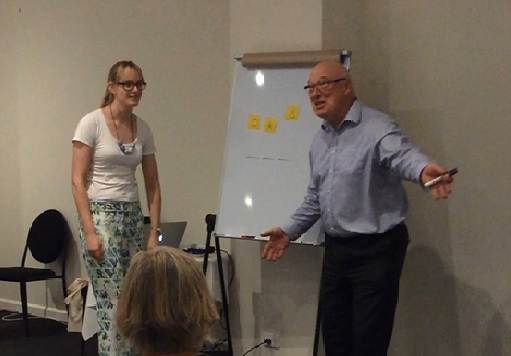
John Walker from Sounds~Write has a neat, quick presentation which really clarifies how tricky it is to learn new abstract symbols, such as letters which represent sounds.
As literate adults, we recognise letters rapidly and automatically. We learnt them as young children, so we can’t remember a time when they were just meaningless squiggles on a page.
However, when we are asked to learn new symbols ourselves, we quickly realise it’s difficult and takes time and practice. If we’re given too much to learn at once, or have to learn a new activity at the same time as the new content, we’re more likely to struggle and fail.
When John gave his nifty presentation at the recent Sounds~Write training in Melbourne, I filmed it on my trusty iPad, so it’s not cinematic quality, but gives you the idea. It’s six-and-a-half minutes long, and if at first it appears blurry, go to the little wheel icon at the bottom right of the video window and increase the number, e.g. to 360p or 480p:

You may need to check a few emails or make yourself a cup of tea while the higher-resolution version loads.
The new symbols John is teaching (on the yellow post-it notes) are a circle, a square, a triangle, and later he adds an asterisk. John has kindly given me permission to share the video with you. Here it is.
Closing the teacher education phonics black hole
3 Replies
Last week I played local host to the first Melbourne Sounds~Write four-day training, attended by 31 fabulous teachers and speech pathologists from Victoria, NSW and ACT.
 I travelled to Perth for this course last year, and really liked it because of the strong emphasis on empowering teachers to teach really well, and the noticeable lack of sales pitches for glossy, expensive materials. I’m convinced that if a course like this were included in teacher undergraduate courses, and offered to current early years and specialist literacy teachers, many or perhaps most of children’s current literacy difficulties could be prevented, or speedily remediated, in a time and cost-efficient way.
The course builds teachers’ understanding of our sound and spelling system, and provides the skills and all the materials to teach it, with classes, small groups or individuals. Unlike many phonics programs, it works right through from little words to long multi-syllable ones containing complex and unusual spellings, and organises them all in a consistent and logical way.
 Education graduates often tell me that they learnt next-to-nothing useful about sounds and spellings at university. In schools I see many, many teachers who are simply fabulous at nearly everything they do, except phonics. There is (as one course participant put it) a black hole in teachers’ phonics knowledge and skills, and it needs to be closed. (more…)
Teaching vowel spellings
0 Replies
I’ve made a short video of myself teaching a student how to spell some words containing the sound “ay” as in “name”, “rain” and “play”, using my Workbook 4.
Teaching strategies and ideas are highlighted in onscreen text, here it is on Youtube.
I hope this is useful to people using, or thinking of getting, the Spelfabet Workbook 4 or 5, and/or that it includes some ideas and strategies that are useful to parents, aides and others who are teaching vowel spellings using other materials. (more…)
 The Spelfabet shop has affordable, downloadable spelling teaching resources.
