
Printable wordbuilding card games
0 Replies
Please note that as of July 2019, the games in this post have been superseded by the ones you can find in this blog post.
It’s been pouring for most of today here in Melbourne, so I’ve been feeling sorry for everyone stuck indoors during the summer holidays. On the plus side, this has motivated me to finally stop obsessively polishing my four new word-building card games, and make them available here.
These games are designed to help learners practice their blending and phoneme manipulation skills, and to learn how to use and combine a variety of graphemes (spelling patterns) representing individual phonemes (speech sounds) in English.
You can find fairly detailed descriptions of each game in each one’s entry in my website shop, so I’ll just put little videos about each one plus a summary in this blog post.
“Short” vowel wordbuilding game
Here learners build words using single-letter vowel spellings, and consonant spellings including “ck”, “ng”, “ff”, “ll”, “ss”, “zz”, “x”, “tch” and “dge”, “sh”, “ch” and “th”. This game also provides lots of opportunities to learn which consonant combinations (blends) are typical of English, such as “fl” and “str” but not “vm” at word beginnings, and “nch” and “mp” but not “jn” at word endings. (more…)
Speak like the Queen when spelling long words
1 Replies
Recently I told a tweenage student to “speak like the Queen” when spelling long words, and her mother said “I don’t think you’ve ever heard the Queen speak, have you?” (headshake). “We must listen to the Queen’s Christmas Message this year”.
The Queen’s Christmas Message was A Thing Australians listened to, before we had 27,000 TV channels and our own national anthem, and before Queen Elizabeth the Second, by the Grace of God Queen of this Realm and of Her other Realms and Territories, Head of the Commonwealth, Defender of the Faith became so elderly she stopped going on telly much.
Fortunately, not only is Her Majesty now on Twitter, but her Christmas messages are on Youtube, in case any kids you know want to listen to them, with a view to imitating her wonderfully rounded vowels and crisp and precise consonants while spelling. Here’s last year’s, skip to 0:45 on the video clock for where she starts talking:
I’m sure if we all enunciated words like “sculpture”, “reconciliation”, “sacrifice”, “captured”, “referendum” and “Ebola” like Her Majesty, we’d always spell them right. (more…)
Teaching beginning reading
3 Replies
Here’s another video demonstration, this time of strategies to help a child successfully read a short, simple book.
The book contains only little words this child can sound out, plus a few common words of which he already has mental images, like “I” and “you” and “see”.
There are many simple, decodable books like the one in this video available, if you know where to look. Click here for a list. Many are also quickly (and often very affordably) available for iPad/tablet or other computers, as apps or electronic books.
Profuse thanks once again to this delightful student and his parents for allowing me to record and share this video.
Of course, as soon as I watched this video I started thinking of all the things I should/could have done better in this session.
Oh well, nobody’s perfect, and I hope it’s still useful.
Phonics crosswords
2 Replies
I have a student working on vowel spellings who’s keen to do crosswords, so I went looking for ones with words organised by spelling pattern.
I found lots of crosswords in the book “Activities for Successful Spelling – the essential guide” by Philomena Ott.
I’ve had this book for a long time, but I found incorrect information in the introduction e.g. it says “oo” as in “cook” and “oo” as in “pool” are diphthongs, and that some people are auditory learners, others kinaesthetic learners etc, so I was put off, and after having spent a lot of money on this book, haven’t really used it.
Here’s a crossword from this book:
 This crossword provides practice with “ay” as in “bray, betray, jay, hay” etc. So it ticks my “does this activity make a point about spelling?” box. (more…)
Phoneme pronunciation
0 Replies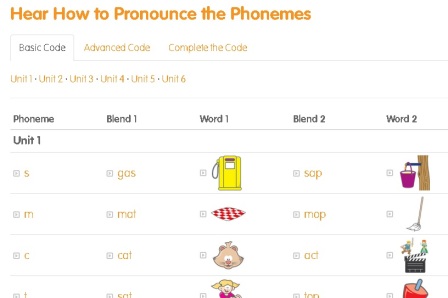
Pronouncing sounds crisply when helping beginners with literacy is very important, especially for blending.
For example, in the word “rat”, some adults say the sounds “r”, “a”, “tuh”, which blended together makes “ratter”.
To give a learner the best chance of blending this word successfully, the sounds need to be pronounced “r”, “a”, “t”, where the “t” is just a little puff of air made with the tongue behind the teeth, and has no voice and no vowel hanging off the end of it. (more…)
Geraldine the Giraffe learns schwa
3 Replies
A colleague has just pointed out a YouTube video which I think perfectly makes the point that a little bit of phonics knowledge can be a dangerous thing.
It illustrates why we urgently need proper, linguistically accurate training for teachers and early literacy authors/publishers.
The video is called Geraldine the Giraffe learns schwa. It seems to be from the UK, and it is being shown to at least some Grade Prep children (5-6 year-olds) here in Melbourne.
Geraldine the Giraffe is a puppet who, after some groovy music and a bit of chitchat, is told she will be learning about the “u” sound.
The letter “u” appears on the screen and she is asked to say the sound “u” (as in cup):
 Then the narrator says, “Rather than learning about the ‘u’ sound with the U letter shape, we’re going to learn about the schwa, and the schwa is the name that we give to the ‘u’ sound in words using a different letter.”
Unfortunately, this is simply wrong. The sounds “u” as in “cup” and the schwa sound are two completely different sounds. (more…)
Reading Bear
2 Replies
Reading Bear is an American website containing free phonics and vocabulary activities which are designed for young children, but aren’t actually very teddy-bearish, so could be used with older catch-up learners too.
The idea came from Larry Sanger, one of the people behind Wikipedia – the sort of person who makes the rest of us feel inadequate, and recalls the Tom Lehrer joke, “When Mozart was my age, he had already been dead for three years”.
Funding for the site came from an anonymous donor, and lots of volunteers and other good people contributed with the intention of creating something great to help little English-speaking kids around the world learn to read, and build their vocabularies. Nice one.
You can use the site without logging in (she wrote, aware that she just lost a lot of readers who are now going to click here and explore the site for themselves), but if you do tell the site your email address and a password, then you’re instantly logged in and can start adjusting the settings and recording your progress.
 The Spelfabet shop has affordable, downloadable spelling teaching resources.
