Phonics Intervention Symposium: Day 4
4 Replies
Sadly, I was too busy to attend the recent international Sounds-Write Phonics Interventions Symposium while it was live and free online. Happily, it was all recorded. A great thing about recordings is that you can watch them at high speed, slowing down and rewinding the best bits, and learn a lot quickly.
It’s school holidays here, so I’ve started working my way through the presentations, starting with the most recent, and helping myself focus by writing notes/thoughts for this blog post. I find restaurant menu codes (V, GF etc) helpful, so have made up codes to suggest who might be most interested/benefit most from each presentation (which could be wrong, so feel free to ignore them):
- SL = school leaders;
- T1 = early years classroom teachers (Tier 1);
- T2 = early years small group/keep up intervention providers (Tier 2);
- T3 = individual intervention providers for older/catch up and neurodivergent learners (Tier 3).
I’ll also note the length of each speaker’s actual presentation, minus the (often very interesting) Q&A.

Laila Sadler succinctly summarises things UK schools are doing to ensure all their kids learn to read. Engaged school leaders and shared belief systems are key, as well as type and timing of teaching/intervention. (SL, 26 minutes)

Lindsay Springer talks about 4-year, school-based research in Canada showing they’re preventing reading failure with screening, high-quality teaching and early intervention. Includes classroom videos and teacher interviews, graphs like this one (applause!), attention to kids’ academic self-concept and agency, and gorgeous quotes from kids at the end (SL, T1, T2, 33 minutes).

Wendy Bowen is from the Orkney Islands, which had close to Scotland’s worst reading results in 2018-2019. Then they read books by Diane McGuinness, trained teachers in Sounds-Write, got decodable books, started gathering data, organised small group and 1:1 intervention, and overcame various obstacles. Now their reading and spelling results are among the best in the country, and fewer kids need intervention (SL, T1, T2, 29 minutes). P.S. Wendy has a wonderful accent.

UK intervention teacher Sarah Horner talks about overcoming the dread forgetting curve with a team approach to little-and-often practice sessions. Each child has a Follow Up Folder, and everyone available, including volunteers, office staff and capable peers, is roped in to grab the folder and help the child do a few minutes’ practice (read a book, play a game, do some writing etc) whenever they can (T3, 15 minutes).

The UK’s Tricia Millar talks about delivering fast, shame-free, life-changing intervention to teenagers in secondary schools, giving them a sense of belonging and the ability to participate. My main thoughts were 1. OMG I need to make time to do That Reading Thing/That Spelling Thing training (yeek, I’ve been saying that for years), 2. Everyone who is interested in literacy in secondary schools should watch this, and 3. I need to find out about the Powell Phonics Checker. (SL, T3, 34 minutes).

Krystal Brady works in an Australian school that had devastating 2021 NAPLAN results. All their teachers, including casuals, were trained in Sounds-Write in 2022, which was rolled out across the school in 2023. At first their focus was Tier 1, but they also ran Keep Up and Catch Up groups, collected DIBELS data, did formative assessment, instructional coaching, collaborative planning, all the good things. They have reaped the rewards, both in student skills and staff satisfaction. More applause! (SL, T1, T2, T3, 39 minutes).

Gail Williams is Principal of an Australian secondary school for students with intellectual disability which uses the Sounds-Write phonics program. She says her school presumes student competence, including for nonspeaking students, and that “The term ‘presuming competence’ is most commonly associated with the work of Anne Donnellan and Douglas Biklen”. Eeek. Biklen promoted facilitated communication (FC), a discredited and unethical Augmentative and Alternative Communication approach, and googling suggests Donnellan condoned it. Happily, there is no mention of FC or its derivatives in this presentation. People with intellectual disability who can understand spoken language can usually learn at least basic literacy skills when these are taught well. They are very useful life skills, so it’s great to see explicit, systematic phonics being taught in a special school. (SL, T3, 27 minutes).

Sue White is an Australian writer and mum of a neurodivergent son who wasn’t learning to read at school. Realising he wasn’t being taught effectively, she tried tutoring, then started homeschooling him at age 7. Jacinda Vaughan from Sounds-Write supported her, and they used age-appropriate decodable books (starting with good old Magic Belt). He’s now 11 and reads Harry Potter. A fun, heartwarming session, full of useful tips for parents of neurodivergent striving readers/spellers (e.g. break it up, stay active, work in the car if need be), and their intervention providers. (T3, 40 minutes).

New Zealand Speech Pathologist and literacy consultant Emma Nahna discusses measuring students’ literacy skill growth precisely and efficiently with free DIBELS 8 assessments. Whole classes do benchmark assessments three times a year, and intervention students are monitored more frequently e.g. fortnightly. One minute Nonsense Word Fluency and Oral Reading Fluency (ORF) subtests are especially useful. A child’s ‘goal line’ is graphed by marking their start point and peers’ average skills at the end of the year/intervention period, and joining the dots. Many children are highly motivated to reach or exceed their goal lines. This talk includes when and how to adjust intervention; strategies for scaffolding fluency and access to text; and links to amazing progress monitoring resources and free training. Wow. (SL, T2, T3, 51 minutes).

UK educational leader Sonia Thompson uses the EEF’s Reading House (a bit like Pam Snow’s Language and Literacy House without the social-emotional aspects) as a framework for discussing the importance of phonics in achieving fluency, and thus reading comprehension. Her overview covers a wide range of important literacy topics including oral language, cognitive load, general knowledge, feedback, prosody, and comprehension strategies. (SL, T1, 52 minutes).
OMG DISK FULL of things to think about and follow up, and that was just the last day. Thanks so much to the good folk at Sounds-Write for organising this event. We’re now on school holidays, so I’m hoping to get through and write up at least Day 3’s presentations in the next week or two. I also hope this post helps others who missed the realtime sessions decide whether to get an All Access or Group Pass to all the 2025 Symposium recordings, and whiz through the whole thing, finding the best bits from your POV. If you do, please share your thoughts in the comments!
Alison Clarke
Speech Pathologist
The Australian Curriculum Version 9.0
29 Replies
Prompted by an interesting Radio National interview with ACARA CEO David de Carvalho, I’ve been trying to get my head around early literacy in version 9.0 of the Australian Curriculum. It’s a definite improvement on previous versions, so WELL DONE to all those who argued for evidence-based practice, sorry I was too busy swimming through COVID-related mud to help.
My main interest is in the English strand for Foundation to Year 2, the vital learning-to-spell-and-decode years. Have predictable texts, multicueing and rote-memorisation of high-frequency wordlists finally been dumped? How specific is it about which phonemic awareness, phonics and morphology knowledge/skills to teach in the first three years? What does it say about spelling?
(more…)THRASS: the phonics of Whole Language
44 Replies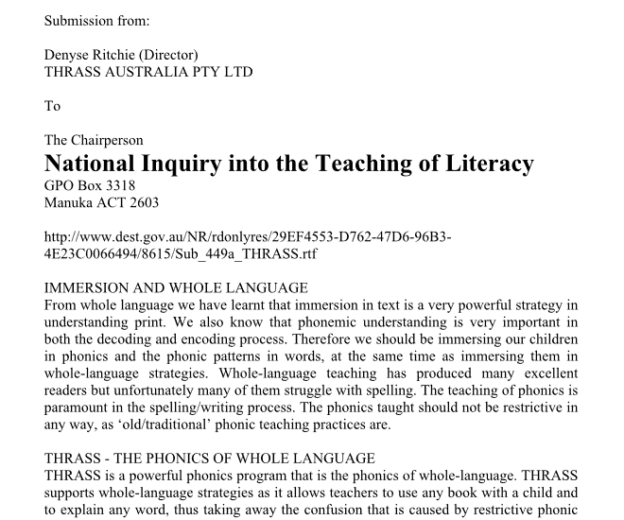
22 September 2024 update: The THRASS Institute (Australasia and Canada) is no longer providing training/resources, and many of the links in this 2020 blog post are no longer active.
People often ask my opinion of the THRASS (Teaching Handwriting, Reading and Spelling Skills) approach, which has long been used in many Australian schools. Till now I’ve mostly replied that I’m no expert on it, but I’m yet to see robust research evidence supporting it, and aspects of it have never made enough sense to me to invest in the training.
I once worked at a school in a tiny room where lots of THRASS resources gathered dust. Two huge, laminated THRASS wall charts kept overwhelming their blu-tack and falling on my head.
I looked through the resources, but was working mostly with kids with language disorder or intellectual disability, and they would have been overwhelmed by wordy, THRASS-chart-based spelling explanations like this or this (cognitive load!). The THRASS graphemes kit was too big for our room’s tiny table, and lacked example words and some of the graphemes I wanted, so I made my own.
I tried using a THRASS board game but found it a bit incomprehensible. I don’t like teaching program-specific jargon, like “phoneme fists” or “grapheme catch-alls”, and rapping THRASS chart words might be fun, but I’m not sure why else you’d do it.
(more…)ABC iView Learn A Word
25 Replies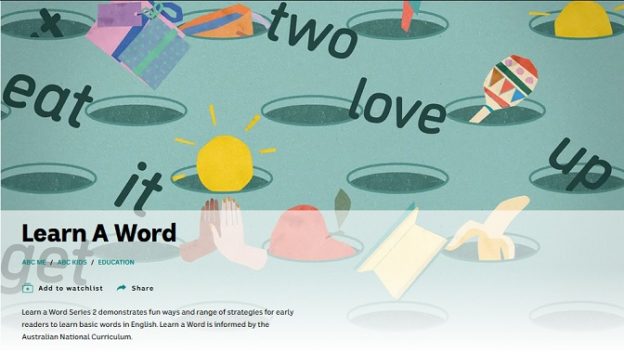
I don’t know who advises our national broadcaster on the content of its early literacy education videos, but I find them pretty underwhelming.
Please don’t show children in your care the Learn A Word series on ABC iView. It teaches children to rote-memorise the appearance of words, recite letter names, and “take a photo with your eyes” of words.
The sounds in words (phonemes) aren’t even mentioned, though awareness of these sounds is the glue needed to make letters and written words stick in memory.
The Learn A Word videos first say “Let’s all learn a word” and a written word appears on the screen. The first word is “after”.

The video script goes like this:
“After. This word is after. Can you point your finger at the word after?
Now use that finger to write with me. Around and down, up and down, around and straight down, then across, from top to bottom then across. Start in the middle then back around, down, up and over. Ay eff tee ee ar. After. We did it! Let’s say it together. After!
Can you write it slowly? Ay eff tee ee ar. Can you say it quickly? Ay eff tee ee ar. Great work!
I can use it in a sentence: After lunch I like to read a book
Take a photo with your eyes and remember this word: After
You just learnt a word!”
Then there is a pause, a new word is presented (the next word is “again”) and the whole thing repeats with much the same script. Well, I haven’t watched them all, as that would make my head explode with frustration, but I’ve watched quite a few, and they’ve been highly repetitive.
Even one-syllable, entirely sound-outable words like “up”, “at”, “it”, “if”, “on”, “get”, “run” and “from” are given this treatment. So are words with common two-letters-for-one-sound (digraph) spellings, like “them”, “good”, “boy” and “say“. Nobody points out that two letters represent one sound in these words, because nobody even mentions sounds.
The videos explicitly encourage a visual whole-word-memorisation strategy, e.g. for the word “it”, the video says: “put it in your head and say it for when you need it. It comes in handy all the time. It is a great word. It.” Here’s how this is illustrated:

Occasionally children are encouraged to write words in the air, on their hands, arms, feet or the floor, very small or very big, very slowly or very fast. There’s music, pictures, and occasional giggling and sound effects.
Two-syllable words, and words with tricky spellings like the Greek-origin “ch” in “school” and the no-longer-pronounced Old English “w” in “two” get the same treatment. There’s no phonics teaching sequence, no patterns, nothing that would make sense to reading scientists, just rote visual memorisation, over and over.
I wish someone responsible for kids’ content at the ABC would read or listen to Emily Hanford’s reports, understand that a mountain of scientific research shows that we don’t learn to read by visually memorising words, and produce better content for Aussie kids. Maybe ABC presenter Dr Norman Swan can be asked to take this up, as he’s the patron of AUSPELD. Learn A Word on iView is simply not up to the ABC’s usual high standards.
Is Reading Eggs all it’s cracked up to be? (boom tish)
26 Replies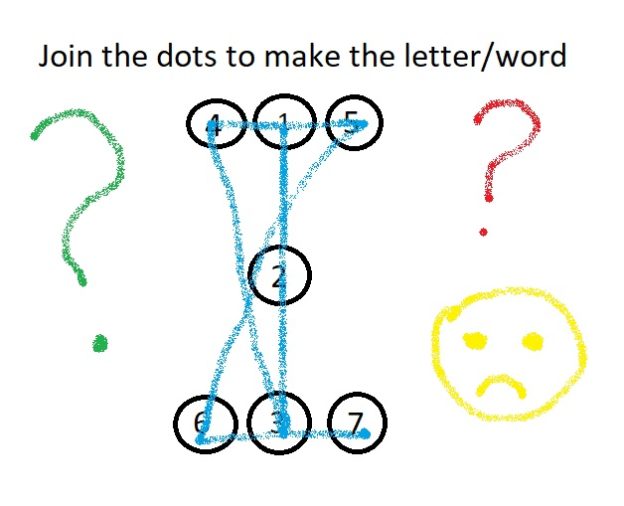
After my last blog post about the new Reading Eggs – Fast Phonics program, its activity that looked exactly like a Nessy activity suddenly got new graphics. Then someone asked me why I’m not a fan of the original Reading Eggs program when it includes a lot of phonics, so I decided to take another look.
With hundreds of new COVID-19 cases daily (yeek) and a new face-masks-in-public rule, my state is heading back into another protracted period of home-based learning, probably including lots of e-learning. I want children to use programs that maximise their chances of successfully learning to read and spell.
Is Reading Eggs from the ABC?
I used to think that Reading Eggs was owned by the Australian Broadcasting Commission, because it uses the ABC logo.
Incorrect. Reading Eggs is owned by a company called Blake e-learning. It uses the trusted ABC name and logo in Australia under a retail partnership with ABC Commercial. The Reading Eggs site visible outside Australia, https://readingeggs.com, has no ABC logo (it quickly redirects Australians to the Australian site).
The ABC Commercial website says, “As an iconic, trusted brand, we are the only Australian distributor equipped to maximise the rights and opportunities across all product categories to help drive your business.” As a member of Friends of the ABC I was pretty surprised at that.
How should early reading and spelling be taught?
Beginning readers/spellers need be told from the very start that spoken words are made of sounds, which we write with letters. This seems obvious to literate adults, but is not at all obvious to young children, or many older learners. I once told a smart, illiterate teenager who’d had ten years of Australian schooling this fact, and he asked: “Why didn’t anyone tell me that?” (if you don’t know why, read journalist Emily Hanford’s reports or watch/listen to her recent PATTAN network talk here).
The sounds in our speech are invisible, quick and smoosh into each other, so splitting them up in order to spell them is hard. English is a mishmash of languages, warped over time (the wonderfully nerdy History of English podcast has details), so our writing system relates 44 speech sounds to 26 letters using five different types of logic:
- One sound can be written with one letter.
- One sound can be written with two, three or four letters e.g. sh, ou, dge, augh.
- Most sounds are written more than one way e.g. out, cow, drought.
- Some spellings represent more than one sound e.g. out, you, touch, cough, soul.
- Meaningful parts used to build longer words often have special spellings e.g. er, ed, ly, al, est, ous, chron.
Reading and spelling software for young beginners should stick to the simplest logic (#1). It should focus on teaching children to break up spoken words into sounds and write them with letters, and read words by saying a sound for each letter then blending the sounds together.
Like all good systematic, explicit, synthetic phonics programs (see examples) this software should start with just three to five sounds, represent them with single letters, and teach kids to use them to spell and read little words e.g. am, at, it, sat, sit, sis, mat and perhaps names like Sam, Sim, Tam and Tim.
Note that the words “is” and “as” don’t follow logic #1, as their last sound is /z/ (logic #4). Including them might confuse some children and undermine logic #1, so if they’re included they should be explained e.g. “at the end of words we often say /z/ for this letter”.
Extra sounds and their spellings should then be gradually, explicitly, systematically introduced and practised to mastery in short words (two or three sounds). Words can then be made longer e.g. with two consonants together as in “clip” and “tent”, then three as in “split” and “helps”, as consonant combinations can be quite hard to segment and blend.
This gives beginners a solid foundation for learning the additional sounds and remaining logic and patterns of our complex spelling system.
How does Reading Eggs stack up?
Reading Eggs offers a free trial period, so anyone can sign in and see the following things for themselves. It first introduces “the sound m, like in mouse” and presents the lower case letter m for children to click on to hear /m/ (I’ll put sounds in slash marks). There’s just letter m at first, and then children must discriminate it from two other letters. There’s no need to link sounds and letters in this activity, so it can be done using visual memory (not the kind of memory used in reading, see this blog post).
The program then asks “which picture starts with the /m/ sound?” and there are two pictures on screens e.g. “moss” and “sat”. I pretended to be a child without any awareness of sounds in words, and answered randomly. When I got it wrong, there was a “boing” sound with zigzags on the screens and I was told to “try again”. When I got it right, a cartoon character said a (less interesting) “yes”. No matter how many times I got it wrong, no help was offered. Eventually, thanks to having a 50-50 chance, I fluked it and went up to the next level.
I was then asked to “find /m/ in these words”, and printed words containing the letter “m” appeared the screen, but the words were not spoken, so again visual memory was all I needed. The words included digraphs (“moon”), split vowel digraphs (“time”) and two-syllable words (“metal”), examples of spelling logic #2 and #4.
When I clicked randomly I was told to “try again” till I eventually fluked enough correct answers. There was a song about words with “m” in them. The words flashed on screens with the letter m in a contrasting colour. To preliterate children, they probably look like chicken scratchings.
Next I was told to “complete the dot to dot to make the letter”, and there were numbered dots on the screen in roughly this layout:

I pretended I hadn’t learnt my numbers yet, and clicked randomly. I got three “boing” sounds and three red crosses on the screen, and then was asked “again?”. This happened no matter how many times I got it wrong. When I clicked on the dots in numerical order, the lower case letter “m” was filled in between the dots, and I was asked to do it faster. I hope a handwriting expert can tell us in the comments whether this sort of numbered-dot-clicking is a good way to teach early letter formation.
Next came a 6×6 letter grid with six copies of the letter “m” in it, in slightly different fonts, and including visually similar letters like “n”, “h” and “w”. I was told to click on /m/. When I made mistakes I got red crosses and “boing” sounds, and after three errors was asked “again?”, but the game did not adjust to my confusion by reducing the number of choices, providing hints or otherwise helping me.
I was then shown a letter “m” and told “This is the letter em, it makes the sound /m/’. Capital em looks like this (M), it also makes the sound /m/”. Preliterate me wondered why we have two letters for the same sound, but this wasn’t explained. A 6X6 grid like the previous one appeared, this time with capital letters, and again if I couldn’t find the M’s, the task was not simplified, I just went round and round being asked “again?” till I fluked it.
Next I was shown a letter “m” in a book and asked to click on the picture that begins with /m/. With only two pictures presented at a time, I had a 50-50 chance. The picture names were not spoken unless I clicked on the speakers next to them, and when I made three mistakes I had to go back to the start. There was no slowing down or stretching out of spoken words, or other explicit assistance with making the connection between the sound in words and the letter.
Next I was shown a screen arranged like this, and asked to drag the words to the pictures:

So far in this program kids have only learnt one letter, so can’t read the words, but that doesn’t matter because you just click on the words and they’re spoken, so all you need to do is match spoken words to pictures. You can just ignore the written words, and since reading them requires logic #2 (moon, mess, mice) and #3 (/s/ as in mess, mice), probably that’s a good thing.
Next there was a book with a different word starting with “m” on each page, including words with vowel and consonant digraphs, consonant blends and two syllables, and a total of 15 different sound-spelling relationships, some based on logic #2 (ey as in monkey and money, oo as in moon, ou and se as in mouse) and logic #4 (o as in money, monkey, mop; n as in man, monkey).
This type of book teaches preliterate kids to “read” by looking at first letters, pictures and guessing words. This is reading-like behaviour, but should never be confused with reading. So far only one sound has been taught, so kids aren’t yet equipped to start reading.
Next, the sound /s/ and letter “s” are introduced in much the same format. There is letter identification and matching, spoken word to picture matching (including the three-syllable word “spaghetti”), and a book about “s” with 23 different sound-spelling relationships involving logic #1, #2, #3 and #4.
In the third level I am invited to “Click on the word I” (my italics) and the capital letter “I” appears, first by itself and then with two other capital letters. Then I’m told I’ll be shown “the sound ‘am’ like in ‘clam'” (my italics). So this activity introduces two extra levels of word analysis – rimes (mislabeled sounds) and whole words. Preliterate me wondered why “I” is called a word, when it has only one letter, while “am” is called a sound, when it has two letters.
Next I was told to click on “am”, first by itself and then with distractor items like “xi” and “lu” on bowls of sugar cubes (Reading Eggs has also offered me cakes and marshmallows, so it’s not from the I Quit Sugar brigade).
Then I am asked to “click on the picture which has the am sound in it”, and pictures offered include “dam”, “ham” (which lots of people don’t eat), “lamb” and “stamp” (the latter being especially hard for little kids to discern the “am sound” in, as it’s not at the start or end of the word).
Then I’m shown the sentence “I am Sam” and asked to click on each word, after which the words are scrambled and I am asked to click on them again. Then I’m asked to “complete the dot to dot to make the letter”, though it doesn’t say which letter. It turns out to be a capital I. Preliterate me wonders why they’re now calling it a letter, not a word.

So far, Reading Eggs seems to be a mixture of initial, letter-of-the-week type phonics, picture-guessing and memorising whole words. In the next activity I’m asked to “say each sound and make the word” and shown how to blend “a” and “m” into “am”. This happens once only, and then I’m told “now it’s your turn”, and the visuals repeat, but not the sounds. The same thing happens for the word “Sam”. Then “a” and “s” (/s/) are blended to make “as” pronounced /az/. Nobody explains the sound change.
Next, lower case letter i is given its letter name (“I”), which you’ll recall was earlier taught as the “word” for upper case letter I. I’m asked to find six of them in a grid, but when I get to the grid I’m told to “click on /i/” (the “short” sound).
Sorry, but I really can’t justify spending any more of my time looking at a program that I am not going to recommend to anyone.
If you’d like my recommendations for early literacy iPad apps for little kids, see this blog post. Several of them have versions on other platforms, including Graphogame, Phonics Hero, Nessy and Reading Doctor.
Four cheers for Emily Hanford
8 Replies
American Public Media journalist Emily Hanford has made some accessible, powerful and widely-discussed documentaries about the gap between reading science and classroom practice in the US. It’s a gap that also exists here in Australia, and elsewhere in the English-speaking world.
If you haven’t listened to her documentaries yet, please make the time to do so. You can click on the pictures below to access each one.
She started in September last year with this:
 In October 2018, she followed up with this:
 She also wrote a New York Times opinion piece entitled “Why are we still teaching reading the wrong way?”
My apologies to blog subscribers who missed these till now. I circulated them on social media but was too stupidly busy with my new office and sick mother to write a blog post about them.
In January this year, on National Public Radio, Emily made:
 In March came this video interview called What Teachers Should Know About the Science of Reading:
Emily’s most recent, again brilliant contribution to aligning teaching with reading science in a pro-teacher, pro-equity way, is this:

I very dare you to get to the end of this documentary and not be gobsmacked by “Father of Whole Language” Ken Goodman’s extraordinary comment “My science is different”.
Goodman shows he is simply not interested in the mountain of scientific evidence contradicting his theory-and-observation-based ideas about how children learn to read, yet his ideas are still the basis of the “three-cueing system” approach to teaching reading that’s still widely used.
The game is up, the facts are out, and thanks to Emily Hanford and APM they’re in a free, accessible and easily digestible format. Please share them with every teacher, parent and other person who might be able to help get a more scientific understanding of how to teach reading into our education system.
I don’t enjoy having to spend a lot of my day undoing poor habits caused by well-meaning, hard-working teachers who were taught half-baked “my science is different” ideas at university and by “meaning-first” educational consultants. And I’m sure that (as the US Reading League people say) when teachers know better, they will do better, and so will their students.
The Language, Learning and Literacy conference – Kathy Rastle
6 RepliesKathy Rastle was another keynote speaker at last week’s great Language, Literacy and Learning conference whose topic is directly relevant to this blog.
You might remember her as a co-author of last year’s influential paper about Ending the Reading Wars, and of this related article (both highly recommended reading).
Hers was the final keynote of the conference, but I met her on the first day. Being a dairy farmer’s daughter who went to Warrnambool High School, I’m still always a little amazed when people with titles like Professor and Head of the Department of Psychology at Royal Holloway, University of London say “hi, I’m Kathy”, and are utterly smiley, nice, and not the least bit pretentious.
Here Kathy is (on the right) with the also-legendary and lovely Lyn Stone (on the left) and Sarah Awesome (AKA Asome) of Bentleigh West PS, (check out their NAPLAN Year 3 spelling gain here!) at the conference Sundowner drinks. However, in the interests of showing proper, gender-neutral academic respect I’ll use her surname from now on.

 The Spelfabet shop has affordable, downloadable spelling teaching resources.