Free spelling lists for teachers
6 Replies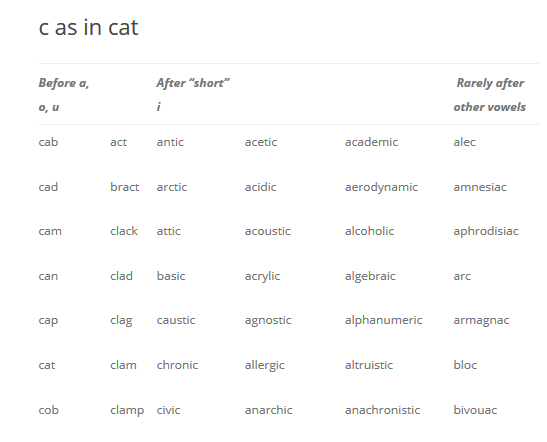
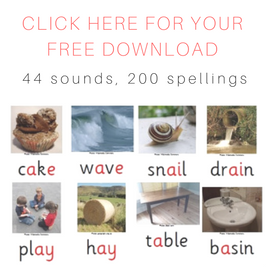
One of my fun summer activities has been refreshing and editing the free spelling lists on my website (yeah, weird, I know).
I hope teachers find them useful when teaching spelling, I know some already do. Other free spelling lists on the internet tend to focus on what words look like, but not what they sound like, or how they’re constructed, or they tend to reflect UK or US accents, not Australian English.

My lists menu allows words to be looked up in three different ways:
- Starting from sounds (phonemes) and looking up their spellings (graphemes). This is the direction we need to work in for spelling, i.e. turning speech into print.
- Starting from spellings and looking up the sounds they represent, which is the reading direction i.e. turning print into speech (whether reading aloud or silently).
- Starting with short, simple words and working towards longer, more complex ones, the direction needed for teaching. This sequence is the one used in my workbooks, but it’s not better than any other sequence. The important thing is to have a sequence. If wanting to use this one, but not sure where to start, my free low-frequency word spelling test might help.
What’s the difference between short and long vowels?
23 Replies
Phonics teaching materials often talk about "short" and "long" vowels, as though the latter are just extended versions of the former.
The five vowels usually called "short" are:
- "a" as in "cat",
- "e" as in "red",
- "i" as in "sit",
- "o" as in "not",
- "u" as in "bus".
The five vowels usually called "long", and which children are told "say their (letter) name", are:
- "a" as in "paper",
- "e" as in "be",
- "i" as in "find",
- "o" as in "go",
- "u" as in "human".
But are we talking about sounds here, or particular spellings of these sounds?
The Categorical Perception Deficit in dyslexia
1 Replies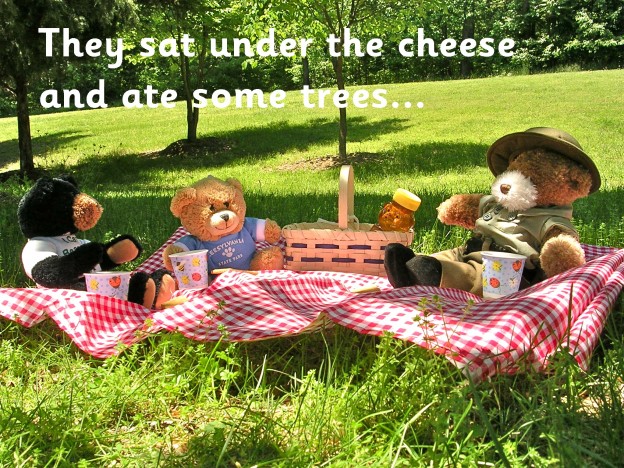
I just read an interesting new article from the journal Scientific Studies of Reading called "The Categorical Perception Deficit in Dyslexia: A Meta-Analysis", by the wonderfully-named Mark W. Noordenbos and Willy Serniclaes.
There's been some research showing that dyslexics (notwithstanding the debate about this term) have trouble noticing the differences that matter between speech sounds, and not noticing the differences that don't matter.
This article explored the reliability and significance of this finding by analysing data from lots of relevant research.
When we're babies, we're capable of discriminating all the sounds of all the languages of the world, but we quickly discard the ones that we don't hear in the language(s) around us, and focus on the ones we do (there's a great Ted Talk called The Linguistic Genius Of Babies about this, if you want to know more).
Noordenbos and Serniclaes trawled through the scientific literature and found 632 studies related to dyslexic students' speech sound perception. They distilled this down to 36 studies of a total of 754 individuals with dyslexia which were relevant to their research question, properly-conducted, complete and comparable enough to put through their statistical mill. The studies were of speakers of English, Dutch, French and Chinese.
They found that dyslexics were indeed reliably and significantly worse at discriminating between speech sounds (phonemes), and more sensitive to sound variations within speech sounds (allophones), than peers matched by age, as well as peers with the same reading age (though the differences were greater between the dyslexics and age peers). Sound discrimination tasks showed up their problem more than sound identification tasks.
The difference between consonants and vowels
48 Replies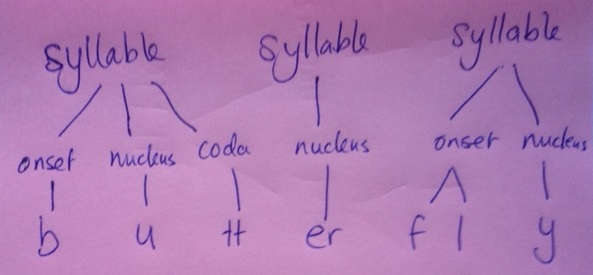
There are five vowels and 21 consonants in English, right? Well, no.
Vowels and consonants are sounds, not letters. Depending on your accent and how thinly you slice them, there are about 20 vowels and 24 consonants.
The difference between vowels and consonants
A vowel is a speech sound made with your mouth fairly open, the nucleus of a spoken syllable.
A consonant is a sound made with your mouth fairly closed.
When we talk, consonants break up the stream of vowels (functioning as syllable onsets and codas), so that we don’t sound like we’ve just been to the dentist for four fillings and the anaesthetic hasn’t worn off yet.
Consonants require more precise articulation than vowels, which is why children find them harder to learn, and often end up in speech therapy after having become so cross at not being understood that they’ve started hitting people.
Only a few children with severe speech sound difficulties (often called dyspraxia or apraxia) sometimes need therapy to help them produce vowel sounds correctly.
Most syllables contain a vowel, though vowel-like consonants can occasionally be syllables. And to complicate matters, many English vowels are technically two or three vowels shmooshed together.
One of my new favourite things is the free version of the Cued Articulation iPad app, which contains this handy consonant chart, which you might like to refer to in what follows:

(Just ignore the “c” with a cedilla, it’s slicing things a bit fine IMHO. Also ignore the “wh” if you say “whale” and “wail” as homophones).
How consonants are produced
Saying consonant sounds involves constricting airflow in different locations in your mouth by:
- briefly stopping then releasing the air (“p”, “b”, “t”, “d”, “k”, “g”),
- diverting the airflow and associated resonance to your nose (“m”, “n”, “ng”),
- squeezing the air through a narrow space (“th” as in “thin”, “th” as in “then”, “f”, “v”, “s”, “z”, “sh”, “zh” as in “vision”, “h”, and in posh dialects, “wh”),
- combining stopping then squeezing (“ch”, “j”), or
- narrowing the vocal tract (“w”, “y”, “r”, “l”).
Consonants that are like vowels – approximants
The last four consonant sounds on the above list – “y”, “w”, “r”, “l” – are produced with less mouth constriction than other consonants, and in linguistics are called “approximants”.
Approximants occupy a kind of linguistic grey area between vowels and consonants, in fact “w” and “y” are also known as semivowels.
There’s very little difference between the consonant sound “y” and the vowel sound “ee” as in “see/sea/me”, and between the consonant sound “w” and the vowel sound “ooh” as in “moon/rule/grew”.
These sounds are classified as consonants because they generally behave like consonants, that is, they’re (in) syllable onsets not syllable nuclei.
Syllabic consonants
In many English dialects, the sound “l” can be a syllable all by itself in words like “bottle” and “middle”. This is also true of the sound “n” in words like “button” and “hidden”.
In these words, the tongue has just said “t” or “d”, so it’s already in the right place to go straight into the sound “l” or “n”, without saying a vowel first. However, we still write a “vowel letter” in this syllable (le, on, en) and we say a vowel sound in other words with similar final spellings, like “giggle” and “dabble”, “ribbon” and “beckon”, “happen” and “embiggen”.
The sound “m” can also act as a syllable in words like “rhythm” and “algorithm”, again because the sounds “th” and “m” are physically very close together. In this case we don’t write a “vowel letter” in the last syllable, but we do say a vowel sound in the last syllable of most words spelt like this, like “autism” and “criticism” (click here for more, see right column).
Tell language mavens who insist a consonant is never a syllable to stick that up their jumpers.
Voiced and voiceless consonants
Some consonants are produced using your voice (“b”, “d”, “g”, “m”, “n”, “ng”, “th” as in “then”, “v”, “z”, “zh” as in “vision”, “j”, “y”, “w”, “r”, “l”) and the rest are voiceless (“p”, “t”, “k”, “th” as in “thin”, “f”, “s”, “sh”, “ch”, “h”).
Most consonants come in neat voiced-voiceless pairs – “p/b”, “t/d”, “k/g”, “th as in thin/th as in then”, “f/v”, “s/z”, “sh/zh as in vision”, and “ch/j” (yes, I read a recent Grammarly blog post, and have decided to start using the Oxford Comma).
Try saying each of these sound pairs in turn, and you’ll notice that the main difference between each pair is that you use your voice for the first sound, but not the second one.
If you are using your voice when you say the sounds “p”, “t”, “k”, “th” as in “thin”, “f”, “s”, “sh” or “ch”, you’re saying them wrong. This can confuse children about the difference between sounds, and/or cause blending problems (click here or here for previous blog posts on this).
The sound “h”, is also voiceless, but lost its voiced pair somewhere down the crack between Old and Middle English, though its ghost still makes guest appearances as the spelling gh in words like “thought”, “night” and “daughter”.
The nasal sounds “m”, “n” and “ng” don’t have voiceless pairs, but are made in the same spots in your mouth as, respectively, “p/b”, “t/d” and “k/g”.
Here are the handy vowel charts from the Cued Articulation iPad app, but please remember it’s an app, so the red buttons marked “diphthongs” and “pure vowels” take you to these charts, they aren’t the labels for the charts they’re on. The chart headings are up at the top, and the sounds are organised from high front vowels at top left to low back ones at bottom right.

 How vowels are produced
All vowel sounds are voiced, unless you’re whispering or speaking Japanese, Quebecois, or a North American indigenous language like Comanche or Cheyenne.
Vowels are sounds produced with the mouth fairly open, and differ by mouth shape, for example “ee” is a high front vowel and “o” as in “got” is a low back vowel.
Some vowels, like the “a” in “cat” and the “i” in “big”, are said with the mouth in the same position from start to finish (monophthongs).
Some vowels, like the “ay” in “paper” and the “I” in “hi”, move from one mouth position to another (diphthongs).
There’s also one vowel in English, the “you” in “human”, which is actually a combination of a consonant and a vowel (“y” + “ooh”). But knowing this doesn’t help us spell it, there isn’t usually any need to notice the little “y” sound, which in some dialects is omitted (think of how the word “news” is pronounced in US English).
In the English I speak, in which the consonant “r” is only pronounced before a vowel, a few vowels like the “ire” in “fire” and the “our” in “sour” contain three mouth positions (triphthongs). When teaching spelling it’s best to treat these as two sounds (i…e + r, ou + r).
Smart children often notice that diphthongs are actually two sounds. This sort of excellent listening should give rise to much rejoicing and praise, after which they can be told that spelling gets mighty confusing if we slice these sounds so finely (e.g. the “ay” sound in paper contains two sounds, but represented by only one letter), so we usually treat diphthongs as single sounds.
The only time I remember having to actively slice a diphthong in half for a learner was in order to explain the spellings of the homophones “gaol” and “jail”. We Aussies learn a lot about gaols in history class and from the family genealogy nut, though we’ve never found out why Great-great-great grandfather William Yates, a 20-year-old York chimney sweep, was transported to Tasmania for life on a ship called the Phoenix in 1820. If your family genealogy nut is in York and can find out, my family genealogy nut would be most appreciative. But I digress.
Consonant sounds spelt with “vowel letters”
Three English “vowel letters” are commonly used in spellings of consonant sounds, such as (the links take you to wordlists for each spelling):
The letter E in the ve in “solve”, the se in “house” and “please”, the ce in “dance” and “ocean”, the ze in “sneeze”, the the in “soothe”, the ed in “jumped” and “hummed”, the dge in “smudge”, and the che in “avalanche”.
The letter I represents the sound “y” in words like “union” and “brilliant, plus it’s in the ti in “motion”, the ci in “social”, the si in “pension” and “version”, the gi in “religion”, the sci in “conscious”, the ssi in “passion”, and the xi in “anxious”.
The letter U is a common way to spell the consonant sound “w”, as in “queen” and “penguin” (we usually write qu and gu, not kw, cw or gw), and is also part of the gu in “guess”, the gue in “league”, the qu in “liquor”, the que in “boutique”, and the “bu” in “build”.
The sound “you” as in “human” is actually a combination of a consonant and a vowel (y+ooh), though it’s mostly spelt with vowel letters: U as in human, U…E as in tune, EW as in few, UE as in cue or EU as in feud. Nouns that start with this sound like “unicorn”, “ute” and “Europe” thus start with a a vowel letter but a consonant sound, which is why we say “a unicorn”, “a ute” and “a European”, not “an unicorn”, “an ute” or “an European”.
Vowel sounds spelt with “consonant letters”
The obvious one here is the letter Y, weirdly called a consonant letter despite mostly representing vowel sounds, in words like “my”, “duty” and “gym” (no, I haven’t been doing enough exercise lately either).
This probably happened because traditional phonics focuses too much on first letters in words, where the letter Y represents a consonant sound (except in words like “Yvette” and “yttrium”).
On top of all this, there are heaps of vowel sounds spelt with two, three and four letters which contain “consonant letters”, mostly the letters W, Y, R and L. Here are some examples:
The letter W is in the aw in “saw”, the ew in “new” and “grew”, and the ow in “how” and “show”.
The letter Y is in the ay in “play”, the ey in “grey” and “valley”, the oy in “boy”, the ye in bye, the y…e in “type”, and the yr in “myrtle”. All four letters representing the vowel sound in the word “myrrh” are supposedly “consonant letters”.
The letter R is in the ar in “car”, “warm” and “scarce”, the er in “her”, the ir in “bird”, the or in “fork”, the ur in “curl”, the air in “hair”, the are in “care”, the ear in “hear”, “learn” and “bear”, the ere in “here”, “there” and “were”, the eer in “beer”, the oar in “soar”, the ore in “sore”, the our in “pour”, the oor in “door”, the eur in “poseur”, the aur in “Minotaur”, and in the English I speak and write, the r in “flour”, re in “centre” and our in “harbour”.
The letter L is in the al in “calm” and walk, and the ol in “yolk”.
The ghostly letters G and H are in the igh in “high”, the ough in “thought”, “drought”, “though”, “through” and “thorough”, the eigh in “weight”, the augh in “caught”, and the aigh in “straight”.
The letter H is also in the ah in “galah”, the eh in “meh”, the eah in “yeah”, the oh in “John”, the ooh in “pooh”, and the uh in “duh”. If I can write it and you can read and understand it, it’s a real word.
So, what’s the difference between vowels and consonants?
The next time a learner asks you which letters are vowels and which letters are consonants, try answering as follows:
- Vowels and consonants are sounds not letters,
- Vowels are the loud sounds that form the nuclei of each syllable, and consonants separate them.
- The letters B, C, D, F, J, K, M, N, P, Q, S, T, V, X and Z are mainly used to spell consonants,
- The letters A and O are mainly used to spell vowels, and
- The letters E, G, H, I, L, R, U, W, Y are used as/in spellings representing both vowels and consonants.
Teaching vowel spellings
0 Replies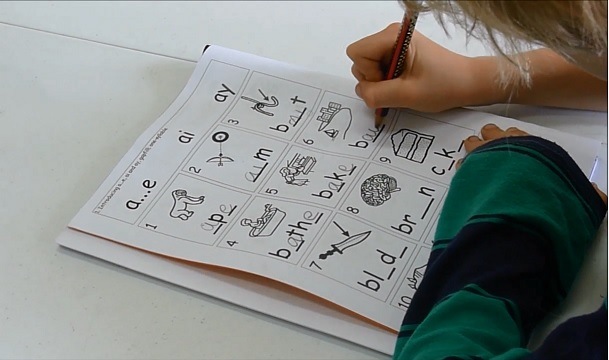
I’ve made a short video of myself teaching a student how to spell some words containing the sound “ay” as in “name”, “rain” and “play”, using my Workbook 4.
Teaching strategies and ideas are highlighted in onscreen text, here it is on Youtube.
I hope this is useful to people using, or thinking of getting, the Spelfabet Workbook 4 or 5, and/or that it includes some ideas and strategies that are useful to parents, aides and others who are teaching vowel spellings using other materials. (more…)
Printable wordbuilding card games
0 Replies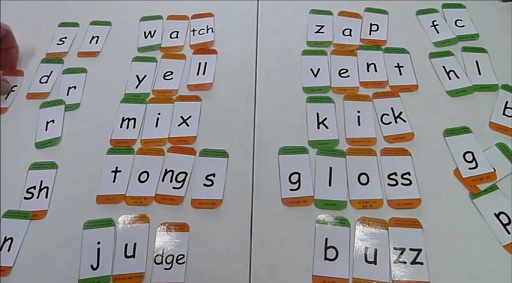
Please note that as of July 2019, the games in this post have been superseded by the ones you can find in this blog post.
It’s been pouring for most of today here in Melbourne, so I’ve been feeling sorry for everyone stuck indoors during the summer holidays. On the plus side, this has motivated me to finally stop obsessively polishing my four new word-building card games, and make them available here.
These games are designed to help learners practice their blending and phoneme manipulation skills, and to learn how to use and combine a variety of graphemes (spelling patterns) representing individual phonemes (speech sounds) in English.
You can find fairly detailed descriptions of each game in each one’s entry in my website shop, so I’ll just put little videos about each one plus a summary in this blog post.
“Short” vowel wordbuilding game
Here learners build words using single-letter vowel spellings, and consonant spellings including “ck”, “ng”, “ff”, “ll”, “ss”, “zz”, “x”, “tch” and “dge”, “sh”, “ch” and “th”. This game also provides lots of opportunities to learn which consonant combinations (blends) are typical of English, such as “fl” and “str” but not “vm” at word beginnings, and “nch” and “mp” but not “jn” at word endings. (more…)
Geraldine the Giraffe learns schwa
3 Replies
A colleague has just pointed out a YouTube video which I think perfectly makes the point that a little bit of phonics knowledge can be a dangerous thing.
It illustrates why we urgently need proper, linguistically accurate training for teachers and early literacy authors/publishers.
The video is called Geraldine the Giraffe learns schwa. It seems to be from the UK, and it is being shown to at least some Grade Prep children (5-6 year-olds) here in Melbourne.
Geraldine the Giraffe is a puppet who, after some groovy music and a bit of chitchat, is told she will be learning about the “u” sound.
The letter “u” appears on the screen and she is asked to say the sound “u” (as in cup):
 Then the narrator says, “Rather than learning about the ‘u’ sound with the U letter shape, we’re going to learn about the schwa, and the schwa is the name that we give to the ‘u’ sound in words using a different letter.”
Unfortunately, this is simply wrong. The sounds “u” as in “cup” and the schwa sound are two completely different sounds. (more…)
 The Spelfabet shop has affordable, downloadable spelling teaching resources.